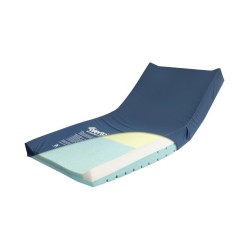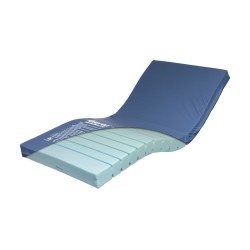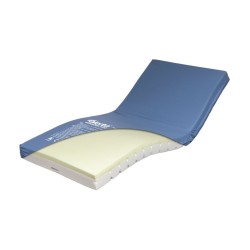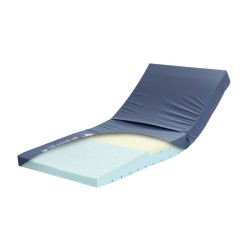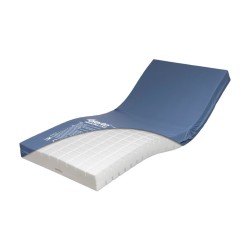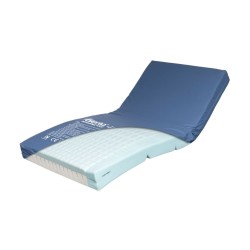
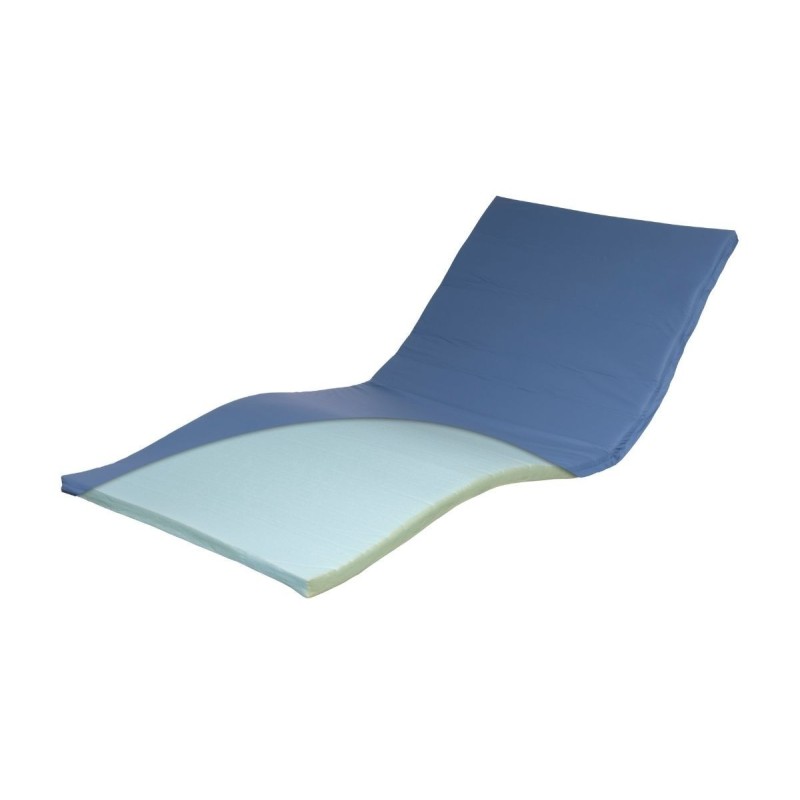

The Alerta Sensaflex Underlay Foam Mattress is a 2-inch foam mattress designed for permanent placement beneath an air mattress system, providing a firm support surface during power failures when the air mattress deflates and a stable platform for CPR when Resuscitation Council UK guidelines require a firm mattress surface for effective chest compressions. The foam underlay removes the need to deflate or remove the air mattress system under emergency conditions. The multi-stretch vapour-permeable antimicrobial PU cover is machine washable to 65°C standard and 95°C sanitisation. The foam is autoclavable at 134°C and the unit is BS7177: Crib 5 fire compliant.
| Specification | Detail |
|---|---|
| Product Code | NCL-ALT-UND |
| Type | Foam underlay for use beneath air mattress systems |
| Foam Thickness | 2 inches |
| Cover | Multi-stretch, vapour-permeable PU |
| Cover Treatment | Antimicrobial with white underside |
| Washing Temperature | 65°C standard | 95°C sanitisation |
| Foam Sterilisation | Autoclavable at 134°C |
| Fire Compliance | BS7177: Crib 5 |
| Application | Beneath air mattress systems in hospitals, care homes |
Resuscitation Council UK guidelines specify that CPR should be performed on a firm, flat surface beneath the patient to enable effective sternal compressions: a patient lying on an inflated air mattress system without an underlay will sink into the mattress during compressions, absorbing the compression force and reducing the clinical effectiveness of chest compressions. The Sensaflex Underlay resolves this by providing the firm surface beneath the air mattress that Resuscitation Council guidelines require, without the clinical delay of deflating or removing the air mattress system during an emergency. CQC Regulation 12 (Safe Care and Treatment) requires that clinical equipment enables safe emergency response: the absence of an appropriate underlay beneath an air mattress system in a care home or NHS ward where CPR capability is required is a potential care quality concern. NICE Guideline CG179 (Pressure Ulcers) addresses the period of air mattress power failure by noting that patients should not remain unsupported on a deflated air mattress: the foam underlay ensures continuous pressure redistribution support even when the air mattress system is non-operational.
Does the 2-inch foam underlay affect the pressure care performance of the air mattress placed on top of it?
A correctly specified 2-inch foam underlay placed beneath an air mattress system should not materially affect the pressure care performance of the air mattress during normal powered operation, as the air mattress itself provides the active pressure redistribution surface in contact with the patient. The underlay functions as a secondary support layer and emergency surface rather than as a primary pressure care intervention. However, the combined height of the underlay plus air mattress should be assessed against the care bed's safe height range for patient transfer, and the mattress system manufacturer's guidance on underlay compatibility should be checked to confirm the underlay does not affect the air mattress's clinical performance or warranty status. In some configurations, a thick underlay may reduce the effective height adjustment range of a profiling bed.
When should the underlay foam be autoclaved versus machine washed, and what does autoclaving achieve that machine washing does not?
Machine washing the cover at 65°C or 95°C achieves thermal disinfection of the cover material at the temperatures required by NHS laundry guidance for patient contact linen (71°C for 3 minutes, or 65°C for 10 minutes, for standard disinfection). The foam itself is not machine washable and is cleaned separately. Autoclaving the foam at 134°C achieves steam sterilisation of the foam core, destroying bacterial spores and prions that thermal disinfection at lower temperatures does not eliminate. Autoclaving is required between patients in infection risk categories where standard thermal disinfection is insufficient - for example, patients with Clostridium difficile, prion disease, or other high-risk infections where the care home's infection control policy specifies sterilisation rather than disinfection for patient contact equipment. Confirm the required decontamination level with the infection control lead for the specific patient and setting before use.
Part of our specialist Pressure Care Systems range. Static foam mattresses provide cost-effective pressure redistribution for lower-risk residents in care homes and home care environments.