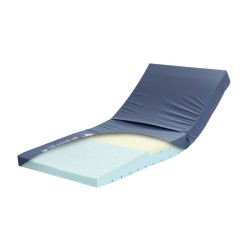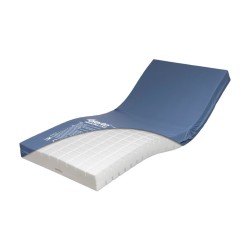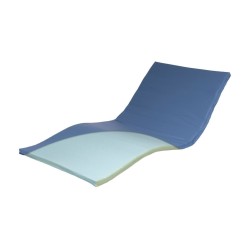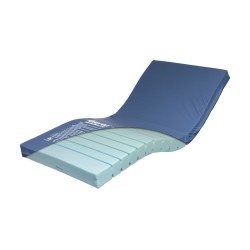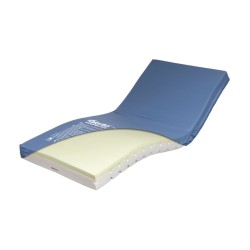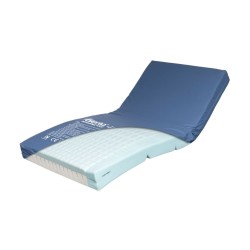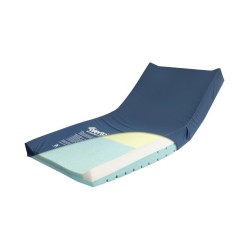
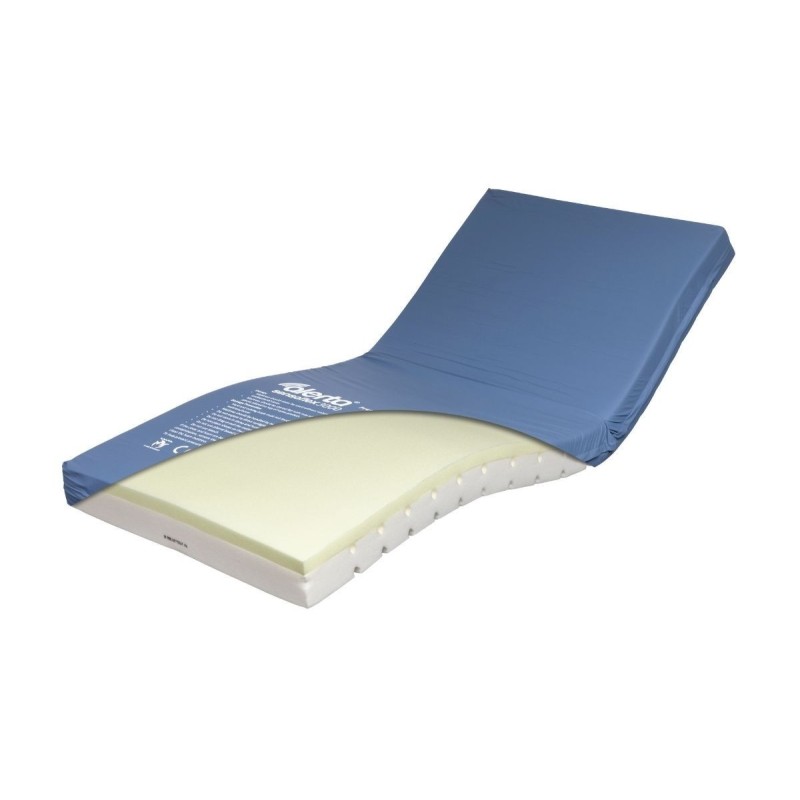

The Alerta Sensaflex 3000/4 Bariatric Foam Mattress is a 120cm wide memory foam profiling mattress for high-risk bariatric patients, providing the same body-contouring viscoelastic pressure redistribution as the standard Sensaflex 3000 in a wider format that accommodates greater body surface contact area without mattress edge compression. The bariatric specification addresses the compound pressure injury risk factors associated with higher body weight including elevated interface pressure, impaired circulation and reduced independent repositioning capacity. Antimicrobial vapour-permeable PU cover machine washable to 95°C, foam autoclavable at 134°C, BS7177: Crib 5 compliant.
| Specification | Detail |
|---|---|
| Product Code | NCL-ALT-3000/4 |
| Type | Bariatric static memory foam profiling mattress |
| Risk Level | High risk - bariatric specification |
| Width | 120cm (bariatric) |
| Foam Construction | Viscoelastic memory foam - body-contouring |
| Cover | Multi-stretch, vapour-permeable PU |
| Cover Treatment | Antimicrobial with white underside |
| Washing Temperature | Up to 95°C for thermal sanitisation |
| Foam Sterilisation | Autoclavable at 134°C |
| Fire Compliance | BS7177: Crib 5 |
| Standard Version | NCL-ALT-3000 (standard width) |
NICE Guideline CG179 (Pressure Ulcers: Prevention and Management) identifies obese patients as a specific at-risk group where the pressure care surface specification must account for both the elevated interface pressure from greater body weight and the physiological risk factors associated with obesity that compound pressure injury risk. The EPUAP/NPIAP/PPPIA guidelines specifically address bariatric patients in the pressure care surface specification guidance, noting that standard-width mattresses may be inadequate for bariatric patients whose body width exceeds the mattress edge and that bariatric equipment specification must consider both weight capacity and body dimension. CQC Regulation 12 (Safe Care and Treatment) requires that equipment is appropriate for the individual: for a bariatric patient at high pressure injury risk, specifying a standard-width mattress that does not accommodate the patient's body width is a documented care quality shortfall. CQC inspectors assess whether bariatric patients have been provided with equipment appropriate for their body size and weight as part of the safe care assessment for this patient group.
Does the care bed need to be a bariatric bed to use the Sensaflex 3000/4, and what bed width is required?
The Sensaflex 3000/4 at 120cm width requires a care bed with a sleeping surface wide enough to accommodate the mattress. Standard UK care home and hospital beds typically have a sleeping surface width of approximately 90cm, which will not accommodate the 120cm bariatric mattress. Bariatric care beds are typically available in 100cm, 120cm and wider dimensions. The bed must be specified to match the 120cm mattress width: confirm the bed's internal sleeping surface width before ordering to ensure the 3000/4 fits correctly and that the mattress does not overhang the bed frame in a way that compromises support at the edges. A mattress that overhangs the bed frame loses structural support at the overhang and may create an uneven sleeping surface that affects pressure redistribution performance.
When should a high-risk bariatric patient be considered for an alternating pressure mattress rather than the Sensaflex 3000/4 static mattress?
NICE CG179 recommends that alternating pressure is considered when static surface pressure redistribution is assessed as insufficient for the individual patient's clinical need. For bariatric patients at high pressure injury risk, the clinical threshold for escalating to alternating pressure may be lower than for standard-weight patients at the same Waterlow score, because the greater interface pressure applied by higher body weight reduces the effectiveness of static pressure redistribution relative to the ischaemia threshold. If a bariatric patient develops Stage 1 or 2 pressure damage while on the Sensaflex 3000/4, the prescribing clinician should reassess whether a bariatric alternating pressure mattress is required to achieve the additional pressure offloading that static foam cannot provide for this specific patient's combination of weight and risk factors.
Part of our specialist Pressure Care Systems range. Static foam mattresses provide cost-effective pressure redistribution for lower-risk residents in care homes and home care environments.