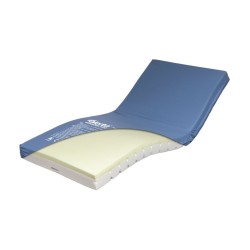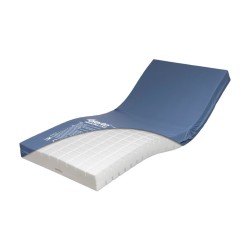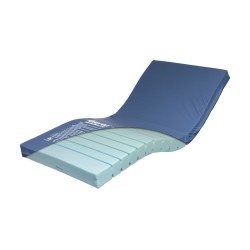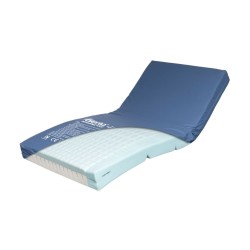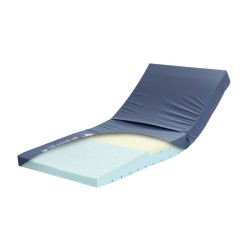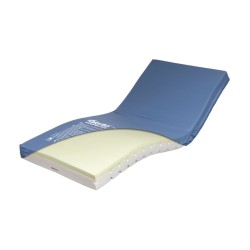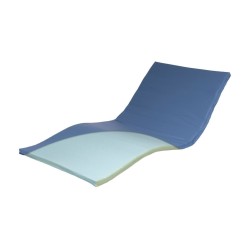
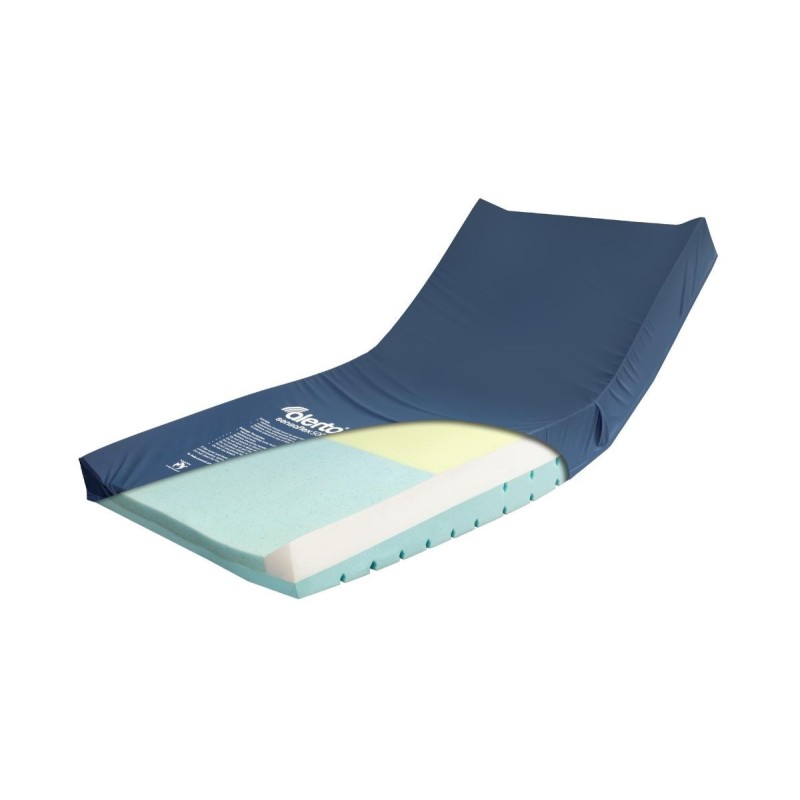


The Alerta Sensaflex 5000 is the premium static foam mattress in the Sensaflex range, designed for patients at very high risk of pressure damage who require the deepest static immersion available. The multi-layer foam construction combines a high-density base with memory foam top layer and gel-infused memory foam heel slope section. Lateral side support wings provide positional security, preventing patient migration toward mattress edges during overnight repositioning. The mattress is compatible with electric profiling bed frames, flexing at articulation points without creating pressure ridges. The Sensaflex 5000 is indicated where patients cannot tolerate alternating pressure cycling or where clinical assessment indicates static redistribution as the appropriate intervention.
| Specification | Detail |
|---|---|
| Product Code | NCL-ALT-5000 |
| Type | Premium static foam pressure redistribution mattress |
| Risk Level | Very high risk |
| Foam Construction | High-density base, memory foam top, SensaGel heel slope |
| Heel Section | Gel-infused memory foam slope |
| Side Support | Lateral support wings |
| Profiling Compatible | Yes - electric profiling beds |
| Cover Material | Water-resistant, antimicrobial, machine washable |
| Application | Hospitals, care homes, NHS environments |
Very high-risk static foam surfaces are indicated under NICE Guideline CG179 for patients where continuous immersion is the assessed clinical requirement, or where the patient does not tolerate alternating pressure cycling. The side support wings address MHRA guidance on mattress edge support and entrapment prevention when used alongside bed rails. CQC Regulation 12 requires that pressure care surfaces match the assessed risk level and that equipment selection considers individual patient tolerance and clinical presentation.
When is a static foam mattress preferred over an alternating pressure system?
Static foam is preferred when the patient cannot tolerate the sensation of air cell cycling (common in patients with cognitive impairment, agitation, or sensory sensitivity), when the clinical assessment indicates that continuous immersion is sufficient for the individual risk level, or when the care environment does not support powered systems (such as home care settings without reliable mains power). The Sensaflex 5000 provides very high-risk redistribution without requiring a pump unit.
What do the side support wings do?
The lateral side support wings are raised foam sections along each long edge of the mattress. They prevent the patient from migrating toward the mattress edges during overnight movement and repositioning. This maintains the patient within the central redistribution zone and reduces the risk of entrapment between the mattress edge and bed rails. The wings do not restrict patient movement during supervised transfers.