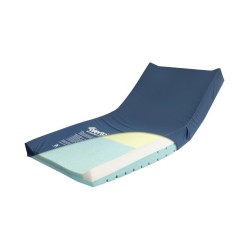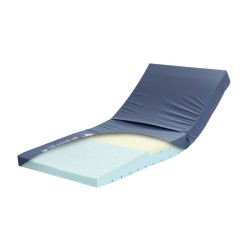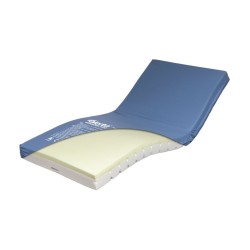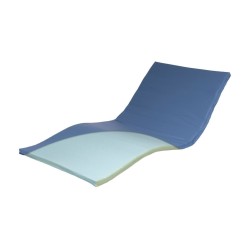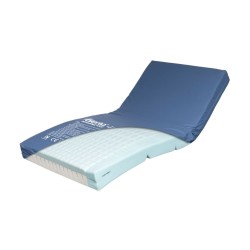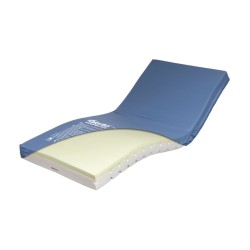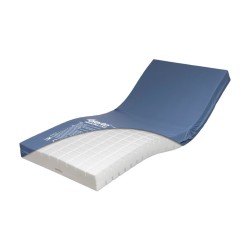
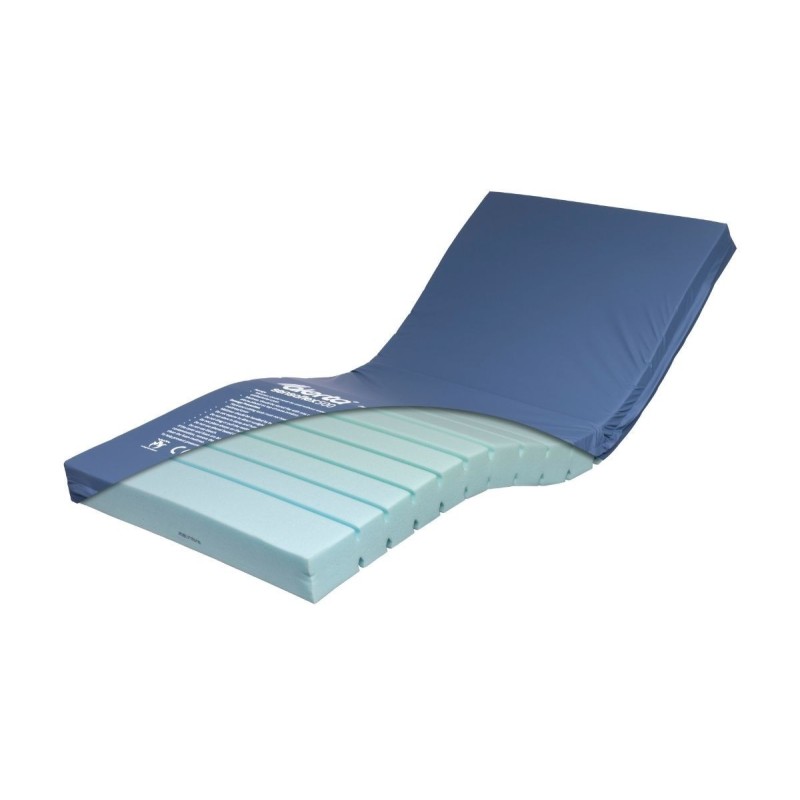

The Alerta Sensaflex 500 Foam Mattress is a medium-risk profiling mattress with castellated foam construction for pressure redistribution in patients assessed as medium risk on the Waterlow Risk Assessment Scale. The castellated foam surface reduces peak interface pressure at bony prominences by increasing deformation area under load, distributing body weight across a larger contact surface than equivalent flat foam. The multi-stretch vapour-permeable PU cover reduces shear and manages microclimate at the skin surface. Antimicrobial cover machine washable to 95°C, foam autoclavable at 134°C, and BS7177: Crib 5 fire compliant for use across all NHS and care home environments.
| Specification | Detail |
|---|---|
| Product Code | NCL-ALT-500 |
| Type | Static foam profiling mattress |
| Risk Level | Medium risk (Waterlow 15-19) |
| Foam Construction | Castellated foam |
| Cover | Multi-stretch, vapour-permeable PU |
| Cover Treatment | Antimicrobial with white underside |
| Washing Temperature | Up to 95°C for thermal sanitisation |
| Foam Sterilisation | Autoclavable at 134°C |
| Fire Compliance | BS7177: Crib 5 |
| Application | Hospitals, care homes, profiling beds |
NICE Guideline CG179 (Pressure Ulcers: Prevention and Management) specifies that patients identified as at risk of pressure ulcers should be provided with a pressure-redistributing support surface: the Sensaflex 500 provides the static pressure redistribution appropriate for patients in the medium-risk category where the castellated foam construction achieves sufficient interface pressure reduction without the additional clinical complexity of alternating pressure systems. CQC Regulation 12 (Safe Care and Treatment) requires that the pressure care surface specification is matched to the patient's assessed risk level: a medium-risk patient on a standard flat foam mattress without pressure redistribution properties may not be receiving the standard of pressure care required by NICE CG179. NICE Guideline CG179 also specifies that all patients on pressure redistribution surfaces should have their risk formally reassessed when their clinical condition changes, as progression to higher-risk status requires an upgrade in the pressure care surface specification - the Sensaflex range provides a consistent surface series (500 medium, 1000 high, 3000 very high, 4000 very high with gel) that allows risk-matched progression without changing supplier or product family.
What does castellated foam mean, and why does it provide better pressure redistribution than flat foam?
Castellated foam has a surface cut into alternating raised peaks and recessed valleys - a pattern resembling the battlements of a castle, which is the origin of the term. When body weight is applied to the castellated surface, the raised foam peaks compress and deform, spreading the load across a larger area than equivalent flat foam that compresses more uniformly. The recessed valleys also allow air circulation at the skin surface, supporting microclimate management. The result is a lower peak interface pressure at bony prominences compared with a flat foam mattress of the same density, because the castellated structure's deformation distributes pressure more effectively. The clinical benefit is reduced interface pressure at the heel, sacrum and other bony prominences without requiring the mechanical complexity of an alternating pressure system.
Is the Sensaflex 500 appropriate for use on a profiling bed, and does profiling affect pressure care performance?
The Sensaflex 500 is specified as a profiling mattress, designed to function across the range of positions a profiling bed can achieve including head elevation, knee break and full flat positioning. The mattress construction maintains consistent pressure redistribution performance across profiling positions, as the castellated foam deforms appropriately at each anatomical zone regardless of the patient's elevation angle. Head of bed elevation above 30 degrees significantly increases shear forces on the sacrum and increases the risk of sacral pressure injury: the vapour-permeable cover reduces the shear contribution from the cover-to-skin interface, but the clinical decision about the patient's head elevation position should be made in conjunction with the patient's pressure care assessment rather than being driven solely by clinical convenience. NICE CG179 recommends that head of bed elevation is minimised for pressure-at-risk patients unless clinically contraindicated by the patient's respiratory or other medical requirements.
Part of our specialist Pressure Care Systems range. Static foam mattresses provide cost-effective pressure redistribution for lower-risk residents in care homes and home care environments.