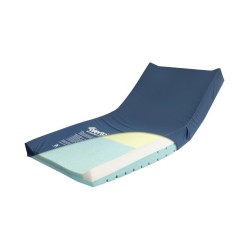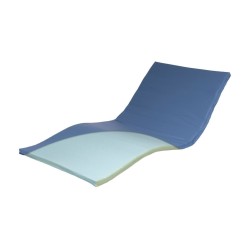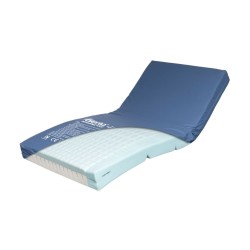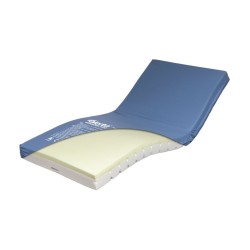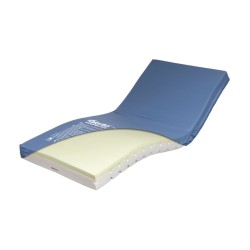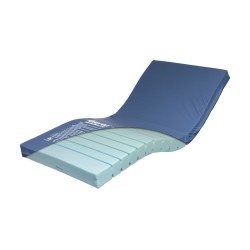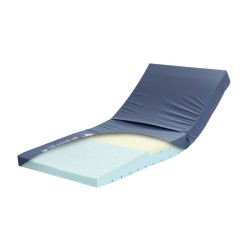
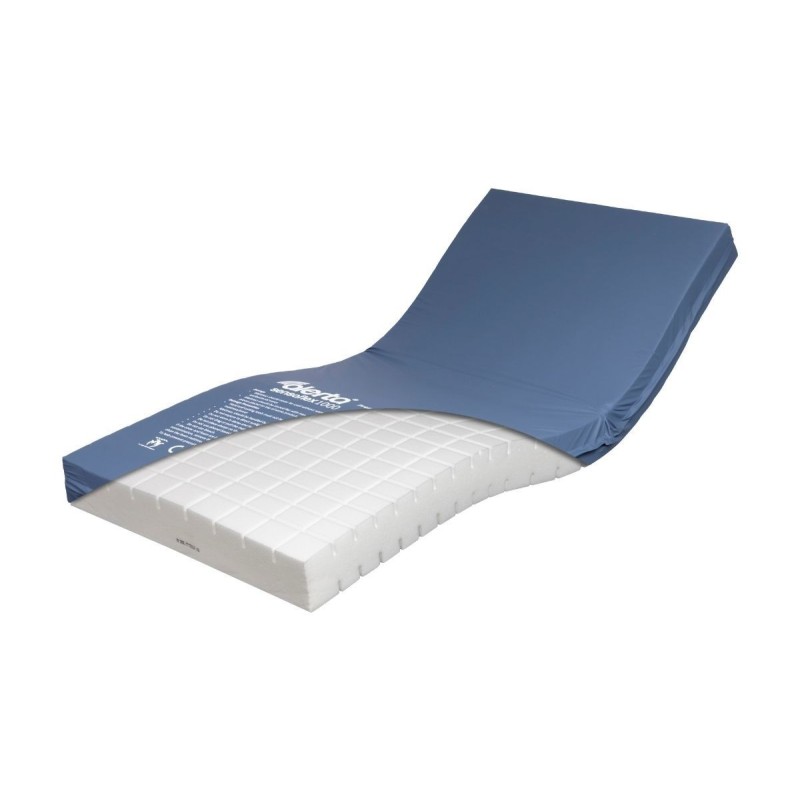

The Alerta Sensaflex 1000 Foam Mattress is a high-risk profiling mattress with castellated foam for patients assessed at high risk on the Waterlow Risk Assessment Scale, providing superior pressure redistribution to the medium-risk Sensaflex 500 through increased foam density and castellated construction. The multi-stretch vapour-permeable PU cover reduces shear and friction during repositioning, the antimicrobial cover is machine washable to 95°C, and the foam is autoclavable at 134°C for high-level decontamination between patients. BS7177: Crib 5 fire compliant for use across all NHS and care home profiling bed environments.
| Specification | Detail |
|---|---|
| Product Code | NCL-ALT-1000 |
| Type | Static foam profiling mattress |
| Risk Level | High risk (Waterlow 20+) |
| Foam Construction | Castellated foam - high-risk specification |
| Cover | Multi-stretch, vapour-permeable PU |
| Cover Treatment | Antimicrobial with white underside |
| Washing Temperature | Up to 95°C for thermal sanitisation |
| Foam Sterilisation | Autoclavable at 134°C |
| Fire Compliance | BS7177: Crib 5 |
| Application | High-risk patients on profiling beds in care homes and NHS wards |
NICE Guideline CG179 (Pressure Ulcers: Prevention and Management) specifies that high-risk patients should receive a higher-specification pressure redistribution surface than medium-risk patients, and that surface specification decisions should be based on the individual's risk assessment using a validated tool such as the Waterlow Scale. The Sensaflex 1000 is the high-risk specification within the Sensaflex static foam mattress range, providing the greater interface pressure reduction required for patients whose Waterlow score places them in the high-risk category. CQC Regulation 12 (Safe Care and Treatment) requires that the pressure care surface specification matches the documented risk assessment: using a medium-risk mattress for a patient assessed at high risk is a documented care quality shortfall. The repositioning guidance in NICE CG179 recognises that even with a high-specification static mattress, repositioning schedules remain required for high-risk patients - the Sensaflex 1000's low-shear vapour-permeable cover supports the clinical safety of repositioning by reducing the tissue damage contribution from the cover-to-skin shear during turning.
What is the difference between the Sensaflex 500 and the Sensaflex 1000, and when should each be selected?
The Sensaflex 500 is specified for medium-risk patients (Waterlow 15-19 or equivalent) and the Sensaflex 1000 for high-risk patients (Waterlow 20+ or equivalent). The principal difference is foam density and castellated construction specification: the 1000 provides greater interface pressure redistribution than the 500 at the same bony prominence locations, matched to the higher clinical requirement of the high-risk patient category. The Waterlow risk category determines the selection: a patient at medium risk receives the 500, a patient at high risk receives the 1000. When a patient's risk assessment changes - for example, following deterioration in clinical condition, skin status or mobility - the mattress specification should be upgraded to match the new risk assessment rather than continuing with the previous specification.
For a high-risk patient, when would the Sensaflex 1000 be appropriate rather than an alternating pressure mattress?
NICE CG179 recommends that the decision between a high-specification static surface and an alternating pressure system for a high-risk patient is based on clinical assessment of the individual's skin status, mobility, comfort and care needs, not solely on risk score. A high-specification static mattress such as the Sensaflex 1000 is appropriate for high-risk patients who can be repositioned on a regular schedule, whose skin integrity is currently maintained and who have no existing pressure damage, and for whom the alternating pressure system's mechanical complexity or noise would be clinically or practically inappropriate. An alternating pressure mattress is typically indicated when static surface repositioning alone is insufficient for the individual - for example, for patients who cannot be repositioned safely or frequently enough, or for patients with existing pressure damage at Stage 2 or above where NICE CG179 recommends consideration of higher-specification active surfaces.
Part of our specialist Pressure Care Systems range. Static foam mattresses provide cost-effective pressure redistribution for lower-risk residents in care homes and home care environments.