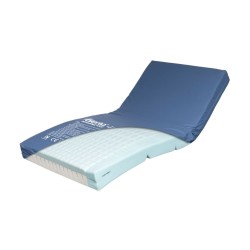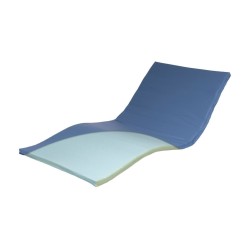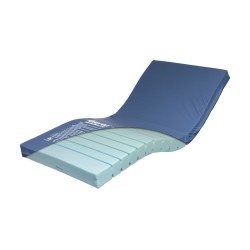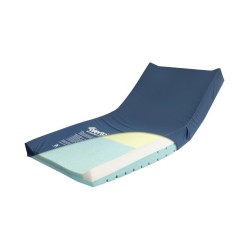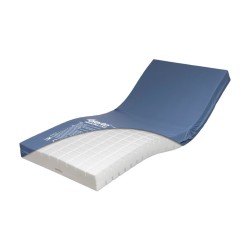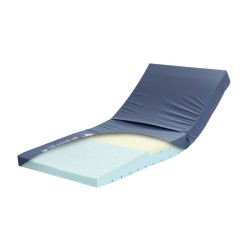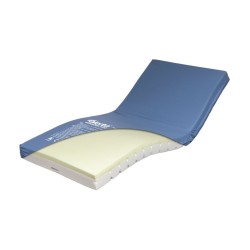
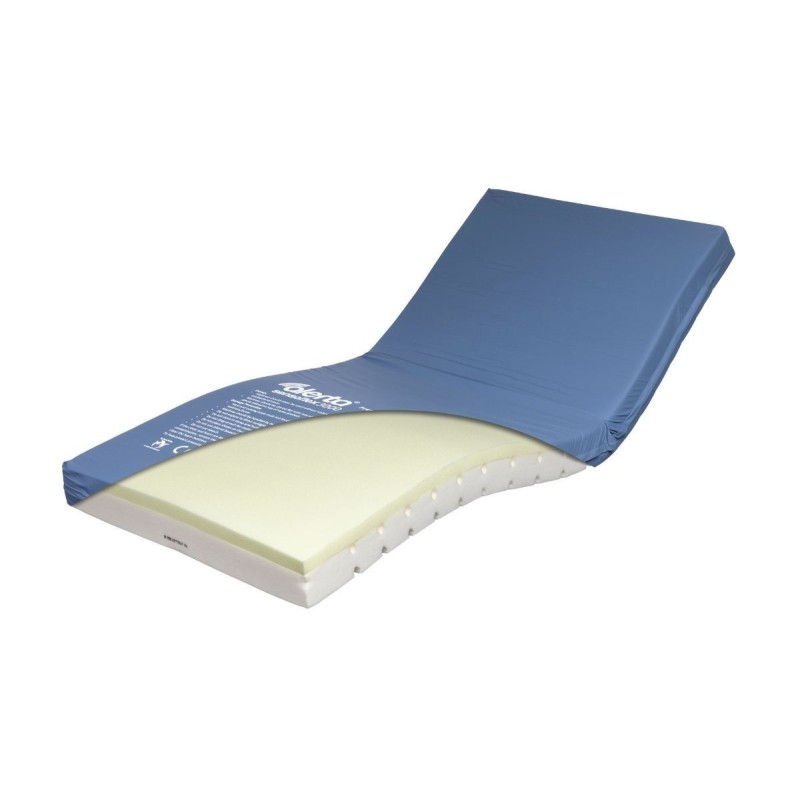

The Alerta Sensaflex 3000 Foam Mattress is a high-risk profiling mattress with memory foam (viscoelastic foam) construction that conforms to the patient's body contours, distributing weight across the maximum available contact surface area to minimise peak interface pressure at bony prominences. The memory foam's viscoelastic properties maintain patient-specific deformation under sustained load without returning to shape, providing consistent pressure redistribution throughout prolonged contact without the intermittent pressure increases associated with elastic foam's return-to-shape cycle. Antimicrobial multi-stretch vapour-permeable PU cover machine washable to 95°C, foam autoclavable at 134°C, BS7177: Crib 5 compliant. Bariatric version available as NCL-ALT-3000/4.
| Specification | Detail |
|---|---|
| Product Code | NCL-ALT-3000 |
| Type | Static memory foam profiling mattress |
| Risk Level | High risk (Waterlow 20+) |
| Foam Construction | Viscoelastic memory foam - body-contouring |
| Cover | Multi-stretch, vapour-permeable PU |
| Cover Treatment | Antimicrobial with white underside |
| Washing Temperature | Up to 95°C for thermal sanitisation |
| Foam Sterilisation | Autoclavable at 134°C |
| Fire Compliance | BS7177: Crib 5 |
| Bariatric Version | NCL-ALT-3000/4 (120cm wide) |
NICE Guideline CG179 (Pressure Ulcers: Prevention and Management) specifies that static high-risk pressure redistribution surfaces should achieve the minimum clinically required interface pressure reduction at bony prominences for the individual patient's risk category. Memory foam achieves this through anatomical conformance: the viscoelastic deformation distributes weight across the full contact surface matching the patient's body shape rather than requiring the castellated geometry of foam to achieve mechanical pressure spreading. For high-risk patients who cannot tolerate or do not require the active cycling of an alternating pressure mattress, the Sensaflex 3000's memory foam provides the maximum static surface pressure redistribution within the Sensaflex foam range. CQC Regulation 12 (Safe Care and Treatment) requires that the mattress specification is matched to the assessed risk: for high-risk patients where the clinical assessment indicates memory foam rather than castellated foam as the appropriate static surface, the Sensaflex 3000 is the within-range specification decision. NICE CG179 also notes that patient comfort is a clinical factor in surface selection: memory foam is frequently experienced as more comfortable than castellated foam for patients with existing skin sensitivity or existing Stage 1 pressure damage where contact comfort affects compliance with the care plan.
What is the clinical difference between the Sensaflex 1000 (castellated foam) and the Sensaflex 3000 (memory foam) for high-risk patients?
Both the Sensaflex 1000 and 3000 are high-risk profiling mattresses, but they achieve pressure redistribution through different foam mechanisms. The Sensaflex 1000 uses castellated foam whose cut surface deforms under load to spread pressure across a larger contact area than flat foam. The Sensaflex 3000 uses memory foam (viscoelastic foam) that conforms to the patient's exact body contours, distributing weight across the full anatomical shape. Memory foam typically achieves a greater degree of anatomical conformance and a larger pressure distribution area than castellated foam for the same applied load, and tends to be preferred for patients who require maximum static surface pressure redistribution or where patient comfort with the contact surface is a clinical factor. The clinical selection between 1000 and 3000 should be based on the prescribing clinician's assessment of the individual patient's pressure redistribution requirement and tolerance.
Does memory foam retain body heat, and is this a clinical concern for pressure care patients?
Memory foam can retain body heat at the skin-to-mattress interface more than standard foam or castellated foam, as the conforming deformation reduces the air gap around bony prominences that would otherwise allow heat dissipation. Elevated skin temperature increases metabolic demand in compressed tissue and is identified in the EPUAP/NPIAP guidelines as a contributing factor to pressure injury risk. The Sensaflex 3000's vapour-permeable PU cover addresses microclimate management by allowing moisture vapour to pass through the cover and by reducing the insulating effect of an impermeable cover surface, but heat management through the foam itself is less complete than with ventilated foam constructions. For patients where elevated skin temperature at pressure areas is a specific clinical concern - for example, patients with diabetes where peripheral circulation is already impaired - consider whether the Sensaflex 4000's gel-topped construction with V-cut airflow design is more appropriate for the specific patient's microclimate management requirement.
Part of our specialist Pressure Care Systems range. Static foam mattresses provide cost-effective pressure redistribution for lower-risk residents in care homes and home care environments.