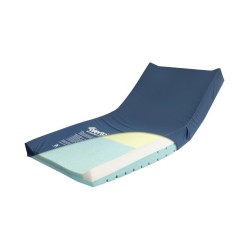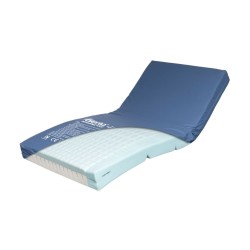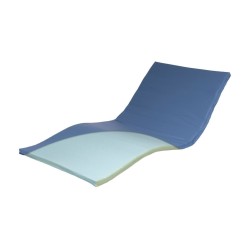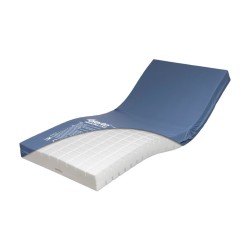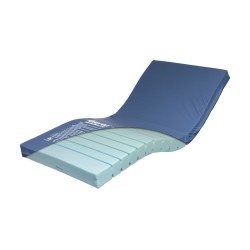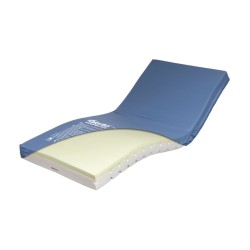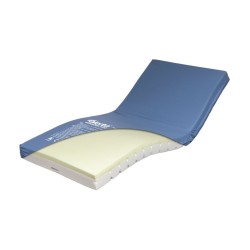
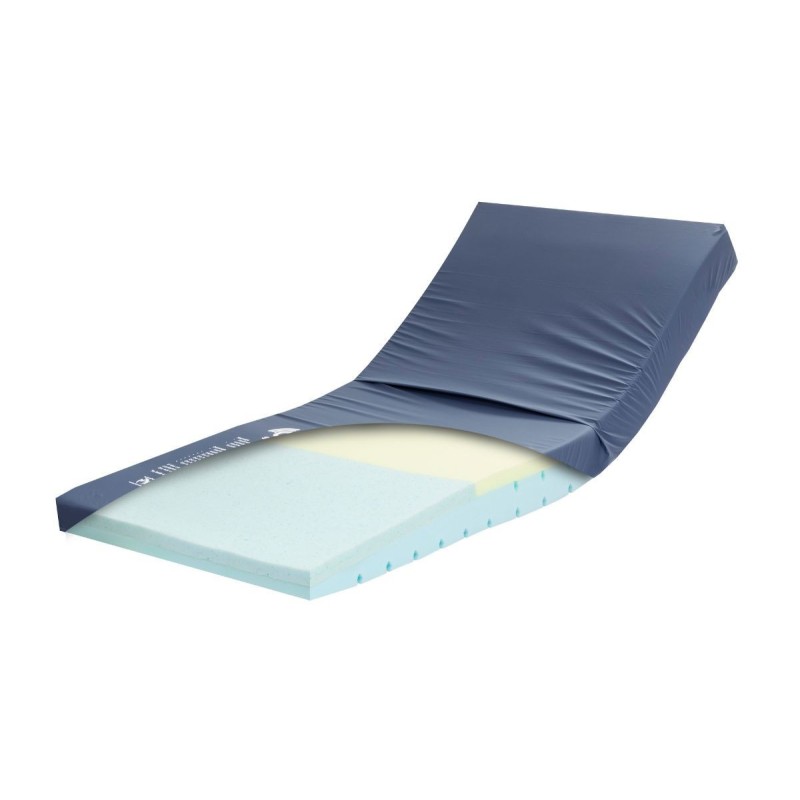


The Alerta Sensaflex 4500 is a static foam pressure redistribution mattress with a SensaGel heel slope section for patients at high risk of pressure damage. The high-density foam base provides structural support while the memory foam top layer delivers continuous immersion and envelopment at bony prominences. The gel-infused memory foam heel slope section provides targeted pressure relief at the calcaneus, addressing one of the most common sites for hospital-acquired pressure damage. The mattress is compatible with electric profiling bed frames, flexing with articulation points without creating pressure ridges.
| Specification | Detail |
|---|---|
| Product Code | NCL-ALT-4500 |
| Type | Static foam pressure redistribution mattress |
| Risk Level | High risk |
| Foam Construction | High-density base, memory foam top, SensaGel heel slope |
| Heel Section | Gel-infused memory foam slope |
| Profiling Compatible | Yes - electric profiling beds |
| Cover Material | Water-resistant, antimicrobial, machine washable |
| Application | Hospitals, care homes, NHS environments |
Static foam pressure redistribution mattresses are indicated under NICE Guideline CG179 for patients assessed as at risk of pressure damage where continuous contact redistribution is clinically appropriate. The SensaGel heel slope addresses EPUAP/NPIAP/PPPIA guidance on heel pressure ulcer prevention, which identifies the calcaneus as requiring specific pressure offloading in at-risk patients. CQC Regulation 12 requires that pressure care surfaces are appropriate to the individual risk assessment.
What is the difference between a static foam mattress and an alternating pressure system?
A static foam mattress provides continuous contact pressure redistribution through material density, contouring, and immersion. An alternating pressure system uses powered air cells that cyclically inflate and deflate to periodically offload tissue. Static foam suits patients at medium to high risk where continuous immersion is appropriate. Alternating systems are indicated where periodic offloading is required for very high-risk patients or those with existing pressure damage.
What does the SensaGel heel slope do?
The heel slope section uses gel-infused memory foam angled to reduce pressure concentration at the calcaneus (heel bone). The heel is one of the most common sites for hospital-acquired pressure ulcers due to its small contact area and prominent bony structure. The gel infusion enhances heat dissipation and immersion at the heel zone, providing targeted pressure relief that a flat mattress surface cannot deliver at this anatomical site.