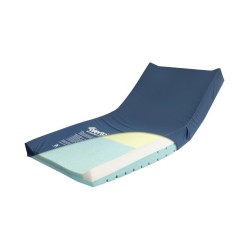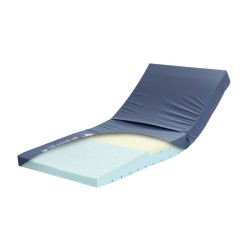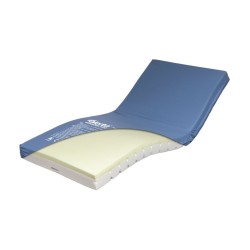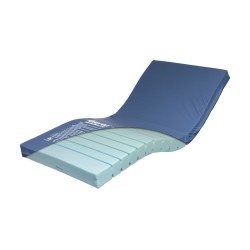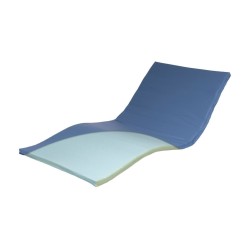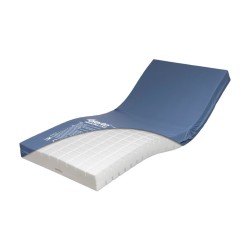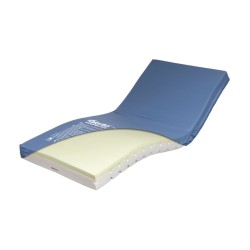
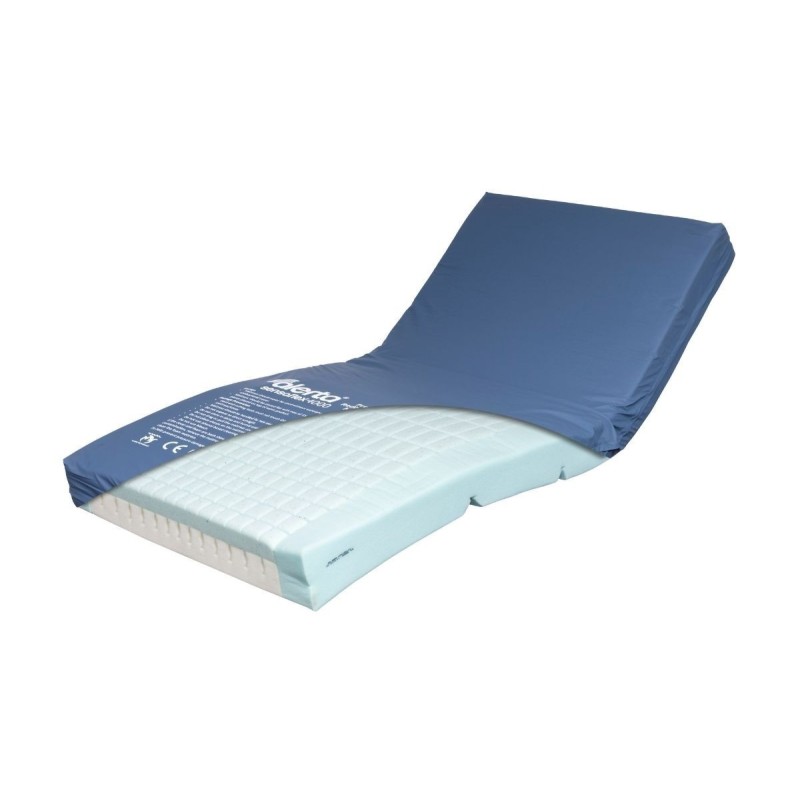


The Alerta Sensaflex 4000 Gel Topped Foam Mattress is the premium very high-risk profiling mattress in the Sensaflex range, combining a high-density foam base, central support layer and castellated gel memory foam top for maximum static surface pressure redistribution. The gel memory foam top reduces peak interface pressure beyond standard memory foam, and the V-cut foam section enhances airflow across the mattress surface for temperature regulation and microclimate management. The three-component construction addresses all EPUAP/NPIAP pressure injury causative factors: interface pressure (gel foam redistribution), shear (vapour-permeable PU cover), and microclimate (gel temperature conduction and V-cut airflow). Foam autoclavable at 134°C, BS7177: Crib 5 compliant.
| Specification | Detail |
|---|---|
| Product Code | NCL-ALT-4000 |
| Type | Static gel memory foam profiling mattress |
| Risk Level | Very high risk |
| Construction | High-density base + central support + castellated gel memory foam top |
| Airflow | V-cut foam section for temperature regulation |
| Cover | Multi-stretch, vapour-permeable PU |
| Cover Treatment | Antimicrobial with white underside |
| Washing Temperature | Machine washable at high temperatures |
| Foam Sterilisation | Autoclavable at 134°C |
| Fire Compliance | BS7177: Crib 5 |
NICE Guideline CG179 (Pressure Ulcers: Prevention and Management) specifies very high-risk patients as requiring the highest level of pressure care intervention within each surface category: the Sensaflex 4000 is the top-specification static surface in the Sensaflex range, with the gel memory foam top and V-cut airflow design providing greater interface pressure reduction and microclimate management than the memory foam 3000. The EPUAP/NPIAP/PPPIA guidelines identify microclimate as the third causative factor in pressure injury - alongside interface pressure and shear - and note that elevated skin temperature accelerates the metabolic processes of tissue ischaemia under pressure. The Sensaflex 4000's gel component and V-cut airflow design specifically address this microclimate dimension. CQC Regulation 12 (Safe Care and Treatment) requires that very high-risk patients receive the equipment specification appropriate to their documented risk level: for a patient assessed at very high risk where the clinical prescription specifies a gel-topped surface, the Sensaflex 4000 is the appropriate static surface specification. Where even the 4000 is insufficient for the individual's pressure care requirement, the clinical escalation is to an alternating pressure mattress system.
What does the gel in the gel memory foam top layer actually do, and how does it differ from standard memory foam?
The gel component in the castellated gel memory foam top layer serves two functions. First, gel has a higher thermal conductivity than foam, meaning it conducts heat away from the skin-to-surface contact point more effectively - reducing the localised skin temperature elevation that occurs in compressed, foam-contact tissue and that the EPUAP/NPIAP guidelines identify as a microclimate risk factor for pressure injury. Second, gel adds a fluid-like deformation component to the viscoelastic foam structure, allowing the combined gel-foam material to conform more closely to the patient's anatomical contours than foam alone, reducing peak interface pressure at the points of maximum bony prominence contact. The castellated structure of the gel memory foam top further contributes by allowing the peaks to deform independently, and the valleys to provide airflow pathways across the mattress surface for additional temperature management.
For a very high-risk patient on the Sensaflex 4000, is repositioning still required, and at what frequency?
Yes. NICE CG179 states that a pressure-redistributing surface does not eliminate the requirement for patient repositioning: it reduces the rate of tissue damage accumulation under sustained pressure but does not reduce the maximum tolerable tissue loading duration to zero. Repositioning frequency for a patient on the Sensaflex 4000 should be determined by the individual's clinical assessment, skin observation findings and the prescribing clinician's judgement, not by the mattress specification alone. The Sensaflex 4000's static pressure redistribution typically allows longer repositioning intervals than lower-specification static surfaces for the same clinical risk level, but the interval should be confirmed by clinical skin observation: if non-blanchable erythema (Category 1 pressure injury) is observed at any repositioning despite the 4000 specification, the repositioning interval should be shortened and escalation to alternating pressure should be considered.
Part of our specialist Pressure Care Systems range. Static foam mattresses provide cost-effective pressure redistribution for lower-risk residents in care homes and home care environments.