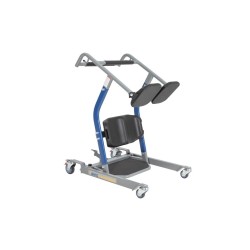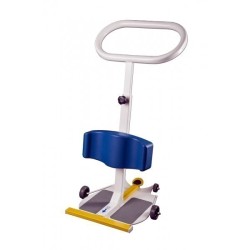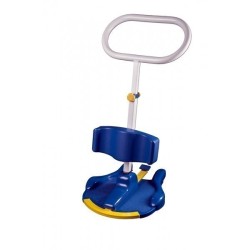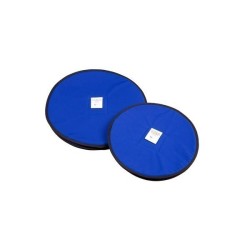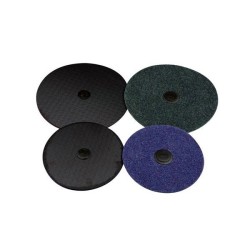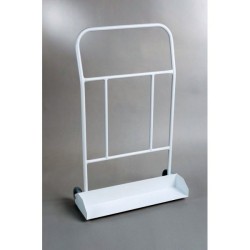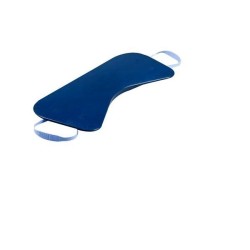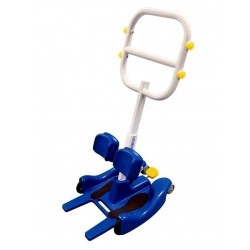
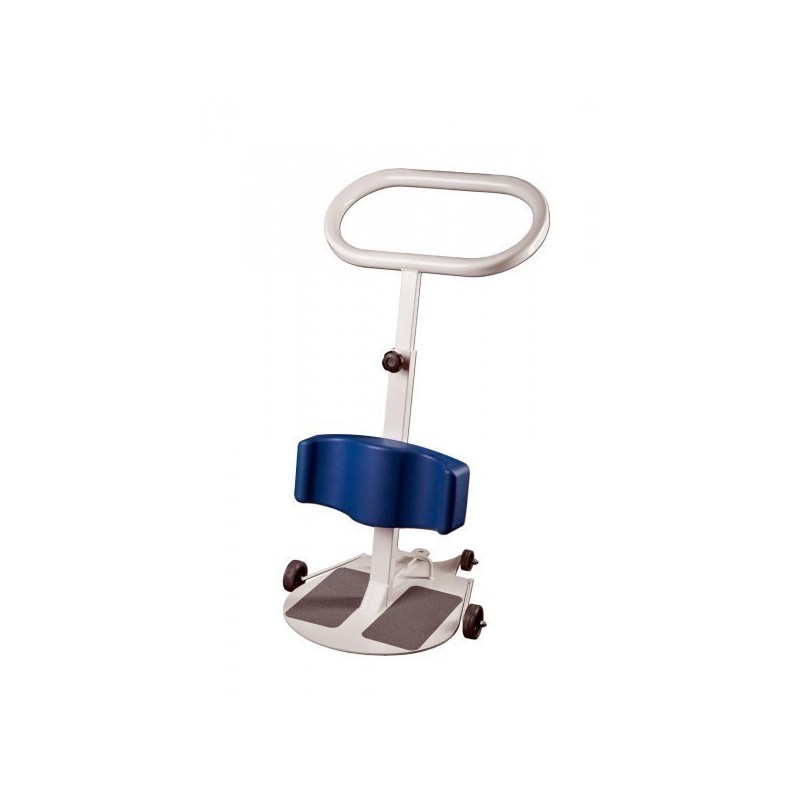

The Rota Stand LOCO-102 is a pivot transfer stand combining a height-adjustable frame, padded shin support and integrated turntable to enable safe assisted pivot transfers between adjacent seated positions including chair to commode, chair to wheelchair, bed edge to chair and wheelchair to toilet. The central wheels allow the Rota Stand to be rolled to the patient even after their feet have been positioned on the footplate - eliminating the repositioning step required with non-wheeled transfer frames - and the foot pedal brake gives the carer active control over the turntable rotation, securing the platform during the standing phase and releasing for the controlled pivot to the destination surface.
| Specification | Detail |
|---|---|
| Reference | LOCO-102 |
| Components | Frame, shin pad, integrated turntable |
| Brake | Foot pedal brake to secure and release turntable |
| Wheels | Central wheels for positioning after foot placement |
| Frame | Height adjustable for all client sizes |
| Applications | Chair-to-commode, chair-to-wheelchair, bed-to-chair pivots |
| Indication | Assisted pivot transfers for partially weight-bearing patients |
LOLER 1998 applies to the Rota Stand LOCO-102 as a standing transfer device used in lifting operations involving people. Thorough examination at suitable intervals - typically every six months for regular-use equipment - should specifically inspect the turntable mechanism for smooth rotation and absence of binding, the foot pedal brake for reliable engagement and release, and the frame structure for cracks, deformation or corrosion. Manual Handling Operations Regulations 1992 TILE risk assessment should be completed for each patient, confirming that the patient can weight-bear sufficiently to stand with the shin pad support, can maintain standing stability during the rotation phase, and that the destination surface height is compatible with the controlled pivot the Rota Stand performs. CQC Regulation 10 (Dignity and Respect) is supported by the Rota Stand's design, which reduces direct physical carer-to-patient contact during the transfer, replacing it with structured mechanical support that preserves patient privacy and independence during a sensitive personal care activity.
How does the Rota Stand LOCO-102 differ from the Rota Stand Solo LOCO-311?
The primary distinction is the T-bar mechanism in the Solo (LOCO-311) that enables single-carer operation by eliminating the need for carer counterbalancing. The LOCO-102 is a two-carer device in most applications, with one carer assisting the client to stand and guiding the rotation while a second carer may be required to manage the turntable brake and destination surface positioning. For care providers looking to reduce two-carer transfers, the Solo is the appropriate upgrade specification. The LOCO-102 remains the appropriate device where two-carer transfers are the standard practice for the patient group and the Solo's single-carer capability is not a priority for the setting.
Can the Rota Stand LOCO-102 be used on a carpet without affecting the turntable function?
The Rota Stand LOCO-102 can be used on carpet, but the turntable's rotation smoothness may be affected by high-pile or thick carpet that exerts lateral resistance on the turntable rim during rotation. On carpeted surfaces, the carer should ensure the foot pedal brake is fully released before initiating the pivot rotation, and that the client is not asked to resist or limit the rotation - allowing the turntable to complete the rotation at its natural speed rather than being held mid-pivot reduces the resistance load on the turntable mechanism during carpet use. For care home environments where all flooring is carpeted, the turntable performance on the specific carpet type should be assessed during the occupational therapy equipment trial before the Rota Stand is prescribed for the client.
Part of our specialist Patient Moving and Handling Equipment range, supporting safe patient transfers across care homes, hospitals, and home care environments.