
Wheelchairs
Wheelchairs in manual, self-propelled, transit, and powered formats for mobility independence in care homes, hospitals, and community settings, MHRA registered and compatible with NHS wheelchair service prescription pathways.
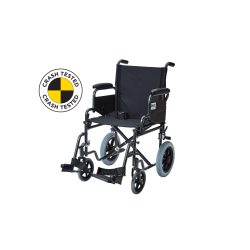
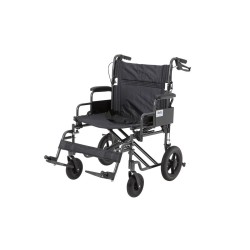
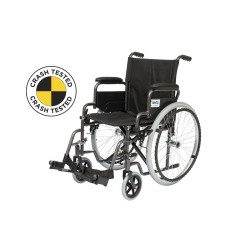
Wheelchairs for Mobility, Independence, and Clinical Use
Clinical Summary: Wheelchairs provide mobility for patients unable to ambulate independently, supporting access to care, community participation, and quality of life across care home, hospital, and community settings. Wheelchair selection should be made through NHS wheelchair service or occupational therapy assessment to ensure correct wheelchair type, seating specification, and pressure management for the individual user, in line with MHRA guidance and BS EN ISO 7176 wheelchair safety standards.
Wheelchair Types
- Self-Propelled Wheelchairs: Wheelchairs with large rear wheels enabling the user to independently propel themselves, suited to patients with sufficient upper limb strength and coordination for self-propulsion in care home and community environments.
- Transit Wheelchairs: Lightweight folding wheelchairs with small rear wheels for attendant propulsion, suited to transport use, clinical attendance, and environments where user self-propulsion is not required or possible. The most commonly used format in care home and hospital transport applications.
- Tilt-in-Space and Reclining Wheelchairs: Specialist postural wheelchairs with tilt and recline functions for users requiring postural management, pressure care support, and rest positions during extended seated periods, specified through occupational therapy assessment.
- Powered Wheelchairs: Electrically powered wheelchairs for users unable to self-propel but with sufficient cognitive function and upper limb control for powered chair operation, providing independent powered mobility in care home and community environments.
Clinical Compliance and NHS Prescription Standards
Wheelchairs supplied by Care Supplies carry MHRA registration and comply with BS EN ISO 7176 wheelchair safety standards. NHS wheelchair services provide prescription wheelchairs for eligible patients based on clinical assessment, with provision funded through NHS community equipment services and integrated care board wheelchair pathways. Privately purchased wheelchairs for care home use should be selected through occupational therapy assessment to ensure appropriate seating, postural support, and pressure management for the individual resident. Wheelchair maintenance, including tyre pressure checks, brake function, and frame integrity, should be included in care home equipment maintenance schedules with documented inspection records retained for CQC review.
| Wheelchair Type | Propulsion | Primary Application | Key Standard |
|---|---|---|---|
| Self-Propelled | User independent | Active users, community | BS EN ISO 7176 / MHRA |
| Transit | Attendant propelled | Transport, clinical attendance | BS EN ISO 7176 / MHRA |
| Tilt-in-Space | Attendant with tilt function | Postural and pressure management | MHRA / OT Assessment |
| Powered | Electric motor, user controlled | Independent mobility, community | BS EN ISO 7176 / MHRA |
Frequently Asked Questions
Q: How do I get a wheelchair through the NHS for a care home resident?
A: NHS wheelchair services provide wheelchairs for eligible patients based on clinical need assessed by an occupational therapist or physiotherapist. Referral is typically through GP, community OT, or hospital discharge team. Eligibility criteria and waiting times vary by integrated care board area. Care home residents with NHS continuing healthcare funding may have faster access through continuing healthcare equipment provision pathways.
Q: What is the difference between a tilt-in-space and a standard reclining wheelchair?
A: A tilt-in-space wheelchair tilts the entire seating system as a unit, maintaining the hip and knee angle while changing the orientation relative to the floor. This redistributes pressure from the ischial tuberosities without increasing shear. A reclining wheelchair reclines only the backrest, which increases hip angle and can increase shear at the sacrum. Tilt-in-space is generally preferred for pressure management, while reclining is used where the patient needs to extend their position for comfort or clinical reasons.