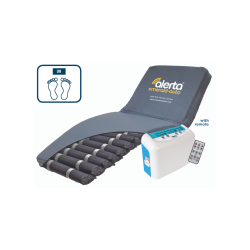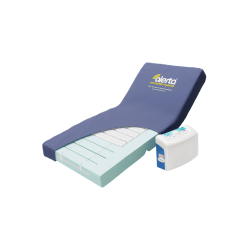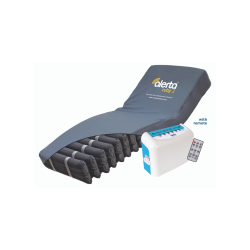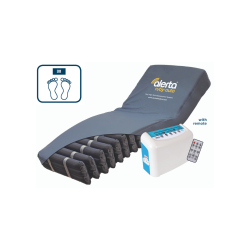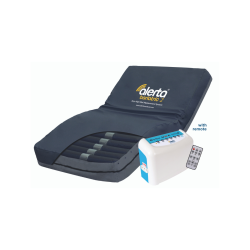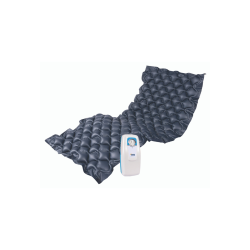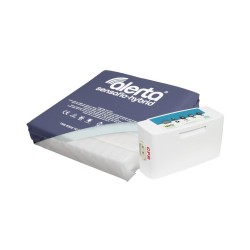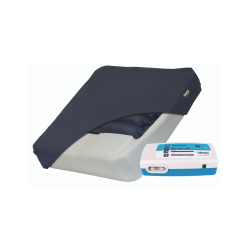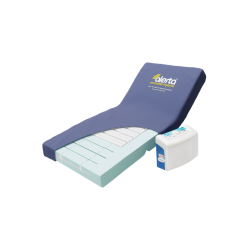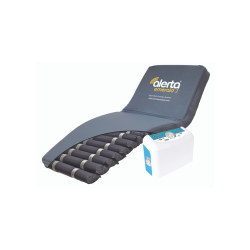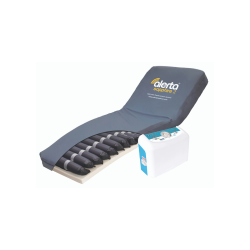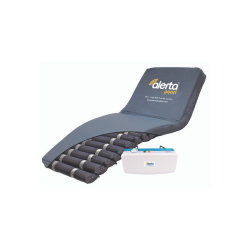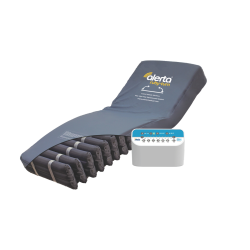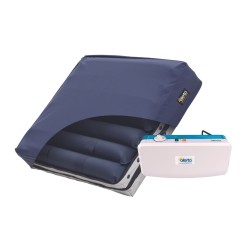
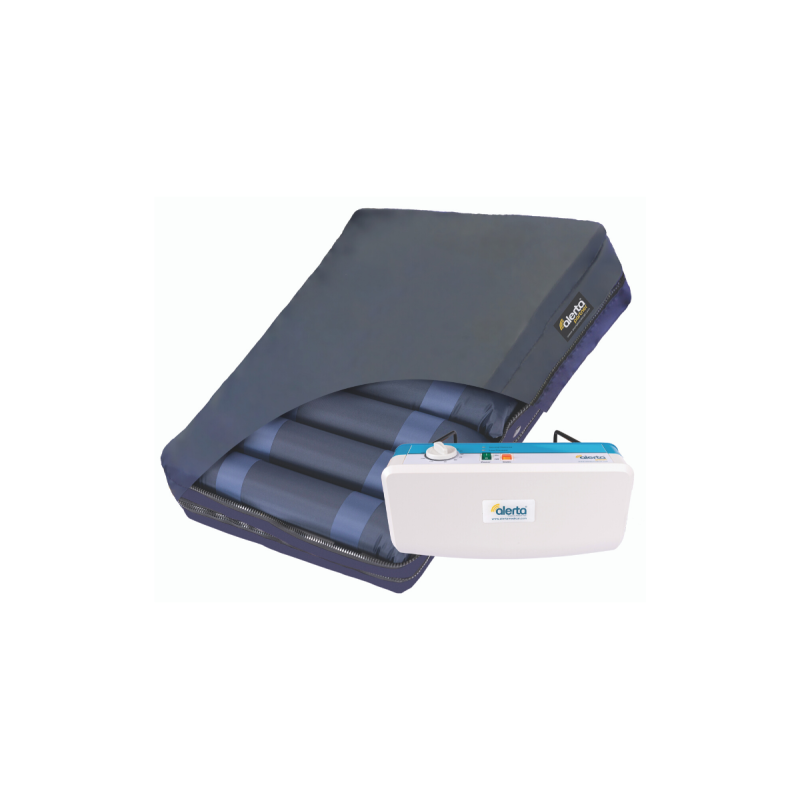


The Alerta Partner Cushion System is an alternating pressure relieving cushion for seated patients at high risk of pressure ulcer development, as assessed using the Waterlow Risk Assessment Scale or equivalent clinical tool. The alternating cell mechanism cycles pressure between cell groups, periodically offloading tissue at the ischial tuberosities, sacrum and coccyx - the primary bony prominences affected in seated pressure injury - allowing capillary reperfusion and reducing the sustained interface pressure that causes tissue ischaemia. A sealed 2-inch foam base provides secondary support, independently removable Nylon TPU-coated cells allow targeted maintenance and clinical pressure mapping, and a 360-degree zipper with multi-stretch vapour-permeable PU cover reduces shear and manages microclimate. Max SWL 150kg.
| Specification | Detail |
|---|---|
| Product Code | NCL-ALT-213/02 |
| Type | Alternating pressure cushion system |
| Risk Level | High risk (Waterlow 20+) |
| Cells | Nylon TPU-coated, independently removable |
| Base | Sealed 2-inch foam |
| Max SWL | 150kg |
| Cover | 360-degree zipper, multi-stretch vapour-permeable PU |
| Cover Cleaning | Antimicrobial, machine washable |
| Transport Mode | Yes - pump pause for safe patient transfer |
| Pressure Mapping | Clinical pressure mapping evaluation included |
NICE Guideline CG179 (Pressure Ulcers: Prevention and Management) recommends that patients at high risk of pressure ulcers who spend extended periods seated should be provided with a pressure-redistributing seat cushion specified for their individual risk level: for high-risk patients, alternating pressure cushion systems are indicated where static foam or gel cushions do not provide sufficient pressure redistribution for the individual's clinical profile. The EPUAP/NPIAP/PPPIA international guidelines identify seated pressure injury as a distinct clinical problem requiring specific seated pressure care equipment, as the interface pressures at the ischial tuberosities during sitting significantly exceed those during supine lying for equivalent risk patients. CQC Regulation 12 (Safe Care and Treatment) requires that seated pressure care is included in the individual's pressure care plan, not solely addressed through bed-based equipment: a patient assessed as high risk must have appropriate seated pressure care equipment documented in their care plan and confirmed in use during CQC inspection of care quality.
How does an alternating pressure cushion differ from a static foam or gel pressure cushion for high-risk patients?
A static foam or gel cushion reduces peak interface pressure at bony prominences by distributing body weight across a larger contact area - pressure redistribution. An alternating pressure cushion cycles the pressure between groups of cells, so that any given anatomical point is periodically fully offloaded rather than continuously loaded at a reduced level. For high-risk patients, periodic full offloading allows tissue reperfusion at the ischial tuberosities and sacrum that continuous loading at a redistributed pressure does not achieve, even if the redistributed pressure is below the theoretical tissue ischaemia threshold. NICE CG179 recommends consideration of alternating pressure systems for high-risk patients precisely because of this tissue reperfusion advantage over static surfaces, which cannot achieve zero load at any single point during normal use.
What is the transport mode, and when should it be used?
Transport mode pauses the alternating pump cycle, allowing the cushion cells to reach an equal static pressure across the surface before patient transfer. This is important because during the alternating cycle, some cells are inflated and others are deflated - transferring a patient during the cycle could create an uneven sitting surface that destabilises the transfer. Transport mode provides a stable, fully supported surface for the duration of the transfer and should be activated before any assisted transfer, including lateral transfers to a commode, bed or vehicle seat, and should be deactivated and the alternating cycle resumed when the patient is resettled in their chair. The foam base provides additional stability during transport mode for patients who may spend extended periods in transit.