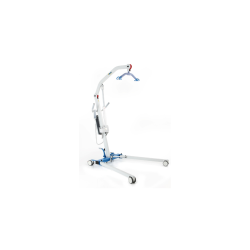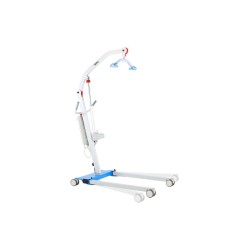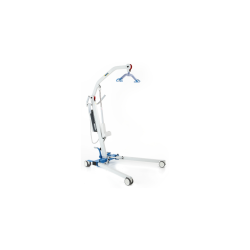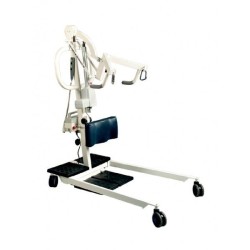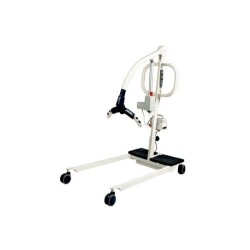
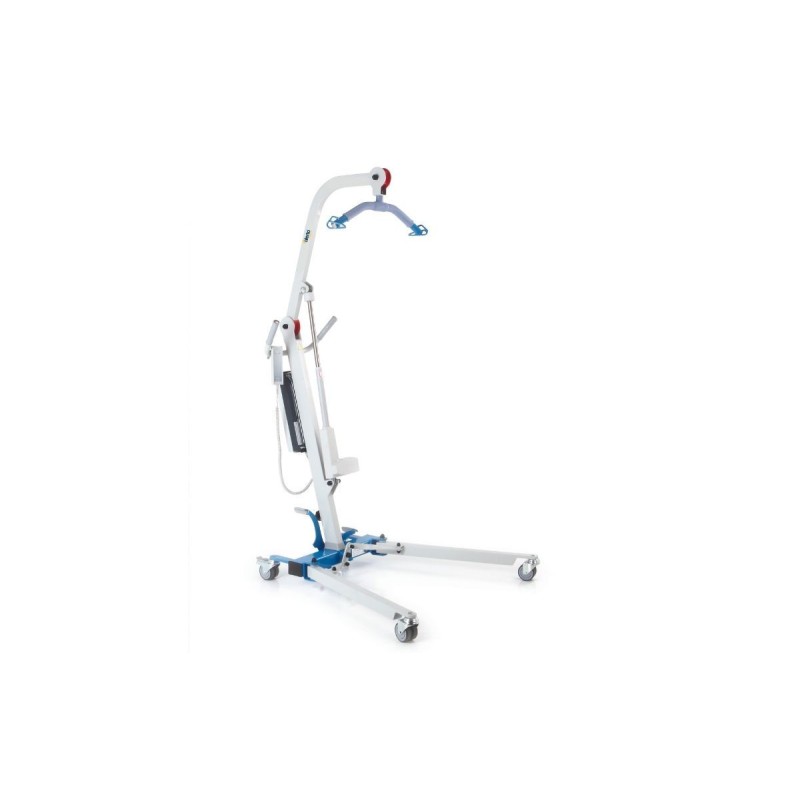

The Alerta Powerlifter Mini 135 is a compact mobile transfer hoist for safely lifting and transferring users up to 135kg in tight domestic spaces, residential care settings and smaller care home rooms where full-size hoists present manoeuvring challenges. The TiMotion control system delivers smooth, controlled lift with emergency stop protection and visual/audible battery indicators. The 360-degree rotating spreader bar with thermoplastic rubber (TPR) anti-swing coating minimises lateral movement during lifts, providing a calm transfer experience for the user. Two-section disassembly and braked rear castors support practical use across multiple settings and narrow doorways.
| Specification | Detail |
|---|---|
| Hoist Type | Mobile transfer hoist |
| Maximum SWL | 135kg |
| Control System | TiMotion (handset and control box) |
| Safety Features | Emergency stop, visual and audible battery indicators |
| Spreader Bar | 360-degree rotation, TPR anti-swing coating |
| Castors | Braked rear castors |
| Disassembly | Two sections for storage and transport |
| Primary Application | Domestic and residential care, tight spaces |
The Alerta Powerlifter Mini 135 is subject to LOLER 1998 (Lifting Operations and Lifting Equipment Regulations) as equipment used to lift people. LOLER 1998 requires thorough examination every 6 months by a competent person, with the examination report retained on site. For domestic use, the employer of the carer is responsible for complying with LOLER 1998; for self-employed carers or personal assistants, responsibility falls to the equipment owner. CQC Regulation 12 (Safe Care and Treatment) requires maintained LOLER records across all care settings using hoisting equipment. MHOR 1992 is addressed by replacing manual patient lifting with mechanically assisted transfer, protecting care staff from musculoskeletal injury. NICE CG179 (Pressure Ulcer Prevention) is relevant to hoist use: patient slings should be removed after every transfer to prevent prolonged pressure contact unless a sit-in sling has been specifically assessed and prescribed.
Is the Powerlifter Mini 135 suitable for home use?
Yes. The Mini 135 is specifically designed for domestic environments and smaller care settings where full-size hoists cannot manoeuvre safely. Its compact footprint, two-section disassembly and 135kg capacity make it suitable for a range of home care setups. LOLER 1998 still applies to hoists in domestic settings where paid carers use the equipment; the employer (or care agency) is responsible for arranging the 6-monthly thorough examination and retaining the examination report.
What type of slings are compatible with the Powerlifter Mini 135?
The Powerlifter Mini 135 is compatible with standard 4-point and 6-point patient slings using loop attachments on the spreader bar. Sling selection should be based on an individual patient assessment covering weight, posture, transfer type and skin integrity. Slings must be selected by a competent assessor (typically an OT) and matched to both the patient and the hoist SWL. Single-use slings are recommended for patients with infection control risks under NHS SICPs guidance.
Part of our specialist Patient Moving and Handling Equipment range, providing CQC and LOLER compliant patient lifting solutions for care homes, NHS trusts, and home care settings across the UK.