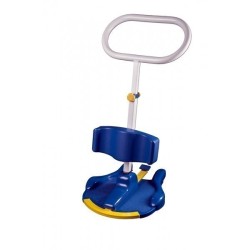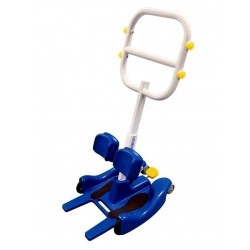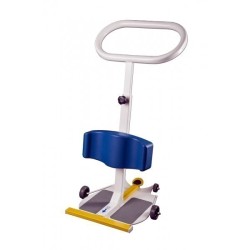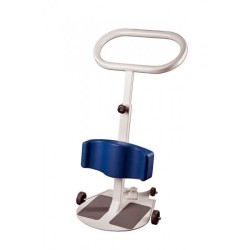
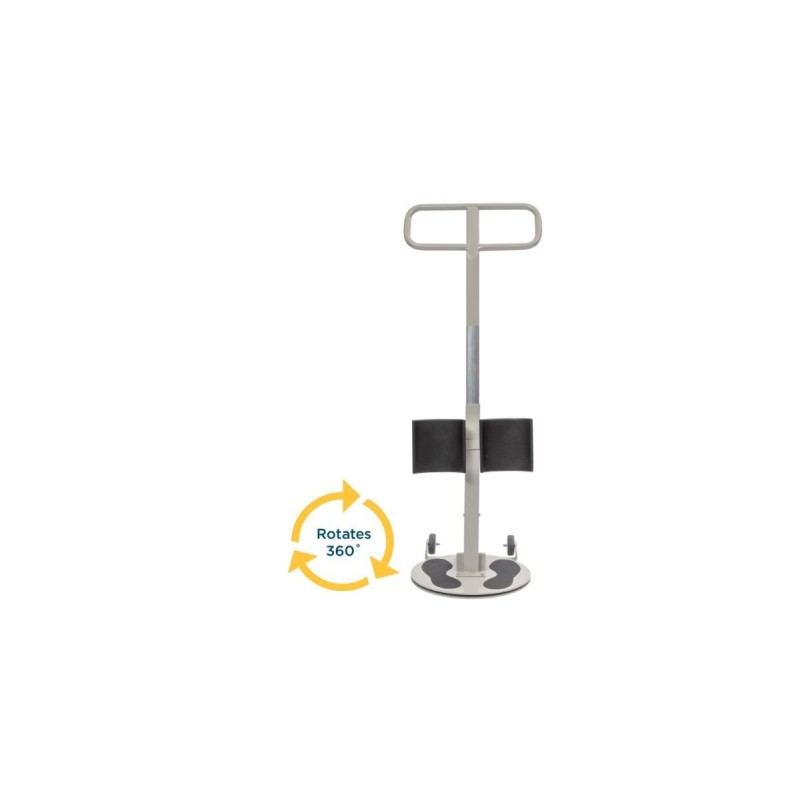


The Alerta Standing Turner is a patient transfer aid designed for carers assisting patients who are partially weight-bearing to make standing transfers between a chair, bed, commode and toilet. Featuring Alerta's GlideTurn easy-swivel base, a height-adjustable handle for patient grip and padded knee supports for lower limb stability, the Standing Turner enables controlled, dignified standing transfers for patients who cannot complete standing pivots independently but can bear some weight through their lower limbs. With a 160kg safe working load (SWL), it covers the vast majority of the partial weight-bearing patient population requiring standing transfer assistance in care home and community settings.
| Specification | Detail |
|---|---|
| Safe Working Load (SWL) | 160kg |
| Brand | Alerta |
| Base | GlideTurn easy-swivel, 360-degree rotation |
| Handle | Height-adjustable for patient and carer comfort |
| Knee Support | Padded for patient stability and comfort |
| Transfer Locations | Chair, bed, commode, toilet |
| Indication | Partially weight-bearing patients requiring standing transfer assistance |
LOLER 1998 (Lifting Operations and Lifting Equipment Regulations) applies to equipment used in the course of lifting operations involving people, including standing transfer aids used in care settings. The Alerta Standing Turner has a rated 160kg SWL that must not be exceeded, and LOLER requires that the equipment is inspected at suitable intervals and maintained in safe working order. Manual Handling Operations Regulations 1992 require that the risk of standing transfers is reduced to the lowest reasonably practicable level: the Standing Turner converts an unassisted standing pivot (high-risk without mechanical support for a partially weight-bearing patient) into a controlled, mechanically supported transfer that significantly reduces the fall and injury risk for both patient and carer. CQC Regulation 10 (Dignity and Respect) is supported by the Standing Turner's design, which enables the patient to participate actively in their own transfer rather than being passively lifted, preserving independence and dignity in a fundamental daily living activity.
Which patients are appropriate for standing transfer using the Alerta Standing Turner?
The Alerta Standing Turner is designed for patients who can partially weight-bear through their lower limbs with assistance - they can stand and pivot with support but cannot complete the transfer independently. This typically includes patients who have had a stroke and have one-sided weakness but can weight-bear on the affected leg with support, patients with early Parkinson's disease who have some freezing but can initiate standing with prompting, and patients with moderate lower limb weakness where full weight-bearing is not possible but partial contribution to the standing action is achievable. The Standing Turner is not appropriate for patients who are fully non-weight-bearing - these patients require a passive hoist for safe transfer. An occupational therapist should assess each patient's weight-bearing capacity before the Standing Turner is introduced to the patient's care plan.
Does the Alerta Standing Turner require LOLER inspection, and if so, how frequently?
Yes. Under LOLER 1998, patient-contact transfer equipment used in care settings should be subject to thorough examination at suitable intervals - typically every six months for equipment used for lifting operations involving people. The specific inspection schedule should be established in consultation with the care organisation's LOLER competent person or a qualified equipment inspector, as the frequency depends on the intensity of use and the manufacturer's recommendations. Inspection records should be maintained as required by LOLER and made available on request during CQC inspections, as evidence of a planned preventive maintenance programme for patient handling equipment is a component of CQC Regulation 17 (Good Governance) compliance.
Part of our specialist Patient Moving and Handling Equipment range. Patient turners enable safe repositioning with minimal manual handling risk for care home staff.