
Patient Turners
Patient turners and transfer turntables for safe standing pivot transfers in care homes and NHS settings, reducing carer manual handling effort during sit-to-stand and turning transfers for patients with partial weight-bearing ability.
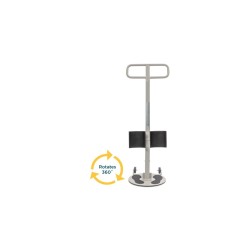
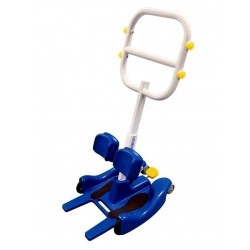
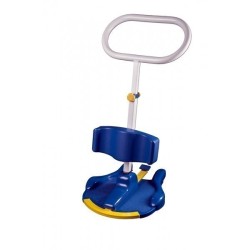
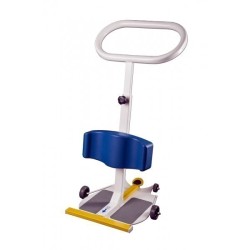
Patient Turners and Transfer Turntables for Safe Pivot Transfers
Clinical Summary: Patient turners and transfer turntables enable controlled standing pivot transfers for patients with sufficient weight-bearing ability to stand but who cannot independently turn and reposition, significantly reducing carer rotational handling forces during bed-to-chair, chair-to-commode, and chair-to-car transfers. They are appropriate only for weight-bearing patients and must not be used for non-weight-bearing or full-dependency transfers, where a hoist is the appropriate safe handling solution.
Patient Turner and Turntable Types
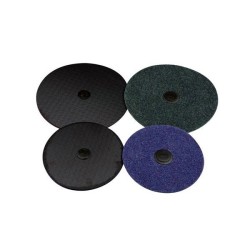
- Foot Turntables: Low-profile rotating platforms placed on the floor for the patient to stand on, allowing the carer to rotate the patient to the target position with minimal rotational force by turning the disc rather than the patient directly. Suitable for bed-to-chair and chair-to-chair pivot transfers.
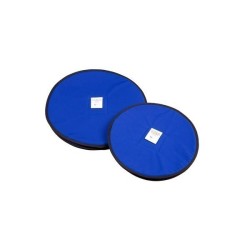
- Seated Turntables: Rotating cushioned pads placed on a seat surface, enabling the patient to be rotated whilst seated during car transfers, chair repositioning, and seated pivot movements without the patient needing to stand fully. Particularly useful for car transfers where the door opening limits standing space.
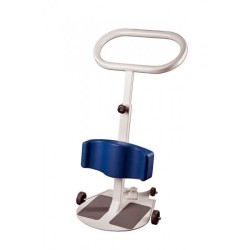
- Power-Assisted Patient Turners: Electrically or manually powered patient turner devices providing supported standing assistance alongside the turning function, suitable for patients who require greater standing support than a standard turntable provides but who retain some active weight-bearing ability.
- Banana Boards and Transfer Boards with Rotation: Curved transfer boards enabling sliding seated transfers with a rotating element, providing an alternative transfer pathway for patients who cannot stand for a standing pivot transfer.
Clinical Compliance and Safe Use Standards
Patient turners and transfer turntables are appropriate only for patients assessed as having sufficient weight-bearing ability to stand safely during the transfer procedure. Individual manual handling risk assessment must confirm weight-bearing status, standing ability, and cooperation level before a patient turner is specified in the handling plan. MHOR 1992 requires that patient handling equipment is selected to match individual patient ability and that staff are trained in correct use techniques. Non-weight-bearing and full-dependency patients must be transferred using an appropriate hoist under LOLER-compliant procedures, and patient turners must not be used as a substitute for hoist transfers in these cases.
| Turner Type | Transfer Application | Weight-Bearing Requirement | Key Standard |
|---|---|---|---|
| Foot Turntable | Bed-to-chair, chair-to-chair standing pivot | Full standing weight-bearing | MHOR 1992 |
| Seated Turntable | Car transfers, seated pivot | Seated with some trunk control | MHOR 1992 |
| Power-Assisted Turner | Standing transfers with support | Partial to full weight-bearing | MHOR 1992 / MHRA |
| Curved Transfer Board | Sliding seated transfer with rotation | Seated, minimal standing | MHOR 1992 |
Frequently Asked Questions
Q: Can patient turntables be used for non-weight-bearing patients?
A: No. Patient turntables and foot turners require the patient to bear their full body weight through their feet during the transfer. They are not appropriate for non-weight-bearing patients, patients with lower limb fractures or post-operative restrictions on weight-bearing, or patients who cannot maintain a standing position safely. For these patients, an appropriate hoist and sling transfer is the safe handling solution under LOLER 1998.
Q: How do patient turntables reduce carer injury risk?
A: During a standing pivot transfer without a turntable, carers must apply rotational force to move the patient from one seated position to another while also supporting their standing posture. This combines lifting, twisting, and rotational forces in a confined space — a high musculoskeletal injury risk combination. A turntable eliminates the rotational element by allowing the disc to rotate under the patient feet, leaving the carer to support posture only, significantly reducing rotational spinal loading.