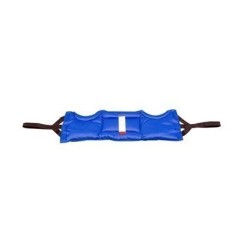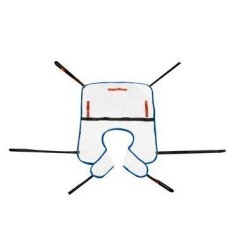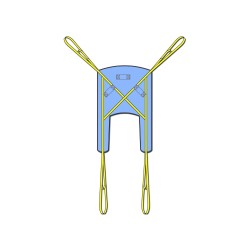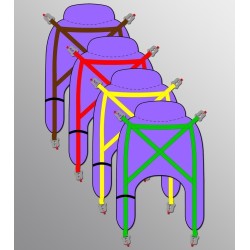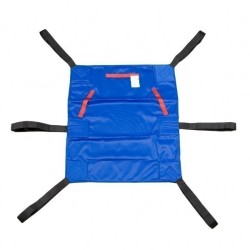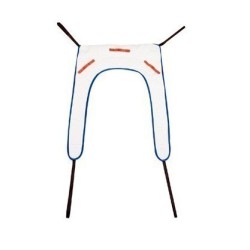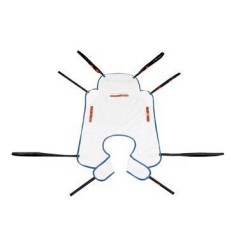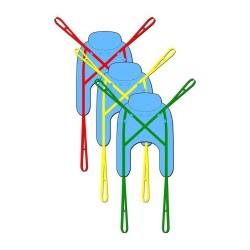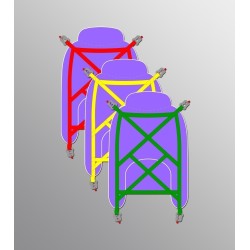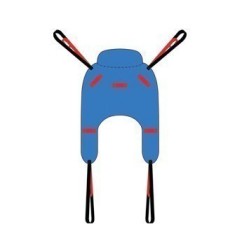


The Select Healthcare Universal Patient Handling Sling provides full-body support during hoist transfers and is available in two configurations: with head support for patients who require full head and neck support throughout the transfer, and without head support for patients with sufficient head and neck control to maintain their own head position during the hoist arc. This dual configuration makes the Universal Sling the appropriate default specification for NHS ward and care home hoist inventories, covering the broadest range of patient types without requiring separate sling specifications for different head-support needs. Compatible with standard spreader bar hoists as part of the Locomotor Sling Range.
| Specification | Detail |
|---|---|
| Brand | Select Healthcare - Locomotor Sling Range |
| Type | Universal full-body sling |
| Head Support | Available with or without - specify at order |
| Hoist Compatibility | Standard spreader bar hoists ONLY |
| Not Compatible With | Wishbone spreader bar or buckle-fastening hoists |
| Type | Reusable, washable |
LOLER 1998 requires that hoist slings are thoroughly examined every six months by a competent person, with the sling also visually inspected before each use. Sling selection for each patient must be documented in the patient's individual hoist transfer plan, specifying the sling type, size, configuration (with or without head support) and compatible hoist, as LOLER requires that lifting operations are planned and carried out safely by trained personnel using appropriate equipment. The choice between the head support and no head support configuration must be made following an occupational therapist or moving and handling advisor's assessment of the patient's head and neck control: using the without-head-support configuration for a patient who lacks adequate head control creates a patient safety risk during the hoist arc that the head-support version prevents.
How do I determine whether the head support or no head support Universal Sling is appropriate for a patient?
Head support is required for patients who cannot maintain their head in an upright position without assistance throughout the hoist transfer arc, which includes patients with significant neurological conditions affecting neck muscle control, patients in very low consciousness or sedated states, and patients who become hypotonic (muscle floppy) when lifted. For patients with good voluntary head and neck control who can maintain their head position throughout the transfer, the without-head-support configuration may be appropriate and may be preferred by the patient as more comfortable. The individual patient assessment by an occupational therapist or moving and handling advisor should determine which configuration is specified in the patient's hoist transfer plan.
Can the Universal Sling be used for both seated and supine hoist transfers?
Yes. The Universal Sling can be applied from a seated position - sitting the patient forward, positioning the sling centrally with the top of the commode aperture level with the seat edge, crossing the leg straps under each thigh and attaching to the spreader bar - and from a supine position in bed. The specific application technique differs between starting positions, and all care staff using the Universal Sling should be trained in both application methods as part of their hoist and sling competency assessment, as incorrect sling application from either position creates an unsafe configuration that could result in patient injury during the lift.
Part of our specialist Patient Moving and Handling Equipment range. Our patient slings are designed for safe, compliant transfers in care homes and clinical environments.