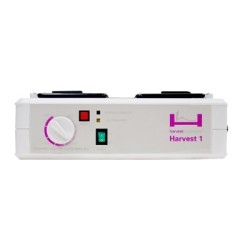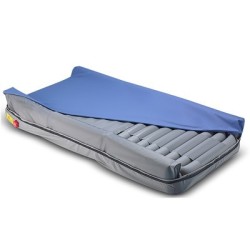
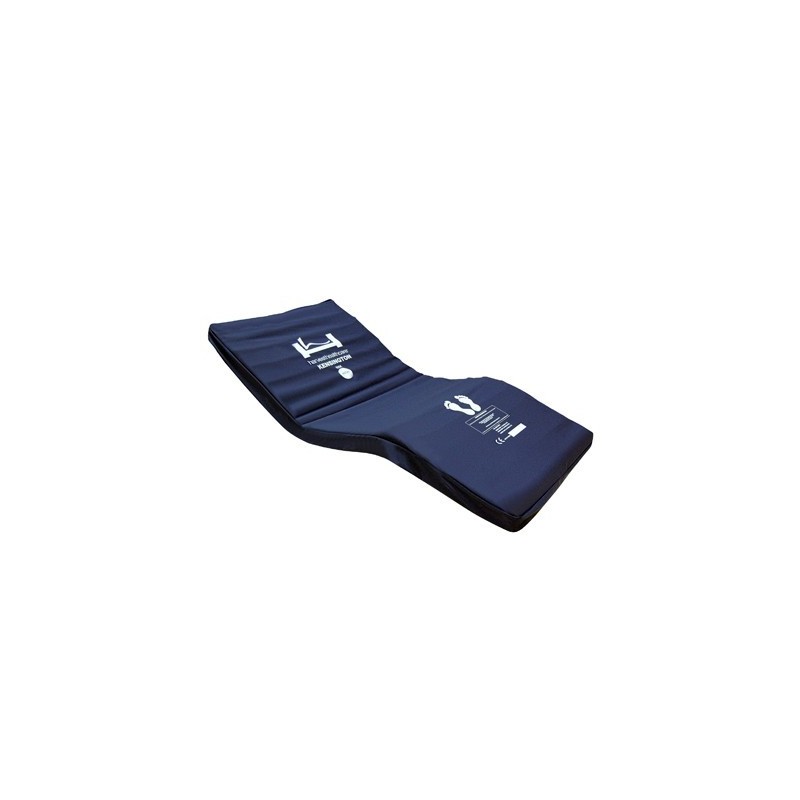


The Kensington Active Mattress by Harvest Healthcare is a 16-cell alternating pressure overlay system designed for residents at high risk of pressure ulceration in community and care home settings. The 10-minute alternating cycle provides dynamic pressure redistribution across the full mattress surface, and the static pillow section maintains head and shoulder stability. The 4-way stretch vapour-permeable welded PU cover is Crib 5 fire rated and wipe-clean for decontamination. Compatible with Harvest Pumps 1 and 250, with SWL up to 184kg using the Harvest 250. All air cells are individually replaceable; 3-year warranty included.
| Specification | Detail |
|---|---|
| Type | Alternating pressure overlay (placed over existing mattress) |
| Air Cells | 16 alternating TPU cells + 2 static pillow cells |
| Alternating Cycle | 10 minutes |
| Dimensions | 2000 x 900 x 110mm |
| Weight | 6kg |
| Cover | 4-way stretch welded PU - VP, water resistant, Crib 5 |
| Pump Compatibility | Harvest Pump 1 (SWL 158kg / 25 stone); Harvest 250 (SWL 184kg / 29 stone) |
| Reference | NCL-HAMKENS001 |
| Warranty | 3 years |
| Clinical Standard | NICE CG179 (high-risk pressure care) |
The Kensington Active Mattress is a Class IIa active medical device under Medical Devices Regulation 2017/745, requiring clinical selection following validated pressure risk assessment per NICE CG179 for residents assessed as high risk. SWL must be verified against the resident's documented weight before deployment, with pump selection determining the maximum safe user weight; MHOR 1992 documentation must confirm weight verification for each clinical issue. The Crib 5 welded PU cover meets the BS 5852 fire safety standard required for care home and hospital settings. The wipe-clean cover supports NHS IPC decontamination between residents. Equipment register documentation and MDR conformity records must be maintained for CQC Regulation 12 compliance.
What is the clinical difference between an alternating pressure overlay and a replacement mattress, and when is each indicated?
An alternating pressure overlay is placed over the existing static mattress and raises the sleeping surface by the depth of the overlay. A replacement mattress replaces the existing mattress entirely and sits on the bed base as the primary surface. The overlay configuration, as used in the Kensington, is clinically appropriate for residents assessed at high pressure risk where the existing static mattress is in good condition and the additional height of the overlay does not compromise transfer safety, bed rail compliance, or bed exit risk. The overlay approach also supports community deployment where a replacement mattress would be difficult to source, install, and service. A replacement mattress is typically indicated for residents at very high pressure risk where a deeper air cell system or integrated foam base is required, for those with existing stage 3 or 4 pressure ulcers, or where the existing mattress is no longer serviceable. The prescribing clinician must assess overlay vs replacement suitability for each individual resident and document the clinical rationale in the care plan.
Do individually replaceable air cells make a clinical difference, and how does cell replacement work in practice?
Yes. An active alternating mattress that loses a single cell due to a puncture or valve failure will continue operating, but the affected cell will not inflate and the alternating cycle will deliver incomplete pressure offloading at the corresponding anatomical zone. If cells cannot be replaced individually, a single cell failure requires replacement of the entire mattress or overlay, which has significant procurement and continuity of care implications. The individually replaceable cell design of the Kensington means that a maintenance engineer or trained clinician can replace the failed cell without taking the system out of service for longer than the replacement procedure requires. Cells should be inspected regularly during cleaning as part of the routine decontamination check; any cell that fails to inflate to the correct firmness during the alternating cycle or that shows visible damage should be replaced promptly and the replacement logged in the equipment maintenance record for CQC Regulation 12 purposes.