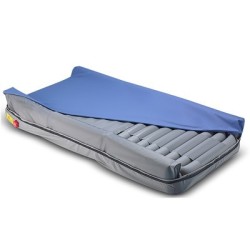
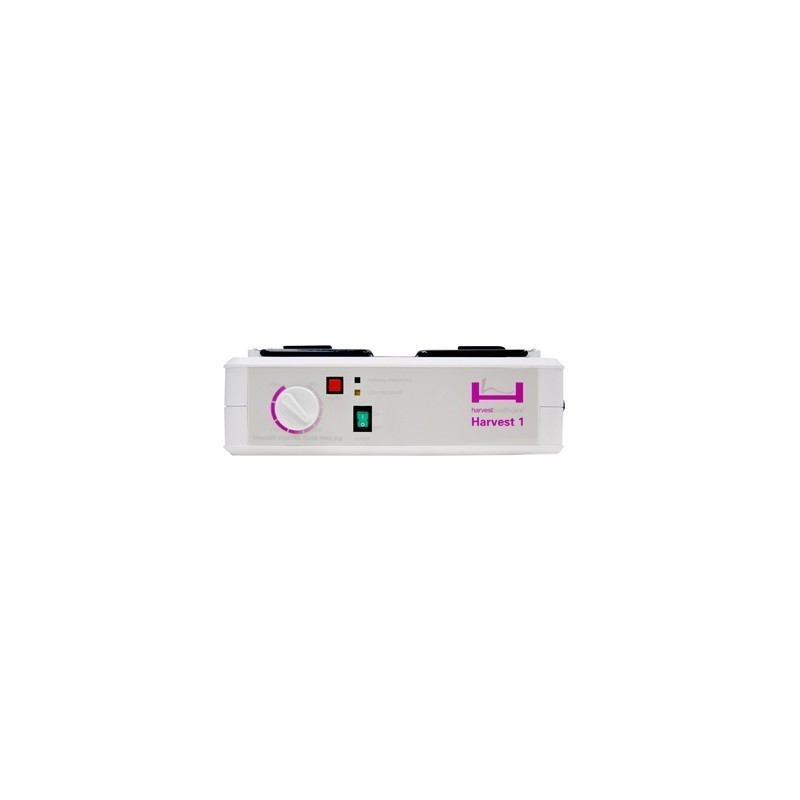


The Harvest 1 Pump is a manually operated dial-controlled pressure pump for use with Harvest Healthcare active mattress systems in community and residential care settings. The dial interface provides straightforward pressure adjustment without digital controls, and the fixed 10-minute alternating cycle delivers consistent therapy within a 30-80mmHg range. Audible and visual low-pressure alarms support overnight safety monitoring. At 1.7kg, the pump is compact and community-portable. Compatible with Kensington, Sandringham, Hampton, and Prime Comfort Active mattresses. Meets EN60601-1:2006 and A11:2011 medical electrical safety standards.
| Specification | Detail |
|---|---|
| Control Type | Manual dial (not digital) |
| Pressure Range | 30-80 mmHg |
| Cycle Time | 10 minutes (fixed) |
| Alarms | Audible and visual low-pressure alerts |
| Weight | 1.7kg |
| Dimensions | 90 x 150 x 290mm |
| Voltage | 230v / 50Hz; Fuse T1A 250v |
| Safety Standard | EN60601-1:2006 and A11:2011 |
| Compatible Mattresses | Kensington, Sandringham, Hampton, Prime Comfort Active |
| Reference | NCL-HPU1 |
The Harvest 1 Pump meets EN60601-1:2006 and A11:2011 medical electrical equipment safety standards, confirming electrical isolation, leakage current limits, and mechanical strength appropriate for use in care settings. As the powered component of an active alternating pressure system, the pump forms part of a Class IIa active medical device under Medical Devices Regulation 2017/745; the pump and mattress must be used as a matched compatible system and documented together in the equipment register. SWL is determined by the connected mattress; the prescribing clinician must verify the resident's weight against the mattress SWL before deployment per MHOR 1992. Pump alarm functionality must be tested at each new deployment and the test recorded in the equipment maintenance log for CQC Regulation 12 readiness.
When should the Harvest 1 be selected over the Harvest 250 or Harvest 3 pumps?
The Harvest 1 is appropriate when the clinical requirement is straightforward alternating pressure therapy on a compatible mattress in a community or care home setting, and where the care team does not need digital therapy modes such as constant low-pressure, seated mode, or variable cycle times. Its manual dial interface suits community deployments where pump operation by a family carer or lone community nurse is required, because there are no digital settings to drift or require reconfiguration between visits. The Harvest 250 should be selected when the clinical need includes multiple therapy modes, a wider SWL ceiling, or digital comfort settings for residents with complex weight profiles. The Harvest 3 should be selected when the mattress requires it - specifically for bariatric mattresses such as the Hampton Extra and Duke Extra 2.0 that are rated for the Harvest 3 exclusively - or when longer cycle time options are clinically indicated.
What does the low-pressure alarm indicate and what action should carers take?
The low-pressure alarm activates when the pump detects that the pressure in the connected mattress cells has fallen below the set threshold, indicating that the alternating therapy is no longer being delivered at the prescribed pressure. The most common causes are: a disconnection between the pump tubing and the mattress connector; a puncture or leak in one or more air cells; a cover or seam failure allowing air loss; or pump malfunction. The carer should first check that the pump tubing is securely connected to the mattress at both ends, then inspect the mattress cells by feel and visual inspection for signs of deflation or damage. If the connection is secure and cells appear deflated, the manufacturer's fault procedure should be followed and the mattress taken out of service for inspection if the fault cannot be resolved. The resident must be repositioned manually on a clinically appropriate alternative surface while the pump and mattress fault is investigated, and the low-pressure event must be documented in the care record.