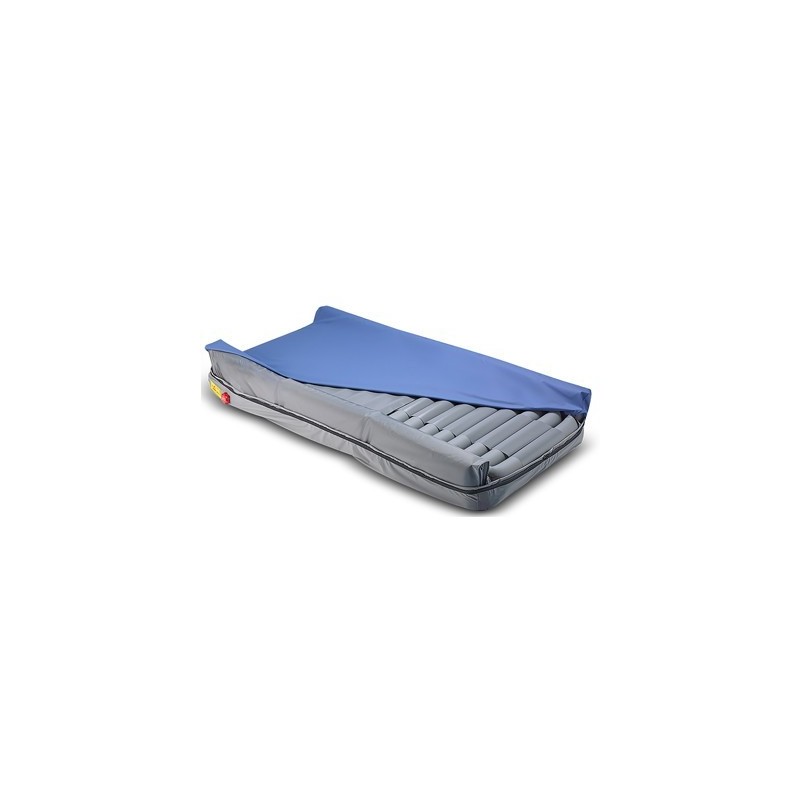


The Optima Turn Rotational Active Mattress is a premium three-mode replacement system delivering lateral turning therapy to 30 degrees bilaterally, alternating pressure with 10-25 minute selectable cycle times, and continuous low-pressure therapy within a single system. The lateral rotation function mechanically repositions the resident to reduce manual carer handling frequency in high-dependency settings. Heel relief and sacral support modes address the highest-risk secondary sites. Electronic pressure control includes alarms, lockout, and transport mode. SWL 180kg. VP, water-resistant, flame-retardant cover for fully profiling beds at high to very high NICE CG179 risk.
| Specification | Detail |
|---|---|
| Type | Alternating pressure replacement mattress with lateral turning |
| Therapy Modes | Lateral turning (up to 30 degrees bilateral); alternating (10-25 min); continuous low-pressure |
| Heel Relief | Dedicated heel offloading mode (independent of main cycle) |
| Sacral Support | Enhanced sacral mode for seated and semi-recumbent positions |
| Pressure Control | Electronic - fast inflation, audible/visual alarms, lockout function |
| Cover | Low-friction vapour-permeable water-resistant flame-retardant |
| Safe Working Load | 180kg (28 stone) |
| Transport Mode | Included for inter-site transfer |
| Reference | NCL-HR800 |
| Clinical Standard | NICE CG179 (high to very high risk; repositioning support) |
The Optima Turn Rotational Active Mattress is a Class IIa active medical device under Medical Devices Regulation 2017/745. Clinical selection requires validated pressure risk assessment per NICE CG179 at high to very high risk, with a documented clinical rationale for lateral turning therapy, typically the inability to tolerate or safely receive manual repositioning at the required frequency. SWL of 180kg must be verified against the resident's documented weight before deployment under MHOR 1992. The lockout function must be activated before deployment to prevent unauthorised adjustment of therapy settings. Alarms must be confirmed operational at each deployment. The flame-retardant VP cover meets institutional fire safety and NHS IPC requirements. Equipment register records and MDR conformity documentation must be maintained for CQC Regulation 12 compliance.
Who is the Optima Turn indicated for, and when does lateral turning therapy become clinically appropriate?
The Optima Turn is indicated for residents at high to very high pressure risk who cannot be manually repositioned at the frequency required by their NICE CG179 repositioning plan. This may be because the manual handling risk to care staff of frequent turning is unacceptable under MHOR 1992 risk assessment, because the resident's clinical condition makes manual repositioning painful or medically contraindicated, or because staffing levels in the care setting cannot support two-hourly manual turns consistently across a 24-hour period. Lateral turning therapy provides the repositioning benefit mechanically, reducing the cumulative manual handling burden on the care team while maintaining the turning protocol required by the pressure care plan. The system is also appropriate for residents with complex respiratory conditions where positional changes affect ventilation, as the degree and timing of the lateral rotation can be precisely controlled in a way that manual turning cannot achieve. The prescribing clinician must document the specific clinical rationale for lateral turning therapy rather than manual repositioning or standard alternating therapy alone.
What is continuous low-pressure therapy and when is it selected over alternating therapy?
Continuous low-pressure therapy maintains all air cells at a consistent low inflation pressure simultaneously, rather than alternating between inflated and deflated cells on a cycle. The effect is to reduce the overall interface pressure between the resident and the mattress surface to the lowest level that still maintains the resident above the bed base, rather than dynamically offloading different zones in sequence. Continuous low-pressure is clinically selected when a resident cannot tolerate the movement associated with the alternating cycle, such as those with severe pain from complex wounds, fractures, or spinal instability where the cell inflation movement is distressing or contraindicated. It is also used during periods of very high skin fragility where the mechanical action of the alternating cycle poses a shear risk at damaged skin sites. The Optima Turn allows switching between all three therapy modes without interrupting the system, giving the care team the flexibility to match the therapy to the resident's changing condition across the care episode.