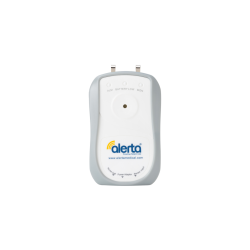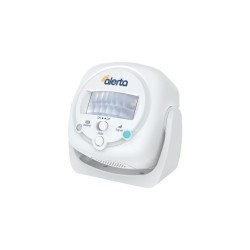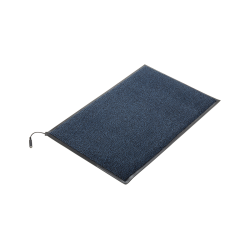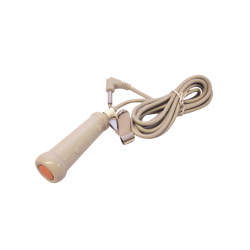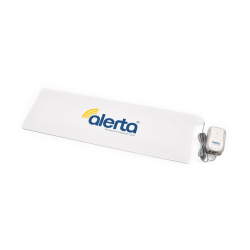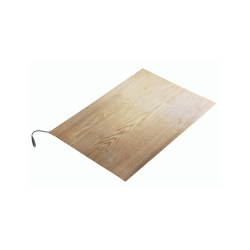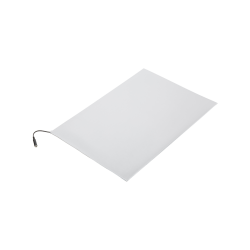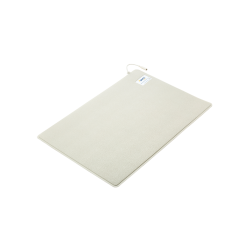
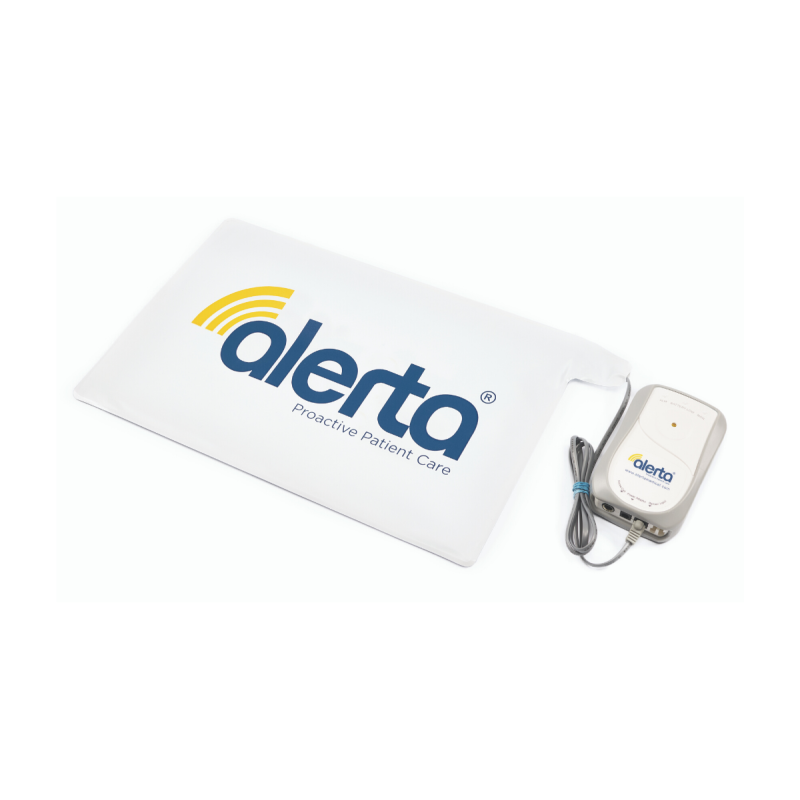


The Wired Chair Alertamat is a 25x38cm antibacterial sensor mat for placement beneath a seat cushion, triggering an alert when a patient rises from the chair and automatically resetting when they return. Supplied complete with the Alerta Alarm Monitor - providing standalone in-room alerting with high, low and silent volume settings, multiple alarm tone options and adjustable 0, 2 or 4-second delay - the system connects via a 2m cable to the nurse call system for centralised alerting or operates independently through the included Alarm Monitor where nurse call infrastructure is not available at the monitoring location. Wired connection requires no pairing, no transmitter battery and no RF signal verification.
| Specification | Detail |
|---|---|
| Product Code | NCL-CAM |
| Mat Dimensions | 25 x 38 cm |
| Placement | Beneath seat cushion |
| Alert Trigger | Pressure release - patient rises; auto-reset on return |
| Surface | Antibacterial, wipe-clean |
| Cable | 2 metres - nurse call or Alarm Monitor connection |
| Alarm Monitor | Included - standalone alerting without nurse call |
| Delay Settings | 0, 2 or 4 seconds (adjustable) |
| Volume Settings | High, low, silent |
| Alarm Tones | Multiple options |
| Monitor Power | Mains adaptor or 1x 9V battery |
| Battery Warning | Low battery indicator |
NICE Guideline NG147 (Falls in Older People) identifies unassisted rising from a chair as a high-risk fall event for patients with orthostatic hypotension, lower limb weakness or dementia-related gait impairment who may fall during the sit-to-stand transition. The Wired Chair Alertamat provides the pre-emptive alert that enables carers to supervise or assist the patient during this transition. CQC Regulation 12 (Safe Care and Treatment) requires active mitigation of identified fall risk: for patients where the chair exit transition is documented as a high-risk moment in the individual's falls assessment, the Chair Alertamat is a recognised monitoring intervention that directly addresses the identified risk. CQC Regulation 10 (Dignity and Respect) is supported by the discreet under-cushion placement that keeps monitoring invisible to the patient and to visitors - the alert is received by staff without visible equipment on the chair surface disrupting the normal appearance of the care environment.
Can the Wired Chair Alertamat be transferred between different chairs as the patient moves during the day, and how quickly can it be repositioned?
Yes. The Wired Chair Alertamat is designed for placement and repositioning as needed. Moving the mat between chairs - for example from a bedroom armchair to a lounge chair as the patient moves through their daily routine - requires disconnecting the 2m cable from the nurse call socket or Alarm Monitor, lifting the mat from beneath the cushion, repositioning it in the new chair beneath its cushion, and reconnecting the cable to the nearest nurse call socket or repositioned Alarm Monitor. The process takes a few seconds per move. In care settings where the patient moves between multiple chairs during the day, the monitoring plan should specify which chair locations require monitoring and at which times, so the mat is consistently positioned at the relevant location. If continuous monitoring across multiple seating locations is required, a wireless Chair Alertamat may be operationally more convenient as it does not require cable reconnection at each new location.
Does the Wired Chair Alertamat work correctly on a heated seat pad, pressure-relieving cushion or memory foam seat?
The Wired Chair Alertamat should be placed between the chair seat surface and the bottom of the cushion, beneath any pressure-relieving cushion rather than within it. On a heated seat pad, confirm that the mat's placement does not cover the heated element in a way that could cause overheating of either the mat or the cushion. On pressure-relieving or memory foam cushions, the mat is placed between the cushion base and the chair seat - not within the cushion structure. The mat sensor requires sufficient weight from the patient's seated position to maintain the circuit. On very thick, high-compression memory foam cushions that significantly redistribute seated weight, test that the sensor reliably detects patient departure before routine monitoring use: if weight redistribution through the cushion reduces the pressure on the mat to below the detection threshold when the patient is seated, the mat may not detect the departure reliably.
Part of our comprehensive Patient Sensor Alarms range. Wired patient alarms deliver reliable, continuous fall prevention monitoring for care home residents and nursing home patients.