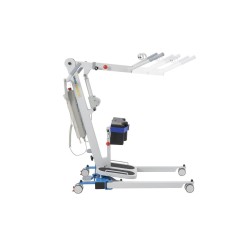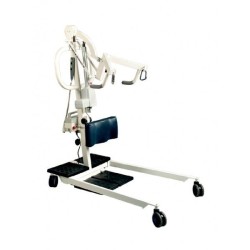
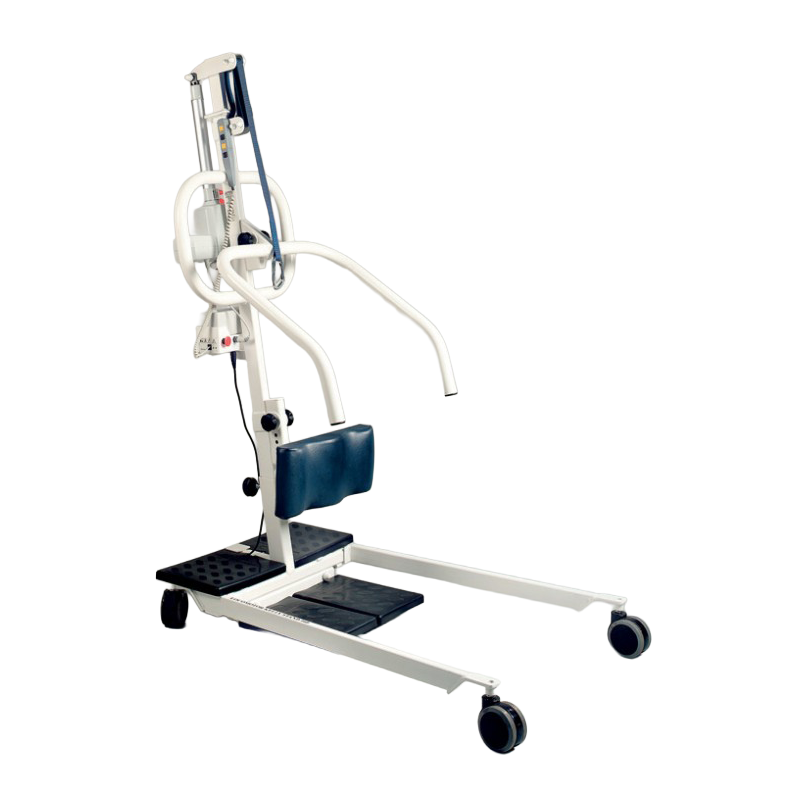

The Kelly Stand is a powered patient standing aid designed for care homes, hospitals and clinical settings where patients require assisted standing for transfers, toileting, dressing and rehabilitation without manual lifting by carers. At 203kg (32 stones) safe working load with powered raising, lowering and leg-opening, the Kelly Stand covers the full patient weight range typically encountered in residential and acute care settings. The unique push-down handlebar design is based on the natural biomechanical action used when rising from a chair; patients instinctively push down to assist their own standing, making the handlebar geometry feel natural and reducing the powered lift load required. The height-adjustable shin pad supports the patient's shins in the correct position during the standing sequence, and the actuator life counter tracks operational cycles for planned maintenance.
| Specification | Detail |
|---|---|
| Device Type | Powered patient standing aid |
| Maximum SWL | 203kg (32 stones) |
| Powered Functions | Raising, lowering, leg-opening |
| Handlebars | Unique push-down design for natural standing action |
| Shin Pad | Height-adjustable |
| Maintenance Feature | Actuator life counter |
| Primary Use | Transfers, toileting, dressing, rehabilitation in care environments |
| Product Code | NCL-LOCO-124 |
The Kelly Stand is subject to LOLER 1998 as equipment used to lift people, requiring 6-monthly thorough examination by a competent person and retention of written examination reports. CQC Regulation 12 (Safe Care and Treatment) requires that LOLER examination records are maintained. The actuator life counter directly supports CQC Regulation 17 (Good Governance) by providing a documented operational cycle count that informs planned maintenance scheduling; the counter makes it possible to demonstrate proactive equipment governance to CQC inspectors rather than reactive maintenance after failure. MHOR 1992 (Manual Handling Operations Regulations) is addressed by the powered raising, lowering and leg-opening, which eliminates the manual handling components of standing transfers for carers. CQC Regulation 10 (Dignity and Respect) is supported by the standing position itself: standing for toileting, dressing and position changes maintains a more dignified care routine than bed-based alternatives and promotes circulation, which is relevant to NICE CG179 (Pressure Ulcer Prevention).
What is the difference between the Kelly Stand and a mobile transfer hoist?
The Kelly Stand is a powered standing aid for patients who retain sufficient residual leg strength or weight-bearing capacity to stand with powered assistance. A mobile transfer hoist (such as the Powerlifter range) uses a sling to fully support a non-weight-bearing patient and lift them clear of a surface for relocation. The Kelly Stand is used where the patient can bear weight on their legs and the clinical goal is to achieve a standing position for functional activities (toileting, dressing, rehabilitation); the transfer hoist is used where the patient cannot bear weight and needs to be lifted and moved between surfaces. An OT or physiotherapist assessment confirms which device is appropriate for each patient.
How does the actuator life counter support LOLER 1998 and CQC Regulation 17 compliance?
The actuator life counter records the number of powered operational cycles the Kelly Stand has completed. Manufacturer guidance specifies the maximum cycle count before actuator servicing or replacement is required. By tracking the cycle count, care homes can schedule proactive servicing before the actuator reaches its end-of-service-life limit, rather than waiting for a failure. This supports CQC Regulation 17 (Good Governance) by providing documented evidence of a planned equipment maintenance programme, and supports LOLER 1998 by enabling the competent person carrying out the 6-monthly thorough examination to assess whether an actuator service is due based on the counter reading.
Part of our specialist Patient Moving and Handling Equipment range. Patient stand aids support safe assisted standing and rehabilitation in care homes and NHS settings.