
Patient Stand Aids
Patient stand aids for assisted sitting-to-standing and standing transfers in care homes and NHS settings, supporting patients with partial weight-bearing ability to participate actively in transfers while reducing carer manual handling effort.
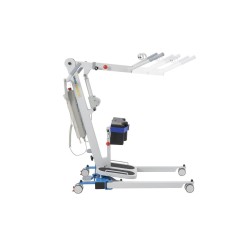
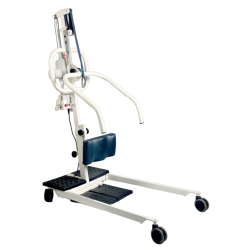
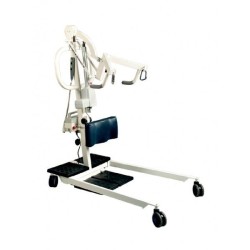
Patient Stand Aids for Assisted Sit-to-Stand and Standing Transfers
Clinical Summary: Patient stand aids support sit-to-stand and standing transfers for patients with partial weight-bearing ability who can actively contribute to the transfer but require additional support and guided movement. They are the appropriate handling solution between the manual-assist and full-hoist-dependency range, reducing carer physical effort during transfers while encouraging patient active participation and maintaining residual lower limb strength and standing function.
Patient Stand Aid Types
- Passive Stand Aids: Powered stand aids where the patient is supported in a sling attached to a powered mast that guides and supports the standing movement, suitable for patients with very limited active contribution but some weight-bearing ability insufficient for a standard pivot transfer.
- Active Stand Aids: Stand aids with handle and knee support that the patient uses to push up from sitting, providing guided upper limb and knee support during the active standing movement without a suspension sling, suited to patients with greater residual lower limb strength and coordination.
- Sara Stedy and Walking Frame Hybrids: Combined stand aid and walking frame devices allowing the patient to stand from sitting and then walk short distances with the device as a support frame, supporting rehabilitation goals alongside safe transfer function. Requires occupational therapy or physiotherapy assessment to confirm appropriate patient selection.
- Bariatric Stand Aids: High-capacity stand aids rated from 200kg to 300kg for bariatric patients with partial weight-bearing ability, with reinforced frames and wider base dimensions for stable standing support at higher patient weights.
Clinical Compliance and LOLER Standards
Patient stand aids with a suspension sling element are subject to LOLER 1998 as lifting equipment and require six-monthly thorough examination. Active stand aids without a suspension function may be classified as work equipment under PUWER 1998 rather than lifting equipment under LOLER, depending on their mechanical configuration — the manufacturer classification should be confirmed at procurement to establish the correct inspection regime. All patient stand aids require individual patient assessment confirming weight-bearing status, ability to follow instructions, and upper limb strength before specification, and must be included in the documented manual handling plan with staff training in correct use technique.
| Stand Aid Type | Patient Requirement | Inspection Regime | Key Standard |
|---|---|---|---|
| Passive Stand Aid | Partial weight-bearing, limited active | LOLER 6-monthly | LOLER 1998 / MHOR 1992 |
| Active Stand Aid | Partial weight-bearing, active | PUWER / manufacturer | MHOR 1992 / PUWER 1998 |
| Walking Frame Hybrid | Standing with short ambulation | PUWER / manufacturer | MHOR 1992 / NICE CG161 |
| Bariatric Stand Aid | Partial weight-bearing, 200kg+ | LOLER or PUWER by type | MHOR 1992 / MHRA |
Frequently Asked Questions
Q: Are patient stand aids subject to LOLER inspection?
A: Patient stand aids with a suspension sling element that supports part or all of the patient weight during lifting are subject to LOLER 1998 as lifting equipment, requiring six-monthly thorough examination. Active stand aids where the patient bears their full weight through their own legs and uses the device only for balance support may be classified under PUWER 1998 instead. Confirm the manufacturer classification at procurement and apply the appropriate inspection regime with documented records retained for CQC.
Q: What patient assessment is needed before a stand aid is used?
A: Individual assessment by an occupational therapist or physiotherapist should confirm weight-bearing status, lower limb strength, ability to follow instructions during the transfer, and upper limb grip strength before a stand aid is specified. The assessment outcome should be documented in the manual handling plan with the specific stand aid model, transfer technique, number of carers, and any specific precautions. Staff involved in stand aid transfers must be trained in the correct technique for that specific device and patient.