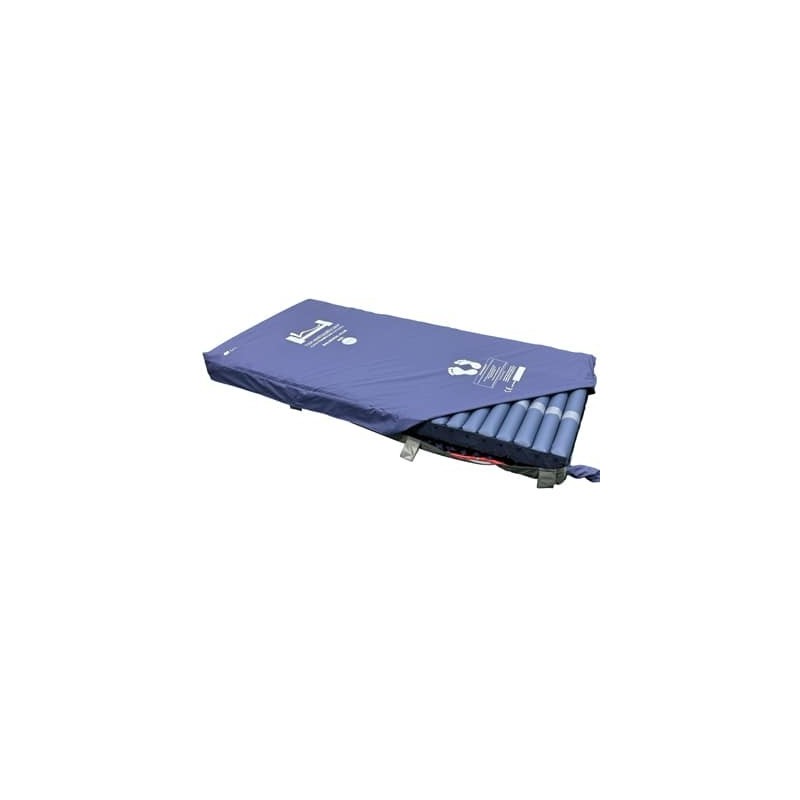


The Balmoral Plus Active Mattress is Harvest Healthcare's most advanced replacement pressure care system, adding a three-part static air cell mat to the Balmoral II specification for accelerated CPR deflation in cardiac arrest scenarios. The 23 alternating pure PU cells and 4 static pillow cells provide very high-risk pressure redistribution on a 50mm foam base, with the three-part static mat deflating as a rapid single unit when the CPR valve is activated. The 24-hour transport cap supports inter-site transfer continuity. Bed rail compliant for all UK profiling beds. SWL up to 254kg with Harvest 3 pump.
| Specification | Detail |
|---|---|
| Type | Alternating pressure replacement mattress |
| Air Cells | 23 alternating PU cells + 4 static pillow cells (27 total) |
| CPR Feature | Three-part static air cell mat for rapid resuscitation deflation |
| Foam Base | Integrated 50mm foam layer |
| Cover | 4-way stretch welded PU - VP, water resistant, Crib 5 |
| Transport Cap | Retains air up to 24 hours during transfer |
| Bed Rail Compliance | All UK profiling beds |
| Pump Compatibility | Harvest 2 (184kg); Harvest 250 (200kg); Harvest 3 (254kg) |
| Reference | NCL-HAMBALM004 |
| Warranty | 3 years |
| Clinical Standard | NICE CG179 (very high risk and stage 4 pressure care) |
The Balmoral Plus Active Mattress is a Class IIa active medical device under Medical Devices Regulation 2017/745. Clinical selection requires validated pressure risk assessment confirming very high-risk status per NICE CG179, or the presence of an existing stage 3 or 4 pressure injury. SWL verification and pump selection must be documented before deployment per MHOR 1992. The three-part static air mat and CPR valve must be tested and confirmed operational on each deployment, with testing recorded in the equipment maintenance log. The Crib 5 cover meets BS 5852 institutional fire safety requirements. Equipment register documentation and MDR conformity records must be maintained for CQC Regulation 12 readiness.
What is the three-part static air cell mat, and how does it differ from a standard CPR valve deflation?
A standard CPR valve on an alternating mattress deflates the entire cell system when activated, which empties all air cells simultaneously and allows the resident to descend onto the foam base as the cells deflate progressively. This process takes longer than ideal for resuscitation and leaves a soft, partially deflated surface rather than a firm one during the first moments after activation. The three-part static air cell mat in the Balmoral Plus is a discrete section of the mattress designed to deflate as a single rapid unit when the CPR valve is activated, converting the relevant surface section to a firm platform almost immediately while the alternating cells complete their deflation separately. This gives the resuscitation team a firm, stable chest compression surface within the critical response window, without requiring mattress removal. Care staff must be trained in the CPR valve location and operation sequence, and this training must be documented in the care setting's emergency response records.
When should the Balmoral Plus be selected over the Balmoral II, and is the three-part static mat the only clinical difference?
The Balmoral Plus is clinically preferred over the Balmoral II in any setting where the speed of CPR surface access is a heightened priority, particularly in high-dependency care where residents have complex cardiac or respiratory conditions that increase the statistical likelihood of arrest events. The three-part static mat provides a faster firm surface for chest compressions than the CPR valve deflation alone, which is the mechanism by which the Balmoral Plus improves resuscitation response over the Balmoral II. In terms of pressure care performance, cell count, SWL, pump compatibility, and transport cap specification, both mattresses are identical. The decision between them is therefore primarily driven by the resident's clinical risk profile, the care setting's resuscitation response policy, and whether the marginal improvement in CPR access speed is clinically indicated for that specific care environment.