
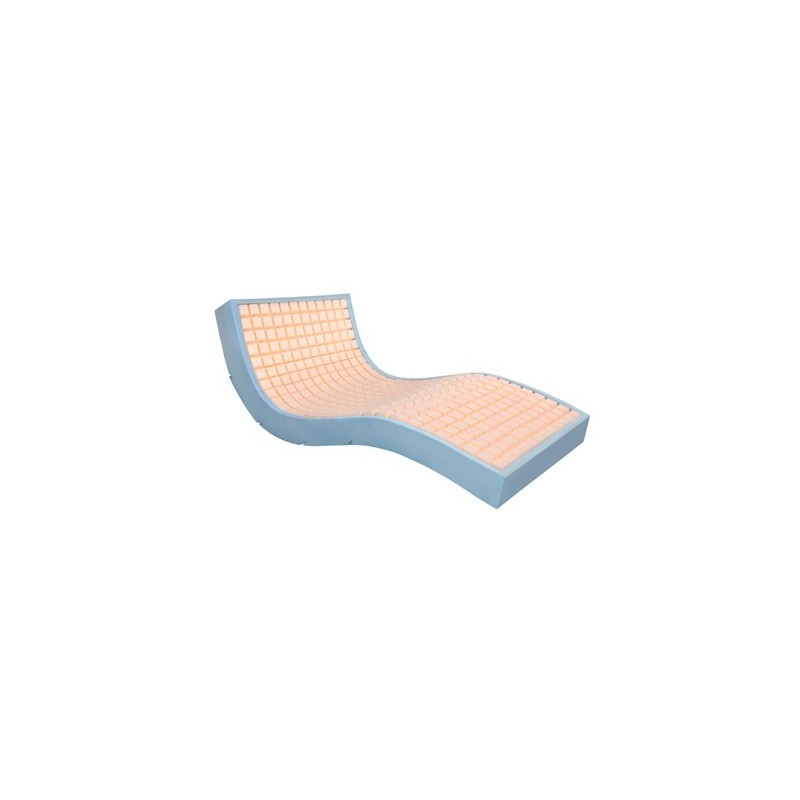


The Kinetic Air Hybrid Mattress provides high-risk pressure redistribution without an electric pump, using internal air channels and responsive valves to redistribute air in response to the resident's weight and movement. The castellated viscoelastic foam top layer conforms to body contours and maintains heat and moisture vapour dissipation channels between the castellations. The high-resilience foam base and walls provide structural support and transfer edge stability. The 2-way stretch VP welded PU cover supports NHS IPC decontamination. SWL 247kg. Suitable for fully profiling beds at high risk per NICE CG179.
| Specification | Detail |
|---|---|
| Type | Non-powered hybrid - air displacement with responsive valves |
| Top Layer | Castellated viscoelastic foam |
| Base and Walls | High-resilience foam for structural support |
| Pressure Mechanism | Internal air channels and responsive valves (no pump required) |
| Cover | 2-way stretch VP PU - waterproof, welded seams |
| Dimensions | 2000 x 900 x 150mm |
| Safe Working Load | 247kg (39 stone) |
| Pump Required | None |
| Bed Compatibility | Suitable for fully profiling beds |
| Reference | NCL-HFK100 |
| Clinical Standard | NICE CG179 (high-risk pressure care) |
The Kinetic Air is a Class I passive medical device under Medical Devices Regulation 2017/745. Clinical selection requires validated pressure risk assessment per NICE CG179 confirming high-risk status. SWL must be verified against the resident's documented weight before deployment per MHOR 1992. The absence of a pump eliminates pump-specific alarm, calibration, and power supply requirements, but the mattress cover and internal air channels must be inspected during routine decontamination to confirm that the valves are functional and that the cover has no splits or perforations. Equipment register documentation and MDR conformity records must be maintained for CQC Regulation 12 compliance.
How does air displacement technology provide pressure redistribution without a pump?
Air displacement technology uses a closed internal air system within the mattress structure where air can move freely between zones through channels and responsive valves, but cannot escape from the mattress. When the resident lies on the mattress, their body weight compresses the air in the cells or channels beneath the body prominences, raising the air pressure in those zones above the pressure in the unsupported zones. The responsive valves allow this excess pressure to flow through the air channels from the high-pressure zones beneath the body to the lower-pressure zones around the body, redistributing the air until pressure equilibrium is approached. As the resident shifts position - rolling slightly, changing limb position, breathing - the load pattern on the mattress changes, triggering further valve-mediated redistribution. The mechanism is continuous and passive, providing redistribution proportional to the load applied without requiring a timed cycle or operator-set pressure level. The clinical performance is pressure redistribution proportional to the resident's movement and position, which differs from the fixed-cycle time offloading of a powered alternating system.
When is the Kinetic Air preferred over a powered alternating mattress for a high-risk resident?
The Kinetic Air is preferred in clinical situations where the absence of a pump is itself a clinical advantage. In community settings where reliable electrical supply at the bedside is not available or where the resident or family is unable to manage a pump and its alarm system, a non-powered system eliminates these barriers to effective pressure care. For residents who are light sleepers or highly noise-sensitive, the complete absence of pump mechanical noise is a clinical benefit that improves sleep quality and reduces the cumulative fatigue and skin perfusion impairment associated with disrupted sleep. For settings where nursing staff cannot be available to respond promptly to pump alarms overnight, the Kinetic Air removes the alarm management burden entirely. The trade-off is that air displacement technology provides passive redistribution proportional to the resident's movement rather than the active fixed-cycle offloading of a powered alternating system; for residents who are completely immobile and generate no spontaneous movement to drive the valve mechanism, a powered alternating mattress provides more reliable clinical performance.
