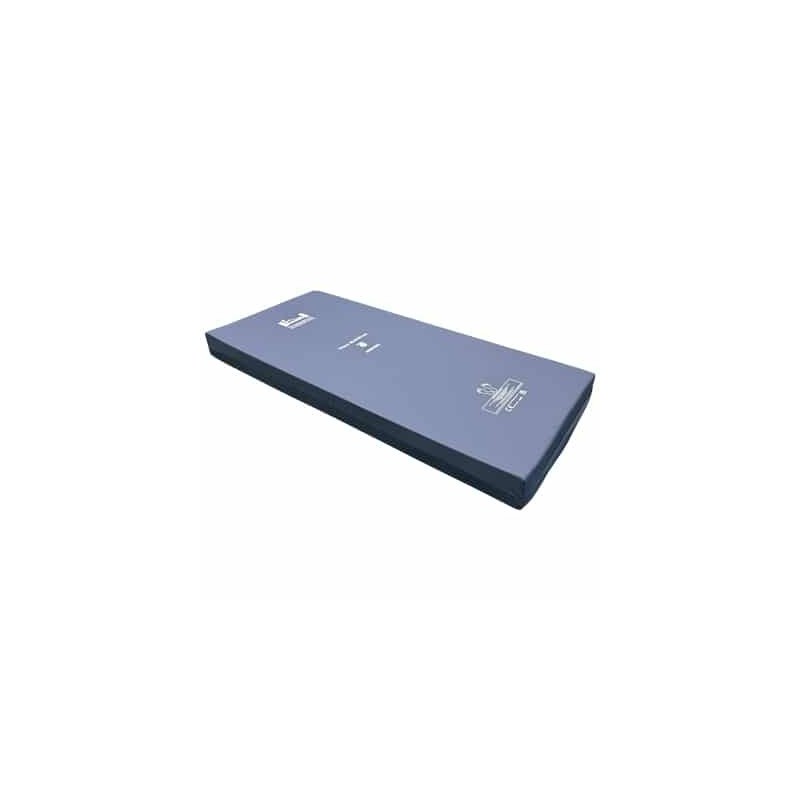


The Visco MultiZone Static Mattress provides very high-risk pressure redistribution using strategically zoned viscoelastic foam of varying densities, targeting immersion and envelopment at the highest-risk anatomical sites. It is clinically indicated for residents at very high risk of pressure ulceration and is suitable for use with existing Grade 2 pressure damage, offering a static alternative to powered alternating systems where those are contraindicated or where high-performance static immersion is the appropriate clinical choice. HR foam base; 4-way stretch VP welded PU cover; 177kg SWL. 2000 x 900 x 150mm; 3-year warranty.
| Specification | Detail |
|---|---|
| Top Layer | Zoned multi-density viscoelastic foam |
| Base | High-resilience foam |
| Cover | 4-way stretch VP PU - water resistant, welded seams |
| Dimensions | 2000 x 900 x 150mm |
| Safe Working Load | 177kg (27 stone) |
| Clinical Risk Level | Very high risk; Grade 2 pressure damage capable per NICE CG179 |
| Reference | NCL-HSMVMZ |
| Warranty | 3 years |
The Visco MultiZone is a Class I passive medical device under Medical Devices Regulation 2017/745. Clinical selection at very high risk requires validated pressure risk assessment per NICE CG179. For residents with existing Grade 2 pressure damage, the prescribing clinician must document the clinical rationale for static rather than active pressure management and schedule reassessment at regular intervals to confirm the static approach continues to meet the resident's clinical need. SWL must be verified at 177kg before deployment per MHOR 1992. The VP welded cover meets NHS IPC decontamination requirements. Equipment register records and MDR conformity documentation must be maintained for CQC Regulation 12 compliance.
What is the clinical difference between immersion and envelopment, and why does the Visco MultiZone use zoned rather than uniform visco foam?
Immersion refers to the depth to which the body sinks vertically into the mattress surface under gravitational load - a deeper sinking position increases the contact area between the body surface and the mattress. Envelopment refers to the degree to which the mattress conforms laterally around the body contours, including the sides of bony prominences and the spaces between them. Both mechanisms increase contact area, which distributes the resident's weight across more surface and reduces peak interface pressure per unit area. Uniform visco foam throughout the mattress would provide high immersion and envelopment everywhere equally, which would reduce postural stability at the sides and edges where firm support is clinically important. Zoned foam addresses this by placing the highest-density visco foam at the sacral, heel, and occipital zones where pressure redistribution is the clinical priority, and retaining firmer foam at the lateral edges, head section, and foot section where structural support and postural stability are required. The MultiZone design achieves both objectives simultaneously within a single static surface.
When should the Visco MultiZone be selected over a powered alternating mattress for a very high-risk resident?
NICE CG179 does not mandate a powered alternating mattress for all very high-risk residents; the decision between static and active pressure management is a clinical judgement based on the individual resident's circumstances. The Visco MultiZone is appropriate as the primary pressure surface when: the resident has a medical or pain condition that makes the movement of alternating cells intolerable or contraindicated; the care setting cannot manage pump monitoring, alarms, or calibration reliably; the cost and logistics of powered equipment are prohibitive for a community deployment; or the clinician's assessment is that high-performance static immersion provides equivalent clinical benefit for that specific resident's body habitus, mobility, and skin condition. For residents with Grade 3 or 4 pressure injuries or for those assessed as very high risk with limited mobility and no contraindication to active therapy, a powered alternating mattress remains the recommended first-line approach. The Visco MultiZone should not be used as the default very high-risk option without documented clinical rationale for choosing static over active management.