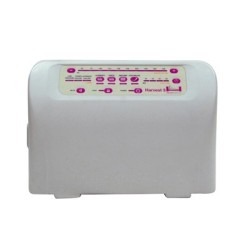
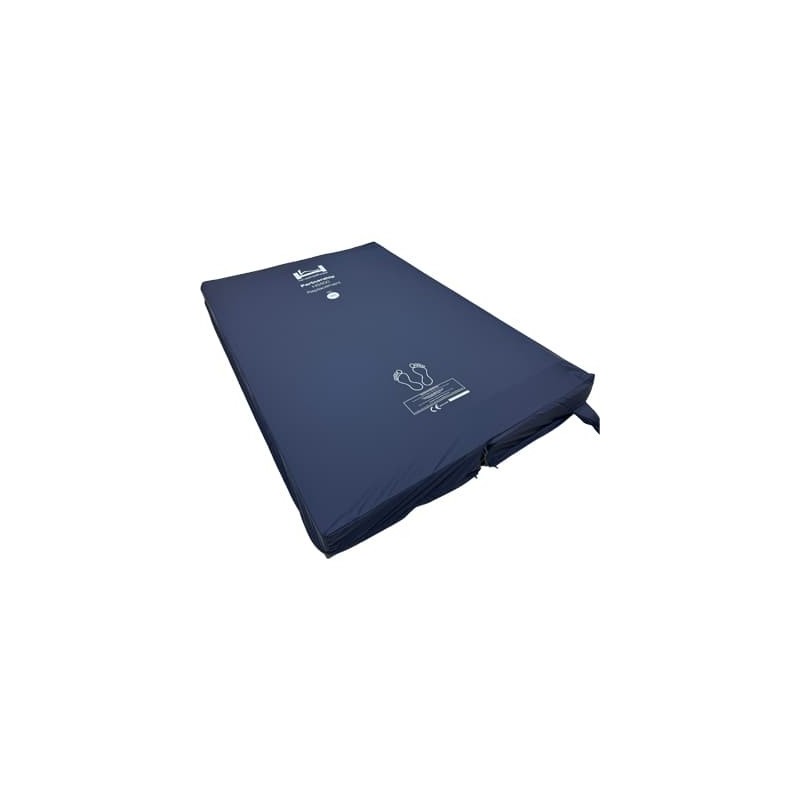


The Partnership Active Mattress by Harvest Healthcare is a uniquely configured double-sided system for couples sharing a bed where one partner requires active alternating pressure therapy. One side provides viscoelastic foam for static comfort; the other provides 15 alternating air cells on a 10-minute cycle for the resident at high pressure risk. Electronic pressure control and timed static mode support personalised therapy management. CPR valve enables emergency deflation; removable cell structure supports full decontamination. Compatible with Harvest 1 and 2 pumps. SWL 158kg on the active side. Bedrail compliant for Woburn Ultimate 1400.
| Specification | Detail |
|---|---|
| Type | Dual-sided double mattress - alternating and viscoelastic |
| Active Side | 15 independent alternating air cells (10-min cycle) |
| Passive Side | Viscoelastic foam for static comfort |
| Pressure Control | Electronic with timed static mode |
| Cover | 4-way stretch welded PU - VP, water resistant, Crib 5 |
| Emergency Feature | CPR valve; removable cell structure for decontamination |
| Safe Working Load | 158kg / 25 stone (active side) |
| Pump Compatibility | Harvest 1 and 2 pumps |
| Bed Compatibility | Woburn Ultimate 1400; divan beds |
| Reference | NCL-HS500 |
| Clinical Standard | NICE CG179 (high-risk pressure care) |
The Partnership Active Mattress is a Class IIa active medical device under Medical Devices Regulation 2017/745. Clinical selection requires validated pressure risk assessment per NICE CG179 for the resident using the active side, confirming high-risk status. SWL of 158kg applies to the resident on the active air cell side only and must be verified before deployment under MHOR 1992. The removable cell structure must be decontaminated between residents in line with NHS IPC requirements for active mattress systems. The Crib 5 welded PU cover meets BS 5852 fire safety requirements for residential and care settings. Equipment register documentation, SWL verification, and MDR conformity records must be retained for CQC Regulation 12 compliance.
Does the alternating motion on the active side disturb the partner sleeping on the viscoelastic side?
The dual-zone design specifically addresses this concern. The viscoelastic foam on the partner side is a static, independent section that does not share the alternating cell infrastructure with the active side; the foam does not move, pulse, or vibrate as a result of the air cell inflation and deflation cycle on the adjacent side. The transition between the two zones is designed to minimise motion transfer, and the low-noise TPU cell design further reduces acoustic disturbance. In practice, the alternating cycle creates low-level vibration that is localised to the active side; most partners adapt to this as they would to any background noise in a shared sleeping environment. For couples where one partner is a very light sleeper or has sleep-related conditions that make any movement disturbance clinically problematic, the prescribing clinician should consider whether a separate sleeping arrangement is more appropriate; however, for the majority of couples where one partner requires pressure care, the Partnership provides an effective solution that preserves the social and psychological benefit of shared sleeping.
Can the Partnership mattress be used in a standard double divan bed, and is the bed rail compliance relevant for home use?
Yes. The Partnership is suitable for divan-style beds in community and residential settings, where the absence of a profiling bed frame means that bed rail compliance in the standard profiling bed sense is not the relevant consideration. For divan use in a home setting, the mattress should be confirmed as fitting the divan base dimensions and the cover should be inspected before each use to confirm the wipe-clean surface remains intact. Bed rail compliance for the Woburn Ultimate 1400 applies to care home or residential settings where that specific profiling bed is in use. In either setting, the SWL of 158kg applies to the active side resident and must be verified before use. The divan suitability makes the Partnership particularly relevant for community-based care where a couple at home requires pressure therapy for one partner without the clinical environment of a profiling bed, and where the goal is to maintain the couple's shared living arrangements for as long as clinically appropriate.