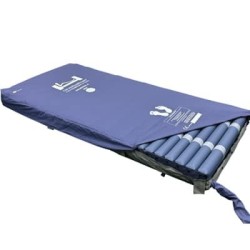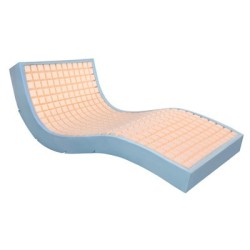
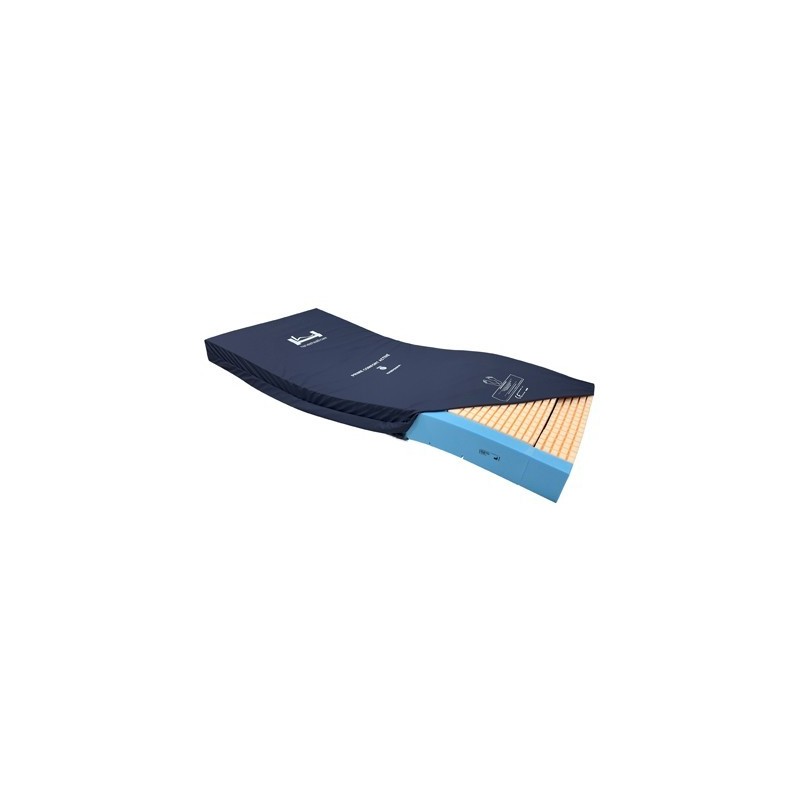

The Prime Comfort Active Mattress is a hybrid system that functions as a static pressure care mattress when unpowered and as an active alternating mattress when connected to a Harvest 1 or 250 pump. The U-shaped HD foam base provides roll prevention and transfer edge support; the castellated central foam insert maintains passive pressure redistribution and skin microclimate management independently of the alternating cycle. The step-up or step-down design follows the resident's changing clinical condition without requiring a mattress change. 4-way stretch welded VP PU cover, Crib 5, antibacterial. SWL 247kg. Bed rail compliant for Woburn, Woburn Low, Community, Community Low. 3-year warranty.
| Specification | Detail |
|---|---|
| Type | Hybrid - static (unpowered) or active alternating (pumped) |
| Air Cells | 10 alternating cells (active when pump connected) |
| Foam Base | U-shaped HD foam for roll prevention and transfer edge support |
| Central Foam | Castellated foam insert for passive redistribution and airflow |
| Dimensions | 2000 x 900 x 140mm |
| Weight | 9kg |
| Safe Working Load | 247kg (39 stone) |
| Cover | 4-way stretch welded VP PU - antibacterial, water resistant |
| Pump Compatibility | Harvest 1 and Harvest 250 |
| Bed Rail Compliance | Woburn, Woburn Low, Community, Community Low |
| Reference | NCL-HHMPRIMA |
| Warranty | 3 years |
| Clinical Standard | NICE CG179 (very high risk - active; high risk - static) |
The Prime Comfort Active Mattress is a Class IIa active medical device under Medical Devices Regulation 2017/745 when operated with a pump, and a Class I passive pressure redistribution device when used in static mode. Clinical selection must follow occupational therapist or nurse assessment per NICE CG179, with the operating mode (static or active) matched to the assessed risk level. SWL must be verified against the resident's documented weight before deployment per MHOR 1992. Bed rail compliance for the four listed frame types has been confirmed under MHRA guidance. Equipment register records must capture whether the mattress is deployed in static or active mode, with the pump serial number recorded when connected. MDR conformity documentation must be retained for CQC Regulation 12 readiness.
What is step-up and step-down functionality and how does it benefit care planning?
Step-up functionality refers to the ability to add pump-powered alternating therapy to a mattress that is already in place as a static surface when the resident's clinical condition deteriorates and higher-level pressure care is required. Step-down refers to the reverse: removing pump-powered alternating therapy when the resident's condition improves and returning the mattress to static mode. The Prime Comfort Active supports both transitions because it functions clinically as either a static or active mattress depending on whether the pump is connected. In practical care terms, this means that when a resident's Waterlow score increases following illness, reduced mobility, or deteriorating skin condition, the clinical team can step up from static to active therapy by connecting a Harvest 1 or 250 pump to the mattress already in the bed, without requiring a mattress change, bed disruption, or a period without pressure care during the transition. The reverse step-down is equally manageable. This avoids the clinical risk and logistical cost of mattress changes at critical transitions in the resident's condition.
What is the clinical role of the U-shaped foam base and how does it differ from a standard flat foam base?
A standard alternating mattress base is typically a flat foam layer beneath the air cells, providing a firm platform that prevents contact with the bed base during the deflation phase of the alternating cycle. The U-shaped base of the Prime Comfort Active adds a raised foam profile along the sides and across the head and foot of the mattress, in addition to the flat supporting base. This U-profile serves two functions. First, roll prevention: the raised foam sides create a gentle lateral containment effect that reduces the risk of a resident with reduced trunk control rolling toward the mattress edge during the night, which reduces bed rail dependency in lower-risk settings. Second, transfer edge support: the firm U-profile at the mattress edge provides a stable surface for a resident to sit on when pivoting from lying to sitting as part of a transfer sequence; a soft-edged alternating mattress without the U-profile compresses under the resident's weight at the edge, reducing the stability of the sitting position and increasing transfer risk.