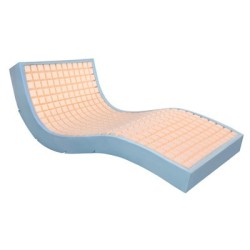
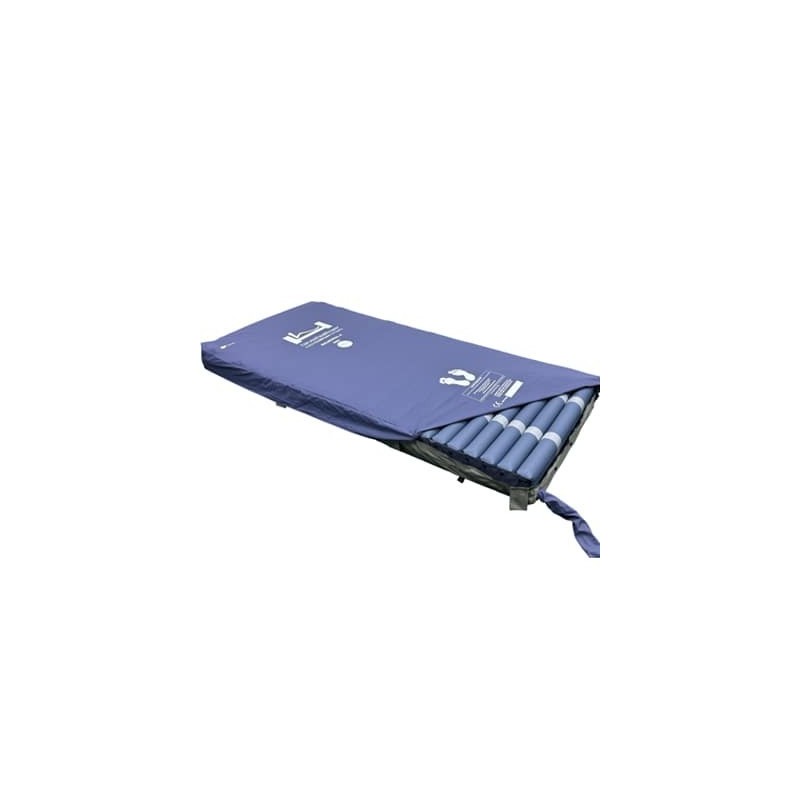


The Balmoral II Active Mattress by Harvest Healthcare is a 27-cell alternating pressure replacement system for residents at very high risk of pressure ulceration or those with existing stage 4 pressure injuries. The 23 alternating pure PU air cells provide quiet, durable continuous pressure redistribution supported by a 50mm foam base. The transport cap retains air for up to 24 hours for safe inter-site transfer. The CPR valve allows immediate emergency deflation. Compliant with UK bed rail regulations across all UK profiling beds. Compatible with Harvest Pumps 2, 250, and 3 with SWL up to 254kg.
| Specification | Detail |
|---|---|
| Type | Alternating pressure replacement mattress |
| Air Cells | 23 alternating PU cells + 4 static pillow cells (27 total) |
| Foam Base | Integrated 50mm foam layer |
| Cover | 4-way stretch welded PU - VP, water resistant, Crib 5 |
| Transport Cap | Retains air up to 24 hours during transfer |
| Emergency Feature | CPR valve for rapid full deflation |
| Bed Rail Compliance | All UK profiling beds |
| Pump Compatibility | Harvest 2 (184kg); Harvest 250 (200kg); Harvest 3 (254kg) |
| Reference | NCL-HAMBALM003 |
| Warranty | 3 years |
| Clinical Standard | NICE CG179 (very high risk and stage 4 pressure care) |
The Balmoral II Active Mattress is a Class IIa active medical device under Medical Devices Regulation 2017/745. Clinical selection requires validated pressure risk assessment per NICE CG179 confirming very high-risk status or existing stage 3 or 4 pressure injury. SWL must be verified against the resident's documented weight with the correct pump selected accordingly; MHOR 1992 documentation must record this verification before deployment. Bed rail compliance across all UK profiling frames confirms entrapment safety under MHRA bed safety guidance. The Crib 5 welded PU cover meets BS 5852 fire safety requirements. Equipment register records, SWL verification, and MDR conformity documentation must be maintained for CQC Regulation 12 compliance.
What is the transport cap feature and why is it clinically important for very high-risk residents?
The transport cap is a sealing device fitted to the mattress inflation port that closes off the air cell system from the pump connection, trapping the current air pressure within the cells for up to 24 hours without requiring the pump to remain connected. For a resident at very high risk of pressure injury who is being transferred between a care home and a hospital, between wards, or between facilities, disconnecting the pump during transit would mean the alternating therapy is interrupted for the full duration of the transfer and any wait periods at the receiving site. For frail residents with stage 3 or 4 pressure injuries where even short periods of unrelieved pressure can cause tissue deterioration, this interruption is a clinical risk. The transport cap eliminates that risk by maintaining the inflation state of the mattress throughout the transfer without pump power, preserving the therapeutic surface during transit and maintaining the continuity of the pressure care plan.
How does the Balmoral II differ from the Sandringham and Duke, and when is it the appropriate prescription?
All three are Harvest Healthcare replacement alternating pressure mattresses indicated for high-to-very-high-risk residents. The Sandringham uses 18 alternating TPU cells and is indicated for high-risk care. The Duke uses 25 alternating TPU cells and is indicated for very high-risk care with a maximum SWL of 247kg on the Harvest 3 pump. The Balmoral II uses 23 alternating pure PU cells, which provide quieter operation than TPU, and supports SWL up to 254kg with the Harvest 3 pump. It also adds the 24-hour transport cap, which the Duke does not include, making the Balmoral II preferable where inter-site transfer is a foreseeable requirement. The prescribing clinician should consider noise sensitivity, transfer frequency, and SWL in choosing between these systems for a specific resident and care environment.