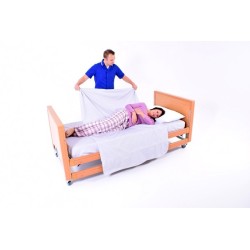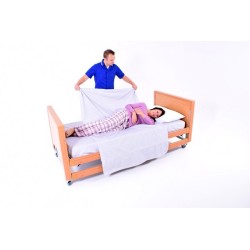
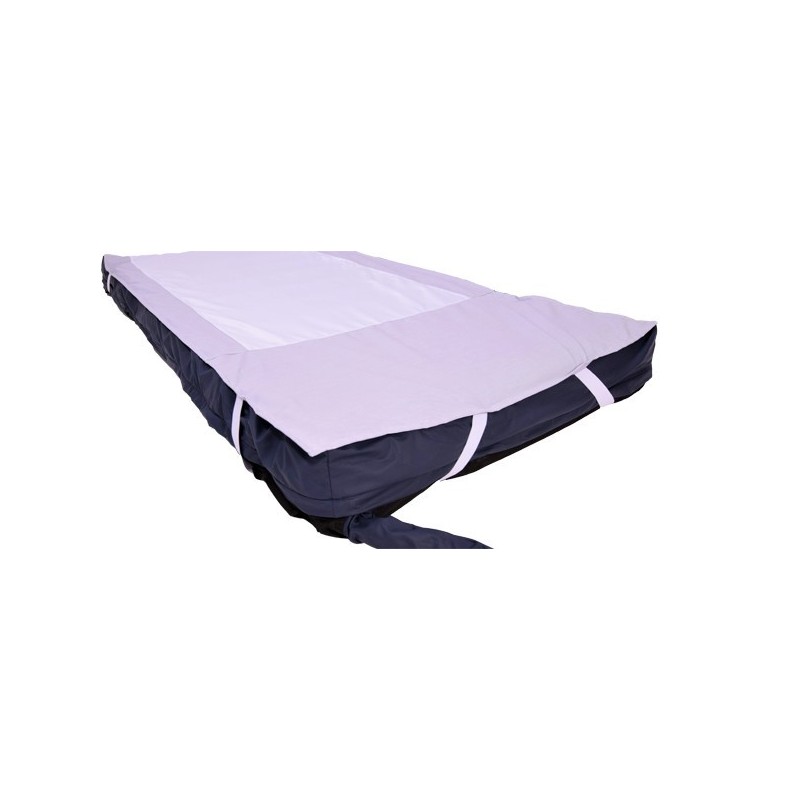

The Turn Easy APM sheet set is specifically designed for use with alternating pressure mattresses, addressing the two requirements that standard bedding cannot meet in this context: pump tubing access at the mattress perimeter and compatibility with alternating cell surface movement during inflation cycles. The base sheet uses corner securing straps to allow clear tubing pathways while keeping the sheet flat and secure. The low-friction satin draw sheet enables carer-assisted repositioning on the alternating mattress surface. Available in standard single and bariatric 4ft configurations. Supports MHOR 1992 and NICE CG179 compliance in APM care settings.
| Specification | Detail |
|---|---|
| NCL-FSC2E | Single base sheet with corner securing straps + 2-way draw sheet |
| NCL-FSC4E | Single base sheet with corner securing straps + 4-way draw sheet |
| NCL-FSC4BE | Bariatric base sheet with corner securing straps + 4-way draw sheet (for 4ft bed) |
| Base Sheet Fastening | Corner securing straps (not elasticated envelope) for tubing clearance |
| Draw Sheet | Low-friction satin for repositioning on APM surface |
| Wash Compatibility | Hot washable - suitable for institutional laundry |
| Origin | Manufactured in the UK |
The Turn Easy APM sheet set supports compliance with MHOR 1992 by providing a low-friction repositioning draw sheet compatible with alternating pressure mattress surfaces, reducing carer repositioning effort without requiring removal of the APM or interruption of the alternating cycle. NICE CG179 requires that repositioning protocols for at-risk residents are maintained during APM use, and the draw sheet allows these protocols to be implemented safely on the APM surface. The corner strap base sheet design preserves APM tubing access and avoids compression of air cells during inflation, which is a clinical requirement for maintaining effective alternating pressure therapy. Hot washability confirms NHS IPC compliance for institutional laundry management.
Why does the base sheet for APM use have corner straps rather than elasticated corners, and does this create a safety risk?
Elasticated-corner fitted sheets grip the mattress perimeter to secure the sheet in place, but on an alternating pressure mattress, the elasticated corner can obstruct the pump tubing outlet at the mattress edge and can also exert compressive force on the mattress surface where the elastic runs over the cell array. This compressive force can restrict the inflation of the outermost air cells and reduce the pressure redistribution effect at the mattress edge, which is precisely where the resident's body may be positioned. Corner straps secure the sheet to the bed frame structure rather than wrapping over the mattress, leaving the mattress perimeter and tubing pathway unobstructed. The strap-secured sheet presents no greater safety risk than a fitted sheet when the straps are correctly fastened; care staff should confirm at each sheet change that all corner straps are secure and that the sheet is lying flat over the mattress surface without folds that could create pressure concentrations under the resident.
Should repositioning protocols on an alternating pressure mattress be different from those on a standard mattress?
Yes. NICE CG179 notes that while alternating pressure mattresses provide dynamic pressure redistribution that can extend the interval between manual repositioning turns compared to a static mattress, they do not eliminate the need for manual repositioning entirely for most residents. The repositioning interval should be determined by the clinician following individual assessment of the resident's pressure risk score, mobility, and response to the APM therapy. When carer-assisted repositioning is required on an APM surface, the inflated cell profile creates an uneven contact surface that increases friction between the resident and the sheet compared to a flat static mattress; this is why the low-friction satin draw sheet in this set is specifically important for APM use rather than optional. The alternating cycle does not need to be paused during repositioning, but care staff should be aware that the cell inflation status will vary during the manoeuvre and should maintain two-carer technique throughout.