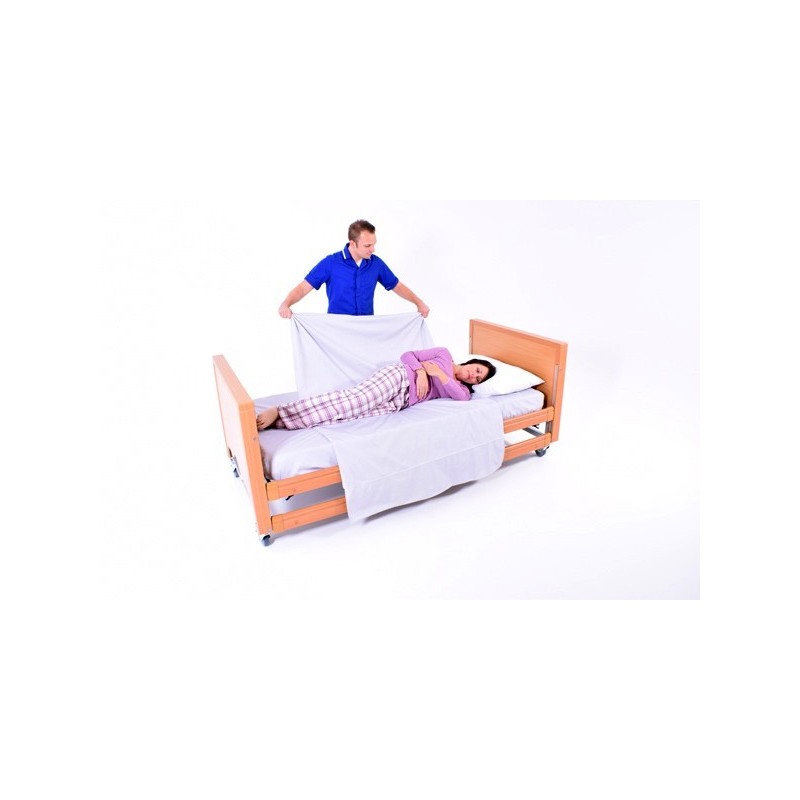

The Turn Easy draw sheet range provides full-width low-friction satin coverage at 200 x 145cm for carer-assisted repositioning in care home, hospital, and homecare settings. Used over the Turn Easy fitted sheet, the satin-on-satin interface reduces the friction between the resident and the bed surface to the level required for safe, low-effort repositioning. The 2-way variant supports up-and-down repositioning; the 4-way variant supports lateral turning as well. Both are hot washable and UK manufactured. Supports MHOR 1992 manual handling reduction and NICE CG179 shear force minimisation during repositioning.
| Specification | Detail |
|---|---|
| TES-4DS145 | 4-Way Draw Sheet - 200 x 145cm (Satin panel: 150 x 145cm) |
| TES-2DS145 | 2-Way Draw Sheet - 200 x 145cm (Satin panel: 150 x 145cm) |
| Satin Panel | Full-width low-friction satin surface |
| Movement Directions | 2-way: up/down; 4-way: up/down + lateral turning |
| Wash Compatibility | Hot washable - suitable for institutional laundry |
| Origin | Manufactured in the UK |
| Recommended Pairing | Turn Easy Fitted Sheet for satin-on-satin interface |
The Turn Easy draw sheet supports MHOR 1992 compliance by reducing the peak force required to complete turning and repositioning tasks without lifting, in line with the Regulation's requirement to reduce manual handling risk to the lowest level reasonably practicable. The satin surface also reduces shear stress on the resident's skin during repositioning, supporting NICE CG179 tissue viability requirements for residents at pressure injury risk. Hot washability confirms compatibility with NHS IPC guidance on laundry management for shared patient linen. The draw sheet should be laundered after each resident use and inspected for satin panel degradation before return to service.
When should the 2-way draw sheet be selected over the 4-way, and can they be used without the Turn Easy fitted sheet?
The 2-way draw sheet (TES-2DS145) is appropriate for repositioning tasks limited to upward or downward movement along the bed axis, such as moving a resident toward the pillow after they have slipped down, or recentring a resident on the mattress. The 4-way draw sheet (TES-4DS145) is required when the repositioning task involves lateral turning from supine to a lateral position, as this requires the sheet to allow sliding in the transverse direction as well as the longitudinal. For a full repositioning protocol that includes both turning and up-bed manoeuvres, the 4-way variant is the correct selection. The draw sheets can be used without the Turn Easy fitted sheet on a standard cotton sheet, but the friction reduction benefit is greatest when the draw sheet is used over the Turn Easy fitted sheet because the satin-on-satin interface at both surfaces creates the lowest achievable friction coefficient across the full repositioning contact zone.
How often should the draw sheet be changed, and how is satin panel integrity checked?
The draw sheet should be changed and laundered after each resident use in line with NHS IPC guidance on shared patient linen to prevent cross-contamination between residents. In single-resident homecare use, the laundering frequency should be set by the clinician or infection control lead based on the resident's condition and care requirements. To check satin panel integrity before return to service, the sheet should be inspected for pilling, thinning, or snag damage across the satin surface; a degraded satin surface that has lost its low-friction property will not provide the repositioning benefit and should be removed from service. Satin degradation is most commonly visible at the panel edges and in the high-contact central zone; these areas should receive particular attention during the pre-service inspection.