
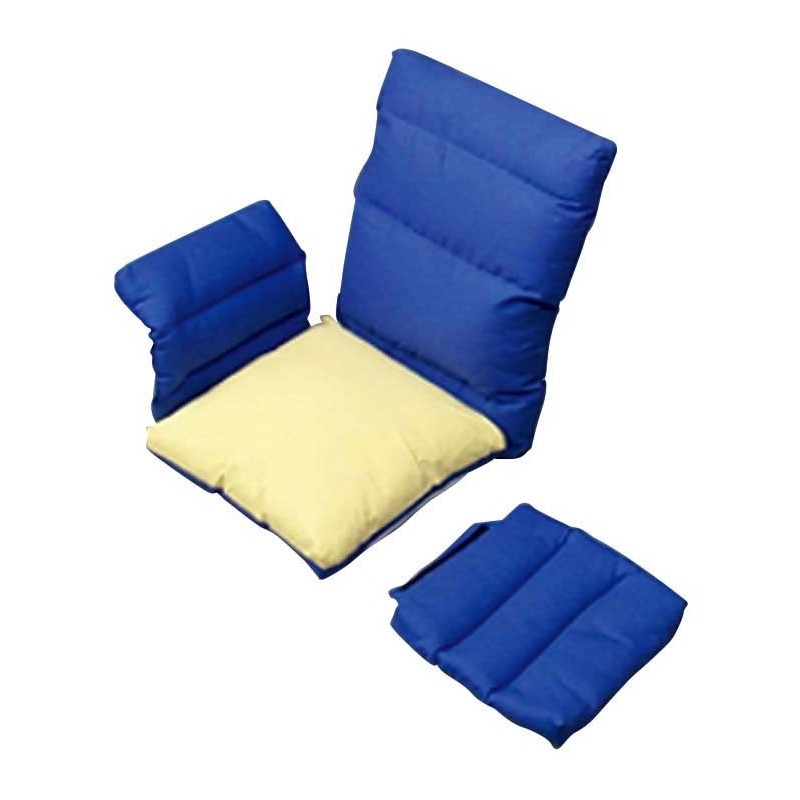

The NCL-FFCS padded wheelchair cushion set provides comfort padding across all primary seating contact surfaces including the seat base, back, and both armrests. Hollow fibre fill across all four components provides consistent softness at the skin interface, reducing pressure, friction, and shear at the seated contact points. Hook-and-loop fastenings secure each component to the wheelchair structure to prevent displacement during use or transfer. Wipe-clean covers support NHS IPC decontamination and incontinence management. Selected to support CQC Regulation 10 dignity and comfort obligations in wheelchair-dependent residents.
| Specification | Detail |
|---|---|
| Contents | Seat base cushion, back cushion, two armrest cushions |
| Fill Material | Hollow fibre |
| Cover Type | Wipe-clean |
| Fastening Method | Hook-and-loop for secure attachment to wheelchair frame |
| Reference | NCL-FFCS |
| CQC Relevance | Regulation 10 (dignity and comfort) |
The NCL-FFCS wheelchair cushion set supports compliance with CQC Regulation 10, which requires registered providers to treat residents with dignity and respect and to maintain comfort in all aspects of daily living, including seating. The wipe-clean covers support NHS IPC decontamination requirements for shared or single-resident wheelchair equipment; decontamination frequency and cleaning agent selection must follow the care setting's infection control policy. For residents at elevated pressure risk, this set must be used alongside a clinically prescribed pressure redistribution cushion selected following occupational therapist assessment per NICE CG179; this set is a dignity and comfort accessory, not a clinical pressure injury prevention device.
Is the padded wheelchair set a substitute for a clinical pressure redistribution cushion?
No. The NCL-FFCS is a comfort and dignity accessory providing soft padding at the wheelchair seating surfaces, and it is not a clinical pressure redistribution device. Hollow fibre fill does not provide the structured pressure redistribution performance of a foam, viscoelastic, or air-cell pressure relief cushion, and does not meet the clinical specification required for residents assessed at elevated pressure risk using a validated scoring tool such as the Waterlow or Braden scale. For residents at moderate or above pressure risk, a clinically prescribed pressure redistribution cushion from the Maximise range must be used on the seat base; the padded wheelchair set may be used for the back and armrests as a supplementary comfort measure. The prescribing occupational therapist must document the clinical rationale for all seating components in the resident's care plan.
Can the wipe-clean covers be removed and replaced if they become damaged?
The components in this set have wipe-clean covers designed for decontamination in place rather than removal and laundering. If a cover becomes torn, perforated, or no longer forms a complete fluid barrier, the individual component must be replaced rather than attempting to repair the cover, as a damaged wipe-clean surface compromises both IPC decontamination and incontinence containment. Care staff must inspect all four components during routine cleaning to confirm each cover remains intact with no splits at the seams or delamination of the wipe-clean film; components identified as damaged during inspection must be removed from use and replaced promptly. Hook-and-loop fastenings should also be checked regularly for lint accumulation, which reduces grip; lint must be removed from the hook surface to maintain secure attachment to the wheelchair frame.
