
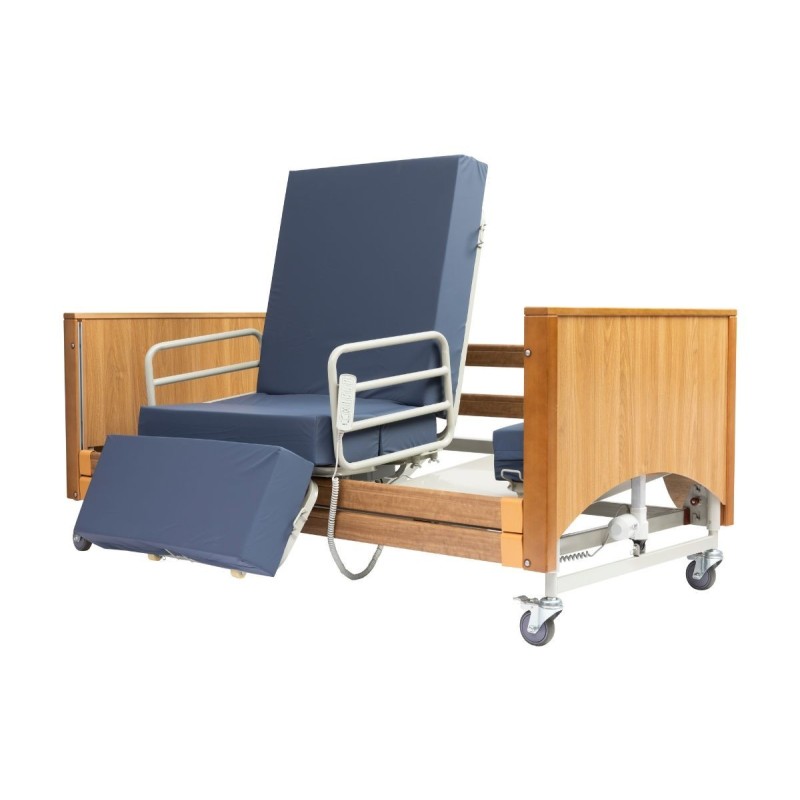


The Alerta Lomond Rotate-Stand-Up Bed is a specialist profiling bed with a powered rotation function that assists patients with sit-to-stand transfers. The rotation mechanism turns the mattress platform toward the bed edge while simultaneously elevating the backrest, bringing the patient from a lying position to a seated transfer position without manual handling. This supports patient independence for toileting, wheelchair transfers, and standing exercises. Full electric profiling with backrest, knee break, and height adjustment provides standard clinical positioning alongside the rotation function. Compatible with alternating pressure mattress systems.
| Specification | Detail |
|---|---|
| Product Code | NCL-ALT-LB-BO |
| Bed Type | Rotate-stand-up profiling bed |
| Specialist Function | Powered rotation for sit-to-stand transfers |
| Safe Working Load | 250kg |
| Profiling Functions | Backrest, knee break, height, rotation |
| Finish | Oak |
| Control | Electric handset with rotation control |
| Mattress Compatibility | Standard and alternating pressure systems |
| Application | Care homes, rehabilitation units, hospitals |
Powered rotation beds fall within LOLER 1998 scope and require six-monthly thorough examination. The rotation function supports the Manual Handling Operations Regulations 1992 by reducing manual lifting during patient transfers. CQC Regulation 12 requires that specialist equipment is assessed individually and that staff receive training in the rotation function. The powered transfer mechanism supports rehabilitation goals by promoting patient independence in line with CQC guidance on person-centred care.
Which patients benefit from a rotate-stand-up bed?
Patients with reduced lower limb strength, neurological conditions affecting transfer ability, or post-surgical rehabilitation needs benefit from powered rotation. The bed is particularly suited to patients who can bear weight once standing but cannot independently move from lying to a seated bed-edge position. An occupational therapy or physiotherapy assessment should determine suitability for each individual.
Does the rotation function require staff supervision?
Initial use should always be supervised until the patient and care team are confident in the transfer process. For patients assessed as safe to use the rotation function independently, unsupervised use may be appropriate and supports independence goals. The risk assessment should document whether supervised or independent use is indicated, and this should be reviewed regularly as the patient's condition changes.
