
Specialist Profiling Beds
Specialist profiling beds for ICU, paediatric, mental health, and complex care environments, with advanced clinical specification, reinforced construction, and compliance with specialist NHS and CQC care pathway requirements across UK healthcare settings.
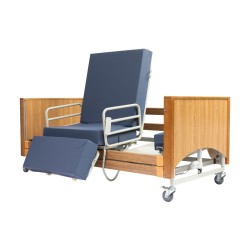
Specialist Profiling Beds for Advanced Clinical and NHS Care Environments
Clinical Summary: Specialist profiling beds are engineered for clinical environments where standard profiling bed specifications are insufficient, covering ICU and critical care, paediatric wards, mental health settings, and complex community care pathways. Specification requires clinical pathway documentation, MHRA registration confirmation, and individual risk assessment aligned to the specific care environment and patient group.
Specialist Profiling Bed Applications
- ICU and Critical Care Beds: Beds with CPR rapid-release function, Trendelenburg and reverse Trendelenburg tilt, and lateral tilt for intensive care unit positioning requirements. Meets IEC 60601 clinical performance standards and NHS critical care procurement specifications.
- Paediatric Profiling Beds: Size-adjustable beds with appropriate lower weight ratings and reduced height ranges for children ward and paediatric care settings, maintaining CQC dignity standards and developmental appropriateness throughout the patient age range.
- Mental Health Profiling Beds: Reduced entrapment risk design, tamper-resistant fittings, and reinforced construction for psychiatric and mental health ward environments, in compliance with CQC safe care requirements and least restrictive practice principles.
- Community and Domiciliary Beds: Compact specialist profiling beds for NHS continuing healthcare pathways, local authority care packages, and occupational therapy prescribed home use, with standard residential power supply requirements and appropriate access dimensions.
NHS Clinical Pathway and CQC Compliance
Specialist profiling beds supplied by Care Supplies carry MHRA registration appropriate to their specialist classification and clinical application. Specification for NHS-contracted environments requires clinical pathway documentation, infection prevention and control compatibility assessment, and manual handling risk assessment for the specific care setting. CQC-registered premises specifying specialist profiling beds for mental health or learning disability environments must document individual risk assessment covering entrapment risk, restrictive practice justification, and regular review arrangements. Community and domiciliary specialist bed specification via NHS continuing healthcare or local authority pathways requires occupational therapy assessment and home environment suitability confirmation.
| Bed Type | Clinical Setting | Key Features | Applicable Standard |
|---|---|---|---|
| ICU / Critical Care | Intensive care units | CPR function, Trendelenburg, lateral tilt | IEC 60601 / NHS Critical Care |
| Paediatric | Children wards | Size-adjustable, lower height range | BS EN 60601-2-52 |
| Mental Health | Psychiatric settings | Reduced entrapment, tamper-resistant | CQC Safe Care Standards |
| Community / Domiciliary | Home settings | Compact, standard power supply | NHS Continuing Healthcare |
Frequently Asked Questions
Q: What types of specialist profiling beds are available for NHS and clinical environments?
A: Specialist profiling beds include ICU and critical care beds with CPR release and full tilt functions, paediatric profiling beds for children wards, mental health beds with reduced entrapment risk and tamper-resistant fittings, and community beds for NHS continuing healthcare and domiciliary settings. Each type meets specific NHS clinical pathway and CQC care standard requirements.
Q: Can specialist profiling beds be supplied for home and community care settings?
A: Yes. Specialist profiling beds can be supplied for home use through NHS continuing healthcare pathways, occupational therapy assessment, and local authority care packages. Care Supplies can supply and install specialist profiling beds in domestic settings, with delivery and setup arrangements coordinated through your care coordinator or occupational therapist.