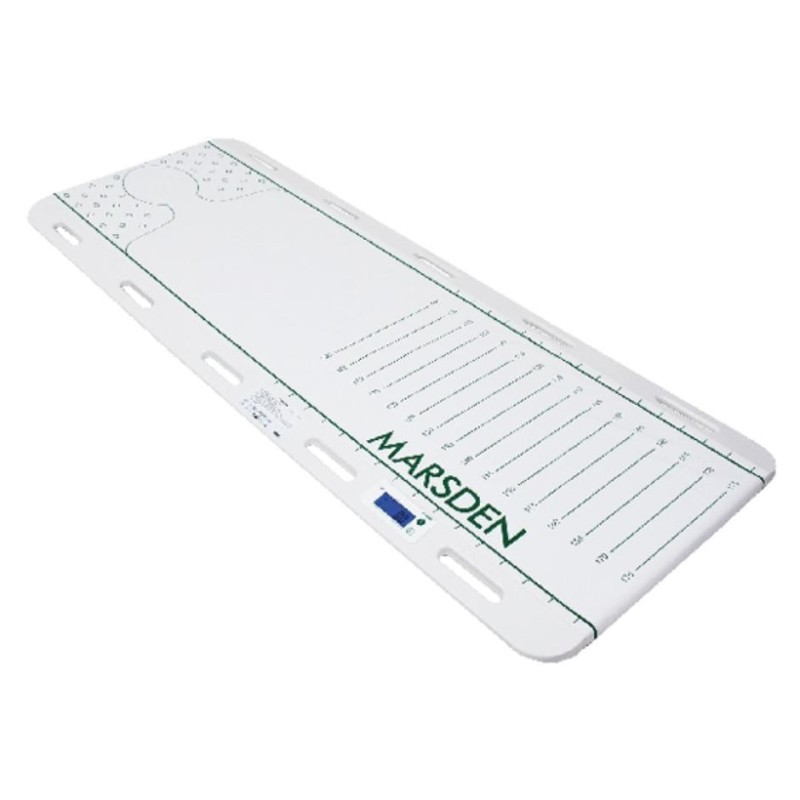


The Marsden M-999 is an award-winning Class III Approved patient transfer scale that obtains an accurate clinical weight reading during a standard lateral patient transfer, the only certified weighing solution that integrates into the patient handling process itself rather than requiring a separate weighing episode. With 250kg capacity and Class III approval under the NAWI Directive, the M-999 addresses the clinical gap for patients where conventional weighing methods - floor scales, chair scales, bed weighers and hoist attachments - cannot safely or accurately deliver a weight reading, including critically ill patients on complex monitoring equipment, severe stroke patients, complex spinal injury cases and highly dependent bariatric patients.
By obtaining the weight during a transfer that is already required for patient care, the M-999 eliminates additional manual handling risk and the LOLER exposure that would otherwise occur from a separate patient handling episode solely for weighing purposes.
| Specification | Detail |
|---|---|
| Capacity | 250kg |
| Graduations | 500g |
| Approval | Class III Approved (NAWI Directive) |
| Weighing Method | During standard lateral patient transfer |
| Primary Indication | Patients where all other weighing methods are clinically unsafe or impractical |
| Clinical Settings | Critical care, stroke, spinal injury, complex bariatric |
| Transport | Optional CC-999 padded carry case |
Class III approval under the NAWI Directive confirms the M-999 is authorised for clinical patient monitoring and drug dosing weight capture in NHS acute and regulated settings. LOLER (Lifting Operations and Lifting Equipment Regulations 1998) and Manual Handling Operations Regulations 1992 both require that patient transfers are conducted in a way that minimises risk to staff: the M-999 captures the clinical weight during a transfer that is already occurring in patient care, without adding a separate handling episode for weighing, which is its primary LOLER compliance advantage over all other clinical weighing methods for complex patients. In critical care and acute settings, the absence of a reliable patient weight is the most significant drug dosing risk factor: the M-999 closes this gap for the patient cohort where the risk is highest.
For which specific patient scenarios is the M-999 the correct clinical specification over other Marsden weighing solutions?
The M-999 is the correct specification when all other weighing methods have been clinically assessed and excluded. This typically covers: patients on complex ICU monitoring who cannot be transferred to or across a bed weigher without risk of disconnection; stroke patients with severe one-sided paralysis and spasticity where hoist transfer is clinically contraindicated; patients with unstable spinal injuries where any weighing method requiring repositioning is excluded; and severely bariatric patients where hoist capacity and floor scale access are both insufficient. The M-999 is not a general-use replacement for bed weighers or hoist scales: it is the clinical solution of last resort for patients where those options have been excluded.
Does the 500g graduation of the M-999 affect its clinical utility for drug dosing?
For the patient cohort the M-999 serves - typically adult patients in acute or critical care - 500g graduation is clinically sufficient for the body-weight-based drug dosing calculations used in this setting. For most adult patients weighing 60kg or more, a 500g graduation produces a dosing weight accurate to less than 1% of body weight, which is within the acceptable precision range for IV drug dosing calculations in NHS critical care. The clinical priority for these patients is obtaining any certified accurate weight rather than achieving the 50-200g precision possible with other methods: the M-999 provides a certified Class III weight that is clinically superior to the estimated or non-certified weights that would otherwise be used for drug dosing in this complex patient group.
Part of our Class III approved Medical Scales and Measuring range. Patient transfer scales provide accurate weighing during transfer for safe clinical monitoring in care homes and hospitals.