
Patient Height Measurers
Patient height measurers and clinical stadiometers for accurate standing height measurement in care homes, GP practices, and NHS settings, supporting BMI calculation, growth monitoring, and nutrition screening across UK clinical environments.
Patient Height Measurers for Accurate Clinical Height Assessment
Clinical Summary: Accurate patient height measurement is essential for BMI calculation, MUST nutrition screening, medication dosing by body surface area, and paediatric growth monitoring in care homes, GP practices, and NHS settings. Clinical stadiometers and height measurers provide measurement accuracy to 1mm or 0.1cm, meeting the precision requirements of NICE nutrition guidelines, NHS Digital Weight Management Programme referral criteria, and RCPCH paediatric growth chart standards.
Patient Height Measurer Types
- Wall-Mounted Stadiometers: Fixed-wall height measurement scales providing precise standing height measurement to 1mm in clinical rooms, GP surgeries, and care home assessment spaces where a dedicated permanent measuring point is required for consistent, accurate height recording.
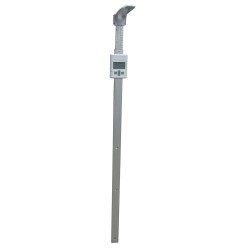
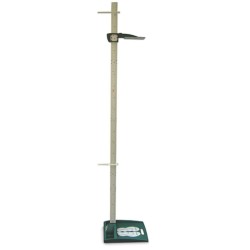
- Free-Standing Stadiometers: Portable telescopic height measurement units for use across multiple room locations or as a standalone height measurement instrument separate from weighing equipment. Suitable for clinics, home visits, and settings without permanent wall space for a fixed stadiometer.
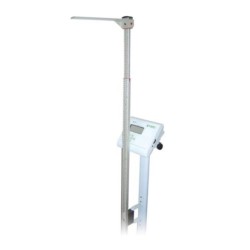
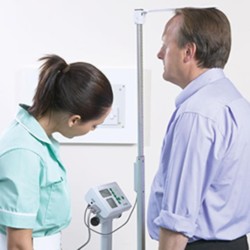
- Integrated Column Scale Stadiometers: Height measurement columns integrated with medical floor scales, providing simultaneous weight and height measurement for immediate BMI calculation at the point of weighing in GP practices and care home assessment rooms.
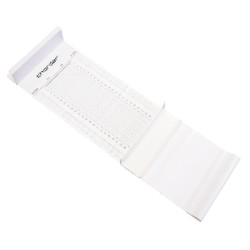
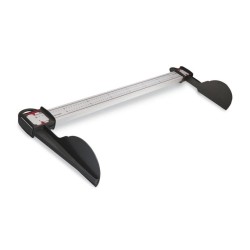
- Seated and Ulna Height Estimation Tools: Instruments for estimating height in patients unable to stand, including knee height callipers and ulna length measurement guides for deriving height estimates using validated MUST nomograms for non-ambulant care home residents.
Clinical Compliance and Height Measurement Standards
Patient height measurers supplied by Care Supplies are calibrated to clinical accuracy standards appropriate to their application. MUST (Malnutrition Universal Screening Tool) guidance and NICE CG32 require accurate height measurement or validated estimation for all nutrition screening assessments, making appropriate height measurement equipment a clinical requirement in CQC-registered care homes. For non-ambulant residents unable to stand for height measurement, knee height or ulna length estimation methods using appropriate instruments provide validated surrogate measures for MUST screening. RCPCH growth chart monitoring in paediatric settings requires 1mm resolution height measurement at each assessment point.
| Instrument Type | Resolution | Primary Application | Key Standard |
|---|---|---|---|
| Wall-Mounted Stadiometer | 1mm | Fixed clinical room assessment | NICE CG32 / MUST |
| Free-Standing Stadiometer | 1mm | Portable, multi-room use | NICE CG32 / MUST |
| Integrated Column Scale | 1mm to 0.1cm | Combined weight and height, BMI | NICE / NHS Digital WMP |
| Ulna and Knee Height Tools | Estimation | Non-ambulant, MUST screening | MUST / NICE CG32 |
Frequently Asked Questions
Q: What height measurement accuracy is required for MUST nutrition screening in care homes?
A: MUST guidance recommends measuring height to the nearest 0.5cm using a calibrated stadiometer where the patient is able to stand. For non-ambulant residents unable to stand, knee height or ulna length measurement using appropriate instruments and validated MUST nomograms provides an acceptable surrogate height estimate for completing the nutrition screening tool in CQC-registered care home environments.
Q: Can patient height be estimated for non-ambulant care home residents?
A: Yes. MUST guidance provides validated nomograms for estimating height from ulna length or knee height measurement for patients unable to stand. Ulna length measurement is simple and non-invasive, requiring only a tape measure and the MUST ulna length nomogram. Estimated height values derived using these methods are valid for MUST scoring and BMI estimation in care home nutrition screening programmes.