
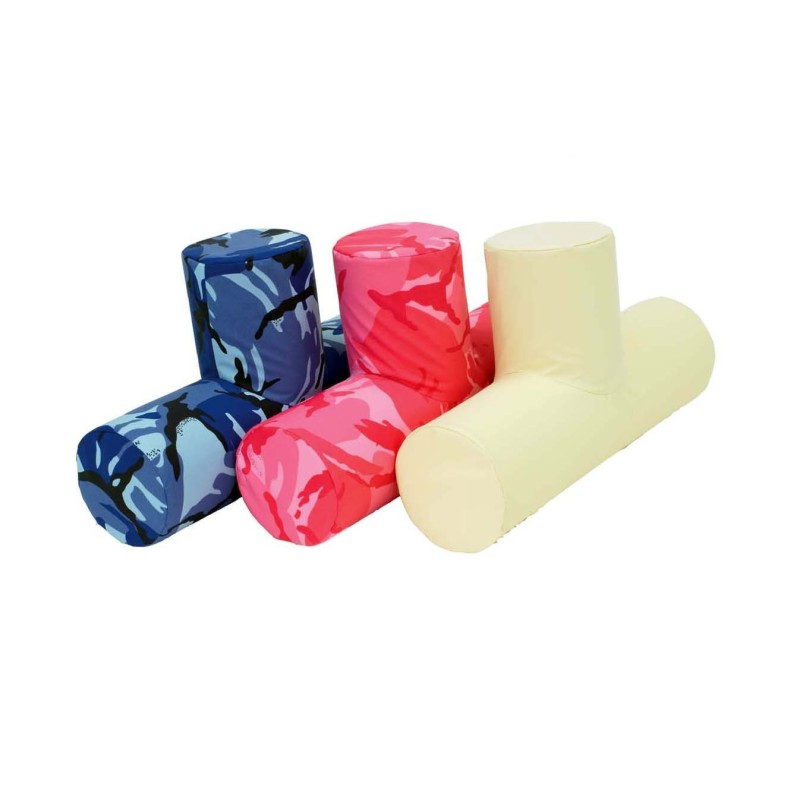


The T-Roll Positioning Aid range provides lower limb alignment and hip abduction support in supine-lying positions through a T-shaped CMHR foam core with a vapour-permeable wipe-clean removable cover. Available in five sizes (paediatric to extra-large) and three colourways. Size and positioning to be confirmed by occupational therapist or physiotherapist.
| Reference | Name | Dimensions |
|---|---|---|
| NCL-PPA | Paediatric (Billy) | 460 x 250 x 100 mm |
| NCL-PAS | Small (Molly) | 510 x 300 x 150 mm |
| NCL-PAM | Medium (Annie) | 710 x 400 x 150 mm |
| NCL-PAL | Large (Archie) | 710 x 400 x 200 mm |
| NCL-PAEL | Extra Large (Eddie) | 710 x 450 x 200 mm |
NICE CG179 (pressure ulcers: prevention and management) specifies that residents at pressure ulcer risk should be repositioned at prescribed intervals and maintained in specific positions; the T-Roll supports the maintenance of the lateral or supine position prescribed in the care plan by stabilising the lower limbs. The vapour-permeable cover directly supports the NICE CG179 microclimate management requirement. MHOR 1992 (Manual Handling Operations Regulations) benefits from the stable positioning that reduces the frequency of carer repositioning interventions. CQC Regulation 12 (safe care) documentation should include the T-Roll specification within the pressure care plan.
What are T-Rolls used for in clinical care?
T-Rolls are used to maintain lower limb alignment and hip abduction in residents who are lying supine and require the legs to be kept in a specific position - for example, following hip replacement surgery where hip adduction and internal rotation must be avoided; for residents with neurological conditions causing involuntary leg adduction; or as part of a pressure care repositioning programme where the 30-degree tilt position requires the legs to be stabilised. The specific clinical indication and the prescribed leg position should be documented in the care plan by the responsible clinician or physiotherapist.
How is the correct T-Roll size selected?
T-Roll size selection should be based on the user's body dimensions - specifically the distance between the user's thighs and the length of the lower leg section requiring support. The occupational therapist or physiotherapist should assess the user and confirm the appropriate size; an undersized T-Roll will not provide effective abduction and may slip out of position, while an oversized T-Roll may create pressure points at incorrect positions. The five-size range from paediatric to extra-large accommodates users from children to large adults, and the clinician should trial the selected size before including it in the care plan.
