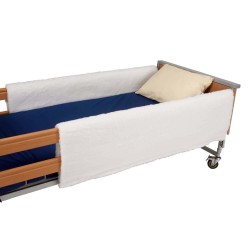


The Optimise Firm Edge Mattress (198x88x15cm, NCL-OPFE) uses reinforced firm side edges to provide a stable transfer platform and prevent unintentional roll-out, reducing fall risk at the bed edge without bed rails or other restraint measures. Profiled pressure-reducing foam surface for pressure redistribution; 4-way turn. A restraint-free approach to bed edge safety per NICE NG45 and MCA 2005.
| Specification | Detail |
|---|---|
| Reference | NCL-OPFE |
| Dimensions | 198 x 88 x 15 cm |
| Key Feature | Reinforced firm side edges |
| Sleeping Surface | Profiled pressure-reducing foam |
| Turn Configuration | 4-way turn |
| Settings | Care homes; community hospitals; homecare |
NICE NG45 (falls in older people: assessing risk and prevention) recommends addressing fall risk at the bed edge during transfers, and specifically supports less restrictive approaches to bed safety; firm edge mattresses address the bed-edge transfer fall risk through a mattress feature rather than a restraint measure, consistent with the NICE NG45 recommendation to consider alternatives to bed rails. NICE CG179 supports the profiled pressure-reducing foam sleeping surface for pressure ulcer prevention. The Mental Capacity Act 2005 supports the less restrictive specification where fall prevention can be achieved without bed rail use. CQC Regulation 12 (safe care) and CQC Regulation 10 (dignity and independence) are both directly supported by this mattress specification.
How do firm edge mattresses prevent falls without restraint?
Standard pressure-reducing foam mattresses have soft side edges that compress easily under the resident's weight when they sit on the bed edge, causing the edge to dip and the resident to lose balance during the transfer movement. The Optimise Firm Edge Mattress uses reinforced foam side sections that maintain their shape under the resident's seated weight, providing a level, stable platform for the transfer. The resident can sit on the bed edge with confidence, push up to standing, and transfer to a chair or wheelchair without the instability of a soft-edged mattress. This addresses the biomechanical cause of bed edge transfer falls without restricting the resident's movement or using bed rails.
How does the firm edge affect pressure care compatibility?
The firm edges are reinforced sections at the sides of the mattress, not across the lying surface; the central sleeping area uses profiled pressure-reducing foam that provides pressure redistribution for residents in the lying position. The firm edge does not affect the pressure redistributing properties of the lying surface. The tissue viability nurse should assess whether the pressure reducing specification of the Optimise Firm Edge sleeping surface is appropriate for the individual resident's tissue viability risk level, using the Waterlow or other validated risk assessment tool, before specifying as part of the pressure care plan.