
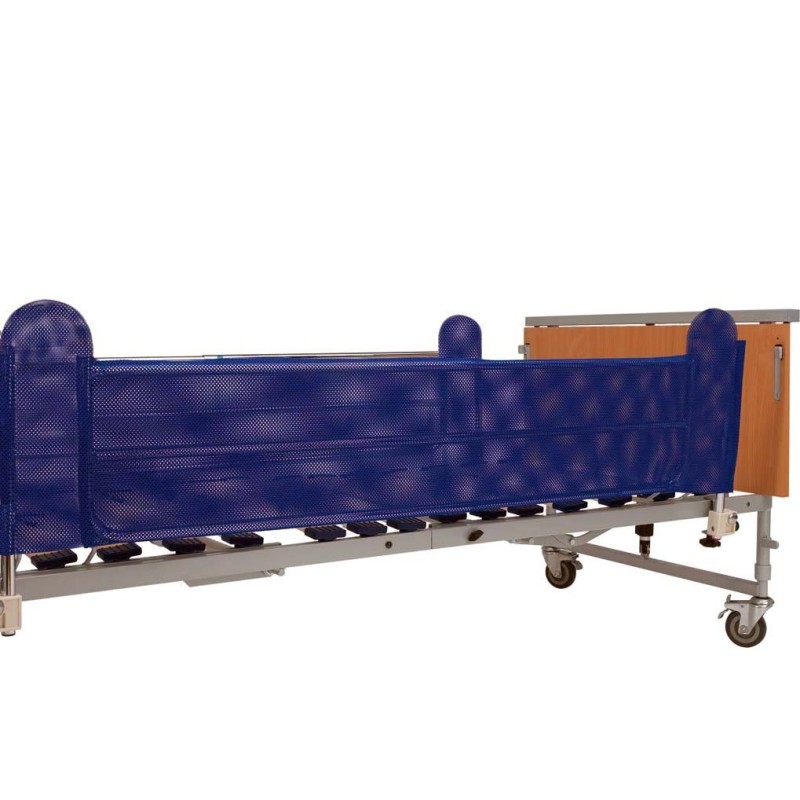

The Net Rail Cover (200cm, Open Ends) completes the net cover range with a design for profiling beds with flat-topped side rails; tea-cosy fitting over the rail with open ends suited to the flat rail end profile. Breathable tough net maintains carer visibility and closes rail gap entrapment zones. Telescopic rail versions: NCL-NET (134cm closed ends) and NCL-NETL (183cm closed ends).
| Specification | Detail |
|---|---|
| Reference | NCL-NETPB |
| Length | 200 cm |
| Rail Type | Flat-topped profiling bed rails |
| Ends | Open |
| Material | Breathable tough net |
| Fitting Method | Tea-cosy style over the rail |
| Telescopic Versions | NCL-NET (134cm); NCL-NETL (183cm) |
MHRA guidance on bed rail safety identifies gaps in the rail structure as entrapment zones; the net cover closes these gaps in flat-topped rail configurations. CQC Regulation 12 (safe care) documentation should confirm the flat-topped rail type, the gap entrapment risk assessment, and the open-end net cover specification rationale. Confirm the tea-cosy fit adequately covers the full flat-topped rail profile for the specific bed model before clinical use. Mental Capacity Act 2005 best interest obligations apply.
What is a flat-topped rail and how does it differ from telescopic rails for net cover fitting?
A flat-topped bed rail has a consistent profile along its full length with a flat or rounded upper surface and does not have the variable-geometry telescoping sections that create mechanism gaps. Flat-topped rails on profiling beds may still have gaps between the rail and the mattress or between the rail sections and the bed frame that present entrapment risk. The net cover addresses these gaps with a consistent fit across the flat-topped profile. Telescopic rail versions (NCL-NET, NCL-NETL) use closed ends to accommodate the end profile of the telescoping mechanism; the open-end version for flat-topped rails does not require this closed-end wrapping at the rail ends.
How does the open-end design suit flat-topped rails compared to the closed-end telescopic versions?
Flat-topped rails typically have a consistent end profile that does not require the closed-end wrapping needed for telescopic rail mechanisms. The open-end design allows the net to accommodate the flat rail end profile without tension at the corners, and allows air circulation at both ends. Where the flat-topped rail ends present a specific entrapment risk at the rail end position, the bed rail risk assessment should confirm whether the open-end net cover provides adequate coverage of the rail end or whether a supplementary protector at the rail ends is needed to close any residual gap.
