
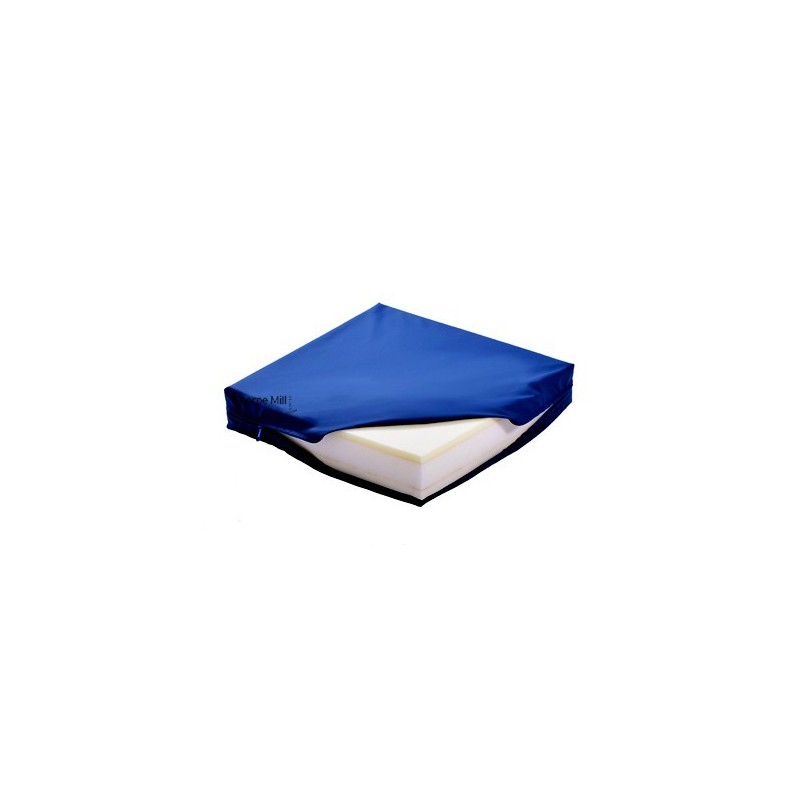


The Maximise Twist is a triple-layer seating cushion designed for residents and wheelchair users requiring pressure redistribution without the depth profile of a 10cm cushion. The layered foam construction combines a firm base layer, a combustion modified high resilience mid-layer, and a viscoelastic contact surface to provide a progressive response to seated load. The 2-way stretch vapour-permeable wipe-clean cover conforms to seated anatomy while supporting skin microclimate management. Suitable for GP, community, and care home settings following occupational therapist assessment against NICE CG179 pressure risk criteria.
| Specification | Detail |
|---|---|
| Dimensions | 43 x 43 x 7.5cm |
| Foam Construction | Triple-layer: base foam, CMHR mid-layer, viscoelastic top layer |
| Cover Type | 2-way stretch vapour-permeable wipe-clean |
| Reference | NCL-MXTC-(3LMC43) |
| Regulatory Status | MDR 2017/745 Class I medical device |
| Clinical Standard | NICE CG179 (pressure redistribution) |
The Maximise Twist is compliant with Medical Devices Regulation 2017/745 as a Class I medical device. Clinical selection must follow occupational therapist assessment of the resident's Waterlow or Braden pressure risk score, seated posture, and mobility level per NICE CG179. The wipe-clean VP cover supports NHS IPC decontamination requirements for shared equipment between residents. Equipment register documentation and manufacturer conformity information must be retained to support CQC Regulation 12 inspections.
How does the triple-layer construction of the Maximise Twist compare to a single-foam or dual-foam cushion?
A single-foam cushion provides a consistent response across the full depth of the foam, which limits its ability to simultaneously support posture and redistribute pressure. The triple-layer architecture of the Maximise Twist provides distinct functional zones: the firm base resists bottoming out under load, the CMHR mid-layer provides resilience and posture support, and the viscoelastic contact layer conforms slowly to the seated bony prominences to redistribute pressure across a wider surface area. This layered response more closely follows the NICE CG179 principle of reducing peak interface pressure at the ischial tuberosities and coccyx, which is where the highest pressure injury risk is concentrated in the seated position.
Is the Maximise Twist suitable for a resident at high pressure risk, or is it designed for moderate-risk users?
The Maximise Twist is appropriate for residents assessed at moderate pressure risk where the clinical priority is pressure redistribution combined with postural support in a standard seat-height profile. For residents assessed at high or very high pressure risk, particularly those with existing Category 2 or above pressure injuries, the deeper 10cm Maximise Contour or Visco range should be considered, as the additional foam depth provides greater redistribution capacity. The prescribing clinician or occupational therapist should match cushion selection to the resident's Waterlow score, seated weight distribution, and time spent in the chair per NICE CG179 assessment guidance.
