
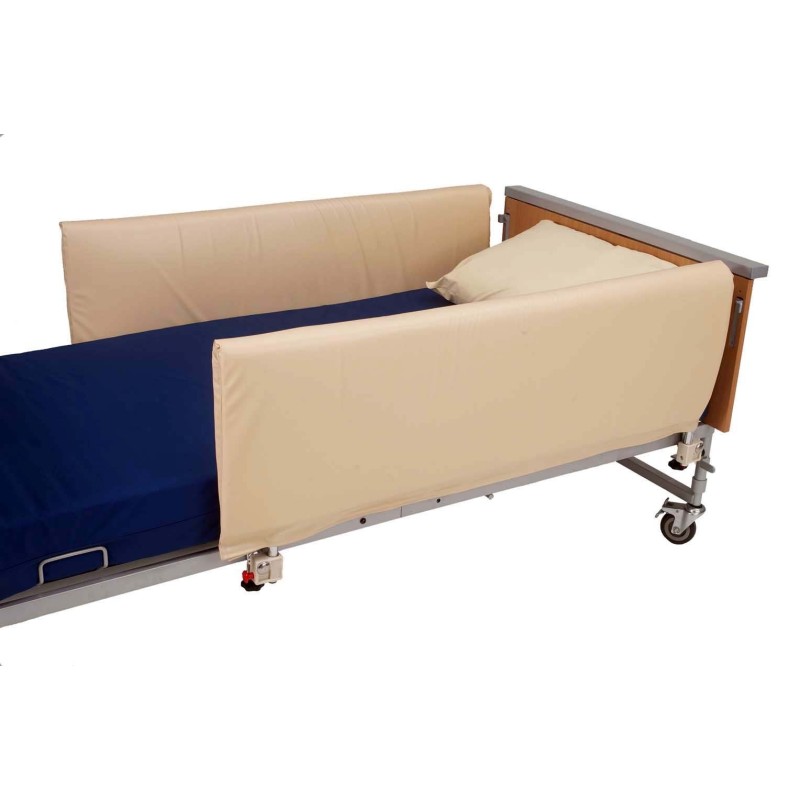


The High-Sided Cotside Bumper (134x96cm, Open Ends) is designed for profiling beds with mattress overlays or alternating pressure airflow mattresses, where the 96cm height provides full rail coverage above the raised mattress surface. FR foam interior meets fire safety requirements. Wipe-clean cover; hook and loop fastenings. Extended-length version is NCL-CSBHL (183x96cm open ends); closed-end versions are NCL-CSBHE (134x96cm) and NCL-CSBHLE (183x96cm).
| Specification | Detail |
|---|---|
| Reference | NCL-CSBH |
| Dimensions | 134 x 96 cm (53" x 38") |
| Ends | Open |
| Foam | Fire-retardant (FR) |
| Cover | Wipe-clean |
| Fastening | Hook and loop |
| Extended Length Version | NCL-CSBHL (183 x 96 cm open ends) |
| Closed End Versions | NCL-CSBHE (134 x 96 cm); NCL-CSBHLE (183 x 96 cm) |
MHRA guidance on bed rail safety requires that bumpers cover the full height of accessible rail surfaces; for overlay and airflow mattress configurations, the 96cm height satisfies this requirement where a 76cm standard bumper would not reach the top of the rail above the mattress surface. FR foam meets the Regulatory Reform (Fire Safety) Order 2005 fire safety specification for soft furnishings in regulated care environments. NICE CG179 is indirectly relevant: alternating pressure airflow mattresses are commonly used for pressure ulcer prevention in high-risk residents, and the correct bumper specification for these beds supports the safe delivery of tissue viability care. CQC Regulation 12 documentation should confirm the overlay or airflow mattress configuration and the 96cm height rationale.
What is an alternating pressure airflow mattress and why does it require a different bumper height?
An alternating pressure airflow mattress is an active pressure relief device that alternates inflation and deflation of internal air cells to redistribute pressure under the resident and reduce the risk of pressure ulcers per NICE CG179. These mattresses have a greater depth than standard mattresses - typically 15-25cm - which raises the effective resident surface above the bed base level and increases the mattress-to-rail-top distance. A standard 76cm bumper fitted below the airflow mattress surface may leave 15-25cm of exposed rail above the mattress level, creating an impact and entrapment risk at the exposed section. The 96cm high-sided bumper covers this additional height.
When should open ends be specified rather than closed ends for this bumper?
Open-ended bumpers (NCL-CSBH, NCL-CSBHL) are appropriate for most clinical settings where the primary safety concern is impact and entrapment along the rail length, rather than at the rail end points. Closed-end bumpers (NCL-CSBHE, NCL-CSBHLE) additionally cushion the rail end positions and provide lateral protection at the ends of the bumper, making them the indicated choice for more active patients who may contact the rail ends during sleep movement, or for high-dependency care environments where the clinical team has identified lateral end contact as a specific impact risk in the bed rail risk assessment.
