
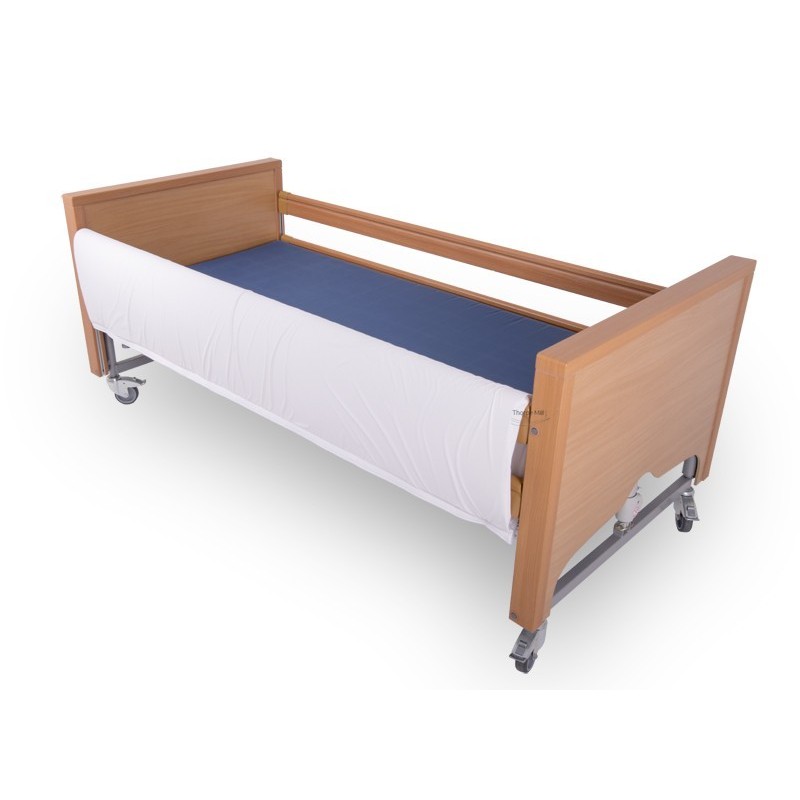

The Full Bed Length Bumper (MRSA Resistant, Wipe-Clean) provides complete 200x76cm inner bed rail coverage with a cover material incorporating MRSA-resistant surface properties. Soft padded interior reduces impact injury risk. Designed for hospital wards, care homes, and high-dependency environments where HCAI prevention is a documented infection control priority. A documented bed rail risk assessment is required before fitting.
| Specification | Detail |
|---|---|
| Reference | NCL-CSBPB15PUK |
| Dimensions | 200 x 76 cm (79" x 30") |
| Cover | MRSA-resistant, wipe-clean |
| Interior | Soft padding |
| Settings | Hospitals, care homes, high-dependency environments |
NHS IPC infection control guidance identifies bed rail surfaces as potential fomite contact points in ward environments; standard wipe-clean covers reduce contamination between cleaning episodes, but an MRSA-resistant cover specification provides an additional surface-level inhibitory property against healthcare-associated pathogen survival. CQC Regulation 12 (safe care) inspections may assess infection control provisions at the bed level; the MRSA-resistant specification provides documented evidence of enhanced infection control effort at the bed rail surface. MHRA guidance on bed rail safety applies; a documented bed rail risk assessment confirming the clinical indication and Mental Capacity Act 2005 best interest obligations is required before fitting.
What does MRSA-resistant mean for the cover material?
An MRSA-resistant cover material incorporates an antimicrobial additive in the cover substrate that inhibits the surface survival and proliferation of MRSA and certain other common healthcare-associated bacteria between cleaning episodes. This does not replace cleaning and disinfection; the cover still requires routine decontamination with an NHS IPC-compliant surface disinfectant wipe per the care home or ward cleaning schedule. The MRSA-resistant property reduces the risk of residual surface contamination persisting between wipe-down events and during the period immediately after a cleaning episode when the surface may still dry, reducing the fomite risk at the bed rail contact surface.
When should this MRSA-resistant version be specified rather than a standard wipe-clean bumper?
The MRSA-resistant version should be specified where the care home or hospital infection control policy requires antimicrobial surface specification for patient equipment in high-risk environments, where the ward or care home has had MRSA incidents where bed rail covers have been identified as a potential transmission surface, or where a commissioning body's specification requires MRSA-resistant patient contact surfaces. For standard care home settings without active HCAI programmes requiring enhanced specification, a standard wipe-clean bumper may be the appropriate and more cost-effective choice. The infection control lead should advise on specification requirements.
