
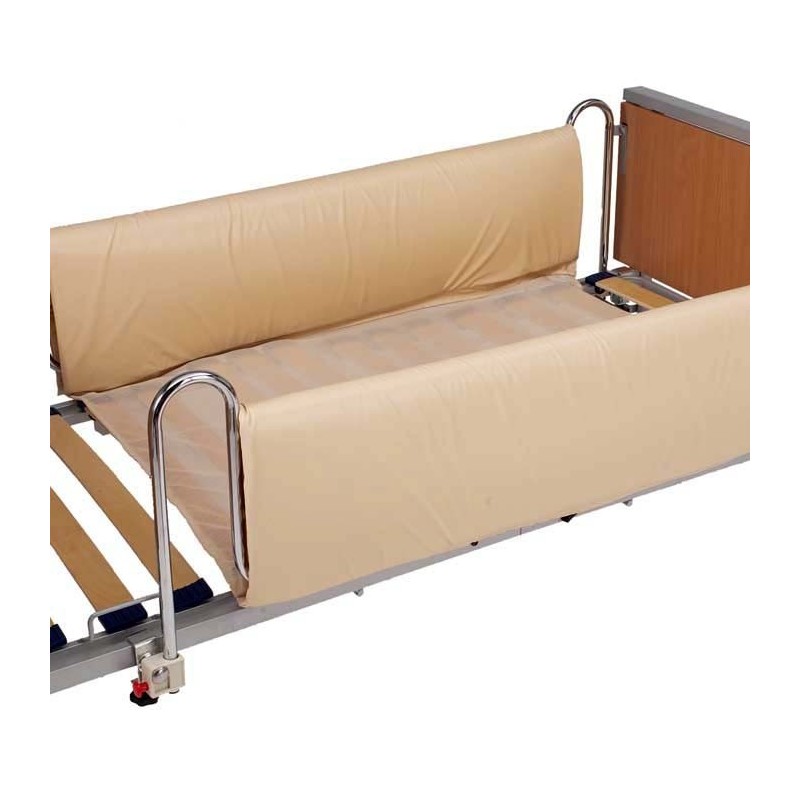

The Connected Cotside Bumper (200x105cm) is designed for profiling beds with a third rail extension, providing 105cm high padded coverage across all three rail levels with a highly permeable base sheet that prevents sub-rail limb entrapment. The mattress secures the base sheet beneath it. Wipe-clean outer. Standard range: NCL-CCB (134x76cm), NCL-CCSFB (183x76cm), NCL-CCBPB (200x76cm), NCL-CCBPBH (200x96cm).
| Specification | Detail |
|---|---|
| Reference | NCL-CCBPBX |
| Dimensions | 200 x 105 cm (79" x 41") |
| Configuration | For two-bar rails with third rail extension |
| Key Feature | Highly permeable base sheet - sub-rail entrapment prevention |
| Securing Method | Mattress sits on base sheet |
| Cover | Wipe-clean |
| MHRA Compliance | Yes |
Three-rail bed configurations create a higher rail structure with multiple accessible surfaces and entrapment zones; MHRA guidance on bed rail safety requires that all accessible rail surfaces and entrapment zones are addressed in the bed rail risk assessment and covered by appropriate safety equipment. The CCB 200x105cm covers the full three-rail height and provides sub-rail entrapment prevention through the base sheet. CQC Regulation 12 documentation must confirm the three-rail configuration, the 105cm height rationale, the sub-rail entrapment risk findings, and the Mental Capacity Act 2005 best interest assessment where applicable. The bed rail risk assessment for a three-rail configuration should include all relevant MHRA entrapment zones.
When is the CCB 200x105cm required rather than the standard three-rail bumper?
The standard three-rail bumpers (NCL-CASA3R, NCL-CASA3R22) provide coverage of the three-rail surface through padded bumpers and a net window, but do not include the base sheet that addresses sub-rail entrapment. The CCB 200x105cm is required where the bed rail risk assessment specifically identifies sub-rail entrapment as a risk in addition to the three-rail surface impact and entrapment risk - i.e., where both the three-rail height and the gap below the mattress are identified as entrapment hazards for the individual resident. The risk assessment findings drive the specification; where sub-rail entrapment is not identified as a specific risk, a standard three-rail bumper is adequate.
How does the base sheet function on a three-rail bed configuration?
The base sheet functions in the same manner as on standard two-rail configurations; it passes beneath the mattress and connects both cotside bumper sides at the mattress boundary, creating a barrier that prevents limbs from entering the sub-rail zone. The additional height of the three-rail bumper body above the base sheet does not affect the base sheet's function at the mattress level. The risk assessment should confirm that the base sheet covers the full width of the sub-rail gap for the specific three-rail bed base dimensions, as bed base widths may vary between models.
