
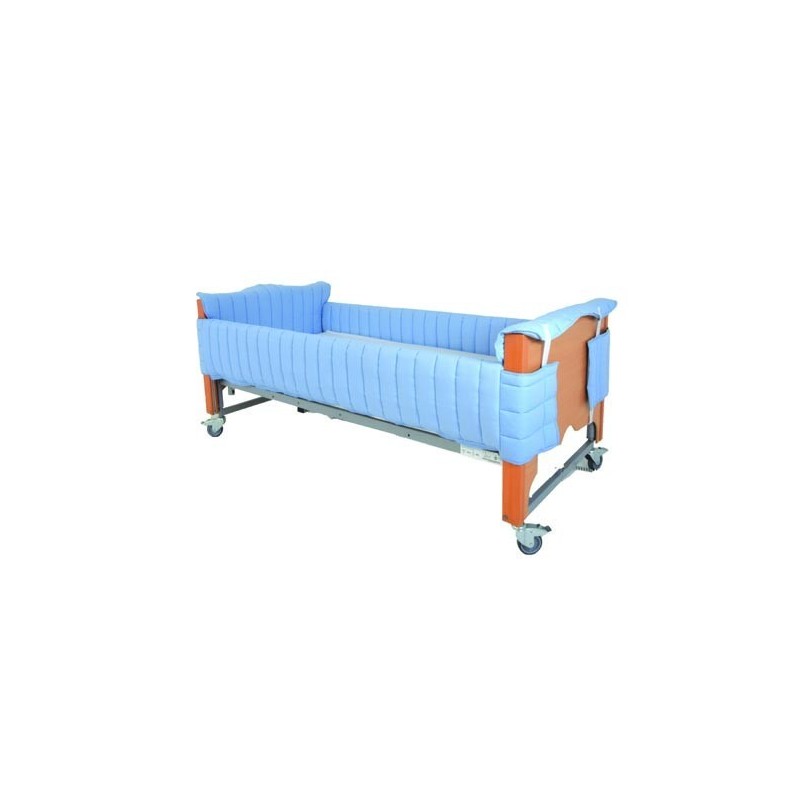

The Standard All Round Protection bed rail covers provide heavily quilted cushioning around side rails, headboards, and footboards for individuals at risk of impact injury during bed rest. Breathable fabric and closed corners maintain secure positioning and airflow during extended use. Fully machine washable per HTM 01-04. Where the gap between the bed rail and the bed frame requires closing to prevent limb entrapment, the Connected All Round Protection version (NCL-MWCARP) provides a linked sheet for this purpose.
| Specification | Detail |
|---|---|
| Reference | NCL-MWARP |
| Coverage | Side rails, headboards, and footboards |
| Construction | Heavily quilted |
| Fabric | Breathable |
| Corners | Closed for secure positioning |
| Washing | Machine washable |
| Connected Version | NCL-MWCARP (adds linked sheet for gap closure) |
MHRA guidance on bedrail safety identifies impact injury and entrapment as the primary patient safety risks associated with bed rail use. Bed rail covers directly address the impact injury risk by providing a cushioned surface at all rail contact points. CQC Regulation 12 (safe care) requires that equipment used in care delivery does not expose residents to unsafe conditions; bed rail covers form part of the documented safe bed management plan where rails are in use. The decision to use bed rails must be preceded by an individual risk assessment; where bed rails may constitute a form of restraint, the Mental Capacity Act 2005 requirements for best interest decisions must be considered by the responsible clinician before implementation.
When should the standard version be used rather than the connected version?
The standard All Round Protection (NCL-MWARP) is appropriate where the bed rail and bed frame design does not create a gap through which limbs could pass, and where the primary safety concern is impact injury from contact with the rail surface. Where the bed rail design leaves a gap between the rail and the mattress or bed frame, the Connected All Round Protection (NCL-MWCARP) should be specified, as the linked sheet closes this gap and prevents limb entrapment. The MHRA guidance on bed rail safety should be consulted when assessing which version is appropriate for a specific bed and rail configuration.
Must a risk assessment be completed before fitting bed rail covers?
Yes. The decision to use bed rails must be documented in a bed rail risk assessment, which considers the individual's risk of falling from bed, cognitive status, movement patterns during sleep, and the risk that bed rails may constitute a form of restraint under the Mental Capacity Act 2005. Bed rail covers are a secondary safety measure to protect against injury once the decision to use rails has been taken; they do not replace the primary risk assessment obligation. CQC Regulation 12 (safe care) inspectors may request evidence of bed rail risk assessments during inspection.