
Standard Profiling Beds
Standard profiling beds with two, three, and four-section electric adjustment for care homes, hospital wards, and residential settings, providing height-adjustable, backrest, and knee-break positioning for safe patient care and pressure management.
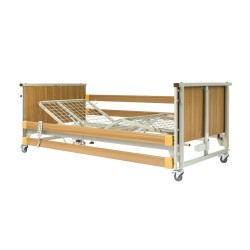
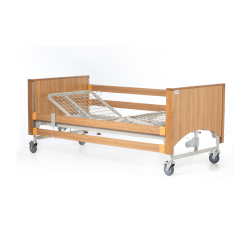
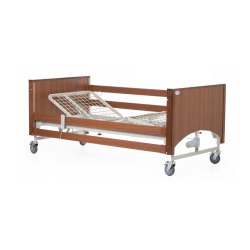
Selecting the Right Standard Profiling Bed for Care Home and Hospital Use
Clinical Summary: Standard profiling beds are the most widely specified adjustable bed format in UK care homes and hospital wards, available in two, three, and four-section configurations to match individual clinical positioning requirements. All models comply with BS EN 60601-2-52 and require documented individual risk assessment and mattress compatibility confirmation before specification.
Standard Profiling Bed Configurations
- Two-Section Profiling Beds: Backrest adjustment only, suited to basic care needs and budget-conscious procurement for lower-dependency residential care environments where fundamental positioning support is the primary requirement.
- Three-Section Profiling Beds: Backrest and knee-break adjustment for general care home and hospital ward use, supporting fundamental clinical positioning requirements. The most widely specified profiling bed configuration in UK residential and nursing care.
- Four-Section Profiling Beds: Independent thigh and knee-break adjustment for precise clinical positioning, post-operative care, and patients with complex lower-limb positioning requirements needing differentiated segment control.
- Height-Adjustable Frames: All standard profiling beds feature electric height adjustment supporting carer manual handling compliance and patient transfer at safe working heights, in line with Manual Handling Operations Regulations 1992.
Clinical Compliance and Procurement Standards
Standard profiling beds supplied by Care Supplies comply with BS EN 60601-2-52, covering entrapment zone dimensions, electrical safety, and mechanical load performance for electrically adjustable medical beds. Specification for CQC-registered premises requires individual risk assessment covering patient weight, mattress compatibility, entrapment zone compliance, and carer manual handling arrangements. All models carry current MHRA registration. Procurement teams should confirm section configuration, maximum weight capacity, and mattress platform dimensions against individual patient care plans before placing orders.
| Configuration | Sections | Key Features | Best Clinical Application |
|---|---|---|---|
| Two-Section | 2 | Backrest adjustment only | Lower-dependency residential, basic positioning needs |
| Three-Section | 3 | Backrest and knee-break | General care home and hospital ward use |
| Four-Section | 4 | Independent thigh and knee-break | Complex positioning, post-operative, clinical ward |
Frequently Asked Questions
Q: What is the difference between two, three, and four-section profiling beds?
A: Two-section beds provide backrest adjustment only. Three-section beds add knee-break adjustment, making them the most common choice for UK care homes. Four-section beds offer independent thigh and knee-break control for the most precise clinical positioning, suited to post-operative care and complex clinical ward settings.
Q: What weight capacity does a standard profiling bed support?
A: Standard profiling beds typically support patient weights of up to 180kg to 200kg depending on the model. For patients exceeding this range, bariatric profiling beds with reinforced frames and higher-capacity motors are required, rated from 300kg and above.