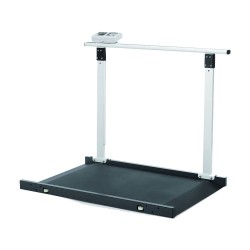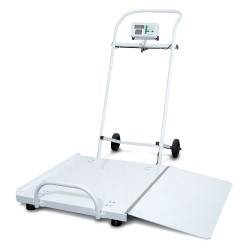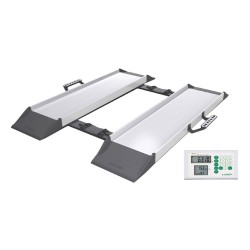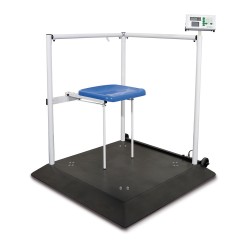
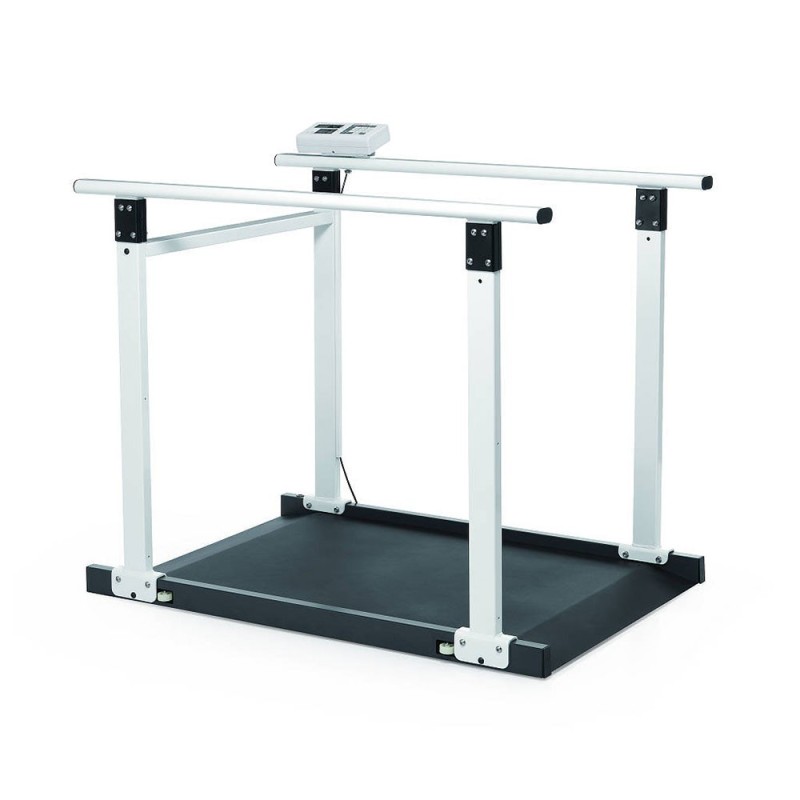

The Marsden M-652 is a Class III and MDD Approved wheelchair scale with integrated dual handrails that extends the clinical application of a single scale to cover both wheelchair-using patients and patients who need hand support to stand safely on a scale. This dual-use capability is a direct NHS procurement efficiency: one M-652 replaces the need for a separate chair scale or bariatric floor scale with handrails alongside a wheelchair scale in mixed-mobility clinical areas, reducing capital cost and floor space requirements without clinical compromise.
The large low-profile platform and ramps on both sides maintain the same roll-on wheelchair access as dedicated wheelchair scales, with the handrails adding supported standing capability for frail or mobility-impaired patients who can briefly bear weight with support.
| Specification | Detail |
|---|---|
| Capacity | 300kg |
| Approval | Class III and MDD Approved (NAWI Directive) |
| Platform | Large, low-profile with bilateral ramps |
| Handrails | Dual integrated handrails for standing patient support |
| Use Modes | Wheelchair patient weighing and supported standing |
| Key Functions | Preset Tare, Hold, BMI calculation |
Class III and MDD approval confirm the M-652 meets NAWI Directive precision standards and EU Medical Device Directive requirements for clinical patient weighing in both use modes. The handrails are structurally isolated from the weighing mechanism, supporting the patient without transferring force to the load cells, maintaining Class III accuracy during standing use regardless of handrail loading, in the same manner as the M-800 bariatric scale's handrail design. CQC Regulation 12 (Safe Care and Treatment) requires clinical environments to have appropriate equipment for all resident or patient categories: the M-652's dual-use design supports this requirement efficiently in mixed-mobility settings.
Do the handrails on the M-652 affect the accuracy of the weight reading during standing use?
No. The M-652's handrails are designed to carry the patient's weight independently of the load cell platform, exactly as on the M-800 bariatric scale. When a standing patient places weight on the handrails, that force is transmitted through the handrail structure to the floor, not to the weighing platform. The scale continues to measure only the weight borne through the patient's feet on the platform, giving an accurate body weight reading regardless of how much support the patient takes on the handrails during the weighing episode.
In which clinical settings is the dual-use M-652 typically specified over separate wheelchair and floor scales?
The M-652 is most commonly specified in NHS outpatient departments, rehabilitation units and care homes where the patient population includes both wheelchair users and patients with partial mobility who can stand briefly with support. In these settings, a single M-652 handles the full mobility spectrum, while a separate wheelchair scale plus a floor scale with handrails would require double the floor space and capital investment. GP practices with limited consultation room space also specify the M-652 where a single piece of equipment must cover all patient mobility types seen in general practice.
Part of our Class III approved Medical Scales and Measuring range. Medical wheelchair scales enable accurate weighing of patients remaining in their wheelchair in care homes and NHS settings.