
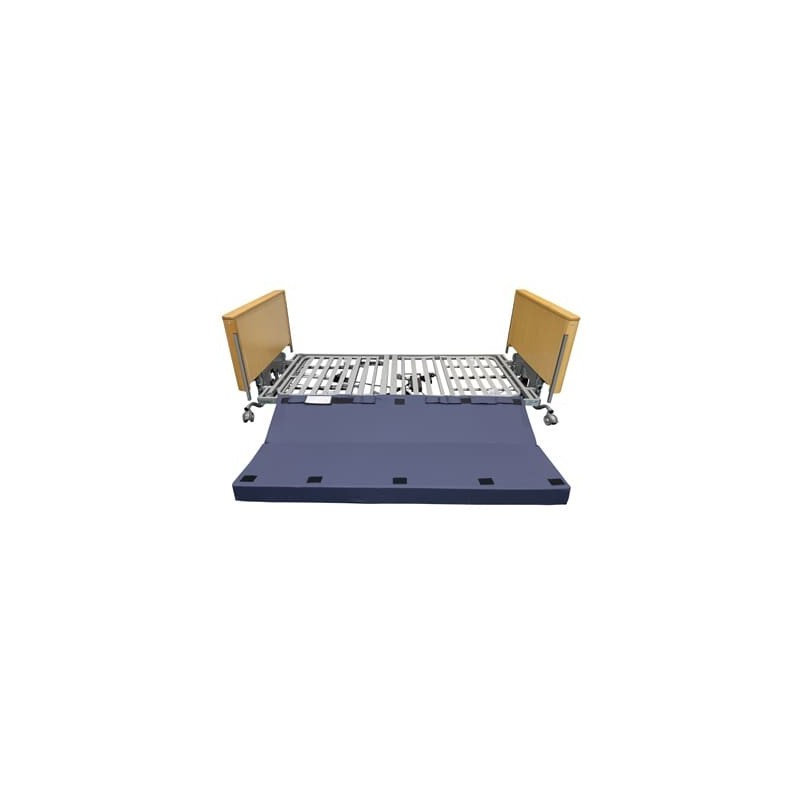


The Universal Safe Roll Bumper attaches to the bed frame via Velcro straps and elevates with the bed, automatically deploying to the floor when the bed is lowered without requiring separate carer action. HD PU foam provides impact absorption during roll-out events. The removable machine-washable cover meets infection control requirements. Deployed open: 1700 x 800 x 200mm; folded: 1700 x 400 x 200mm. Supports bed rail reduction strategies under the Mental Capacity Act 2005 and MHRA guidance. Compatible with nursing homes and domestic environments.
| Specification | Detail |
|---|---|
| Dimensions - Deployed | 1700 x 800 x 200mm |
| Dimensions - Folded | 1700 x 400 x 200mm |
| Foam Type | High-density polyurethane (HD PU) |
| Attachment Method | Velcro straps to bed frame; additional securing flaps |
| Cover | Removable and machine washable |
| Wash Guidance | Pre-wash cold 10 min; main wash 80 degrees 10 min; cold rinse; tumble dry low; no iron |
| Reference | NCL-HFB003 |
| Warranty | Contact supplier |
The Safe Roll Bumper is a clinical safety accessory used within a documented falls management plan under NICE NG45 and NICE CG161. Where it is used as part of a bed rail reduction strategy, the decision must be made through a documented best interest process under the Mental Capacity Act 2005, with the clinical rationale recorded in the resident's care plan and reviewed at regular intervals. The MHRA bed rail safety guidance requires that any change to a resident's bed rail configuration is assessed for entrapment risk; replacing a rail with the Safe Roll Bumper removes the rail entrapment risk at the bumper side but must not create a new entrapment risk at the attachment points or frame edges. Velcro attachment integrity must be confirmed at each deployment. The machine-washable cover must be laundered per the specified washing instructions; deviation from the temperature guidance may compromise cover integrity or infection control performance.
What is the clinical process for substituting a bed rail with a Safe Roll Bumper, and who must approve the change?
Substituting a bed rail with a fall impact management product requires a documented clinical decision-making process under the Mental Capacity Act 2005. The process begins with an individual falls and bed rail risk assessment by the responsible clinician or occupational therapist, which must determine: whether the bed rail was prescribed primarily to prevent roll-out or to assist the resident's own transfers; whether the resident has the capacity to understand and consent to the change; and whether the Safe Roll Bumper provides equivalent or better risk management for the specific fall pattern identified. If the resident has capacity, they must be involved in the decision. If they lack capacity, the best interest decision must be made with the involvement of family, an advocate if appropriate, and documented in the care record. Once the substitution is approved, the removal of the rail and the installation of the Safe Roll Bumper must be documented in the care plan, the equipment register must be updated, and a review date must be set to confirm the intervention continues to meet the resident's needs.
Does the bed-attached design mean the bumper is always deployed, and can it be removed if the resident does not need it during the day?
The bumper's bed-attached design means it moves with the bed but does not mean it must always be fully deployed to the floor. When the bed is raised to the carers' working height during personal care or clinical procedures, the mat folds up against the bed frame and is not deployed on the floor, automatically removing the floor protection during the period when the resident is under direct carer supervision. When the bed is returned to the resident's sleep position, the mat refolds to the floor. This automatic deployment-and-stowage cycle is the primary practical advantage over floor-lying mats, eliminating the task of separately deploying and storing the mat at each carer visit. If the bumper is not clinically indicated during daytime hours, the Velcro attachments can be unfastened and the bumper stored separately; however, this requires a manual care action at each transition and loses the automatic deployment benefit. The care plan should specify whether the bumper is to be deployed automatically with bed height changes or whether manual overnight-only deployment is required for the specific resident.
