
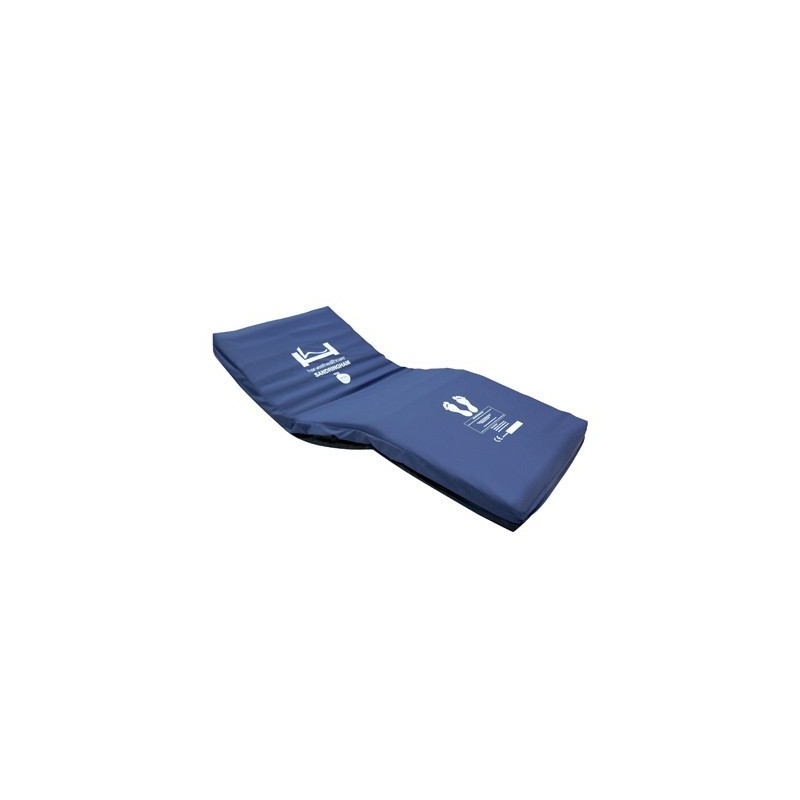


The Sandringham Active Mattress from Harvest Healthcare is an 18-cell alternating pressure replacement mattress system for residents at high risk of pressure ulceration. The integrated 50mm foam base prevents contact with the bed base during cell deflation and provides postural stability at 160mm total system depth. The 10-minute alternating cycle, low-noise TPU cells, and 2-cell static pillow section address both pressure redistribution and sleep comfort requirements. The 4-way stretch welded vapour-permeable PU cover is Crib 5 rated and wipe-clean. Compatible with Harvest Pumps 1 and 250; SWL 184kg with Harvest 250. All cells interchangeable; 3-year warranty.
| Specification | Detail |
|---|---|
| Type | Alternating pressure replacement mattress |
| Air Cells | 18 alternating TPU cells + 2 static pillow cells |
| Foam Base | Integrated 50mm foam layer |
| Alternating Cycle | 10 minutes |
| Dimensions | 2000 x 900 x 160mm |
| Weight | 9kg |
| Cover | 4-way stretch welded PU - VP, water resistant, Crib 5 |
| Pump Compatibility | Harvest Pump 1 (SWL 158kg / 25 stone); Harvest 250 (SWL 184kg / 29 stone) |
| Reference | NCL-HAMSAND001 |
| Warranty | 3 years |
| Clinical Standard | NICE CG179 (high-risk pressure care) |
The Sandringham Active Mattress is a Class IIa active medical device under Medical Devices Regulation 2017/745. Clinical selection requires validated pressure risk assessment per NICE CG179 confirming high-risk status. SWL must be verified against the resident's documented weight before deployment; pump selection determines maximum user weight under MHOR 1992 equipment selection requirements. The Crib 5 welded PU cover meets BS 5852 institutional fire safety standards. Wipe-clean decontamination supports NHS IPC compliance between residents. Equipment register documentation, SWL verification records, and MDR conformity information must be retained for CQC Regulation 12 compliance.
What is the clinical function of the 50mm foam base layer in the Sandringham, and is it clinically superior to a mattress without one?
The integrated 50mm foam base layer in the Sandringham serves two primary clinical functions. First, it provides a firm, stable platform beneath the alternating air cells that prevents the resident from contacting the bed base structure through the air cells during the deflation phase of the alternating cycle; without a foam base, a fully deflated cell would allow the resident's bony prominences to approach or contact the rigid bed base, which would concentrate pressure at exactly those sites the alternating system is intended to protect. Second, the foam layer provides a static pressure redistribution surface beneath the dynamic alternating layer, so that even if the alternating system suffers a pump failure, the resident remains on a pressure-redistributing foam surface rather than a flat rigid base. This fail-safe characteristic is clinically relevant for overnight or unmonitored use periods where pump alarms may not be responded to immediately.
How does the Sandringham compare to the Kensington overlay for a resident at high pressure risk in a care home?
Both the Kensington and Sandringham operate on a 10-minute alternating cycle with TPU cells and are rated for high-risk pressure care per NICE CG179. The key differences are the system configuration and depth: the Kensington is a 110mm overlay placed over the existing mattress, while the Sandringham is a 160mm replacement mattress that includes an integrated foam base. For a care home where the existing mattresses are in good condition and the bed rail configuration is compatible with the additional 110mm height of the overlay, the Kensington provides effective high-risk alternating pressure therapy at a lower system depth and weight. For residents at high risk where a deeper alternating system with an integrated foam base is clinically preferred, or where the existing mattress is due for replacement, the Sandringham is the more appropriate selection. The prescribing clinician should consider the resident's risk score, bed configuration, and care environment when choosing between the two systems.
