
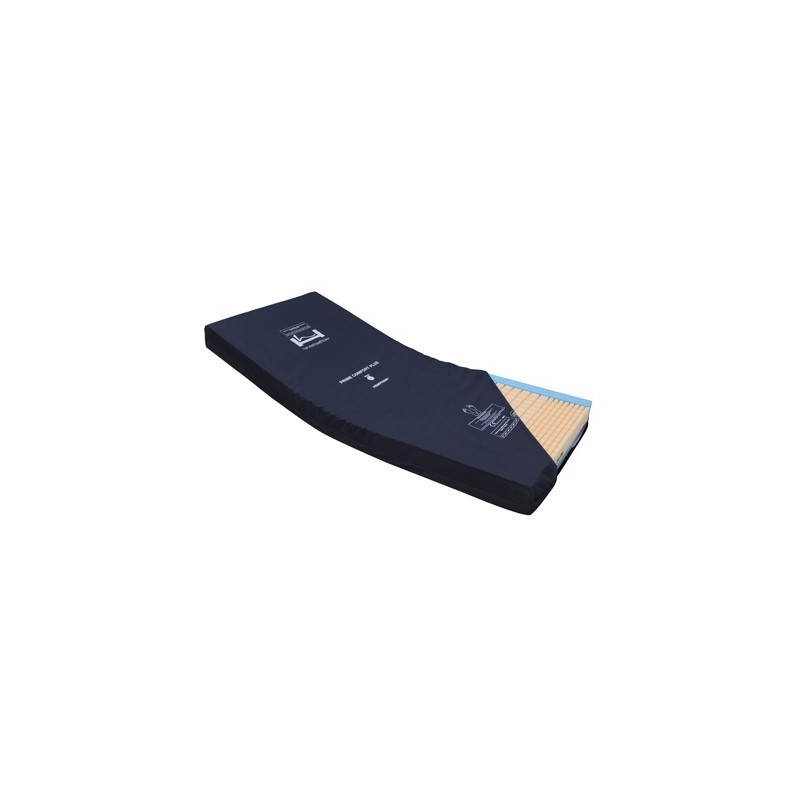


The Prime Comfort Plus Static Mattress builds on the Prime Comfort specification with integral side walls for lateral stability and transfer support, a castellated foam top layer for skin microclimate management, and keyhole profiling slots in the HD base for compatibility with electric profiling beds. The SWL of 247kg (39 stone) extends above the standard Prime Comfort's 177kg ceiling, accommodating heavier residents at high pressure risk. The four-way stretch vapour-permeable welded Crib 5 PU cover provides NHS IPC decontamination and fire safety compliance. 2000 x 900 x 140mm; additional sizes on request; 3-year warranty.
| Specification | Detail |
|---|---|
| Foam Construction | Castellated top layer; side wall construction; HD keyhole-slot base |
| Cover | 4-way stretch VP PU - antibacterial, water resistant, Crib 5, welded seams |
| Dimensions | 2000 x 900 x 140mm (additional sizes on request) |
| Safe Working Load | 247kg (39 stone) |
| Fire Standard | Crib 5 (BS 5852) |
| Reference | NCL-HSMPRIMP |
| Warranty | 3 years |
| Clinical Risk Level | High risk per NICE CG179 |
The Prime Comfort Plus is a Class I passive medical device under Medical Devices Regulation 2017/745. Clinical selection requires validated pressure risk assessment per NICE CG179 confirming high-risk status. SWL must be verified against the resident's documented weight before deployment per MHOR 1992; the 247kg ceiling accommodates heavier residents excluded from the standard Prime Comfort. The Crib 5 welded VP cover meets BS 5852 fire safety requirements under the Regulatory Reform (Fire Safety) Order 2005. Keyhole profiling slot compatibility must be confirmed with the specific electric profiling bed in use before deployment. Equipment register records and MDR conformity documentation must be maintained for CQC Regulation 12 compliance.
What is the clinical benefit of side wall construction, and how does it differ from a standard edge on a static mattress?
A standard static mattress has a foam profile that tapers or compresses at the edges without structural reinforcement, which means the mattress edge area provides less support than the central zone and is less suitable for transfer manoeuvres that require the resident to sit at the mattress edge. The side wall construction of the Prime Comfort Plus places a firmer foam surround along the long edges of the mattress, maintaining the edge profile under the seated load of a resident during transfer and preventing the edge from collapsing. This provides two clinical benefits: it reduces lateral drift for residents with limited trunk control who may shift toward the mattress edge during sleep, and it provides a stable sitting edge for transfer sequences where the resident needs to sit upright on the mattress before pivoting or standing. The MHOR 1992 safe transfer assessment for each resident should note whether edge stability is a handling consideration, and if so, a mattress with side wall construction is the appropriate selection.
What are keyhole profiling slots and why are they necessary on a mattress used with an electric profiling bed?
Keyhole profiling slots are a series of cuts or recesses made in the foam base of the mattress, typically positioned at the articulation points of a profiling bed frame - the head section hinge and the knee break. When an electric profiling bed elevates the head section or raises the knee section, it bends at those hinge points, and the mattress must flex with the bed to maintain contact with the surface at all angles. A solid, uninterrupted foam base resists this bending and either pulls away from the bed surface at the hinge points - creating a gap where the resident's spine is unsupported - or prevents the bed from reaching its full profiling angle. The keyhole slots allow the foam base to open at the hinge point during profiling, accommodating the bed angle while maintaining foam support across the rest of the mattress. For residents requiring elevated head positions for respiratory management, dysphagia, or enteral feeding, correct mattress profiling is a clinical requirement rather than a comfort preference, and a mattress without profiling slot compatibility may prevent the bed from achieving the prescribed position.
