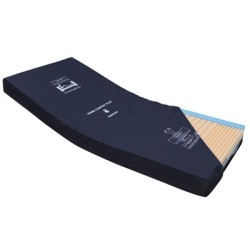
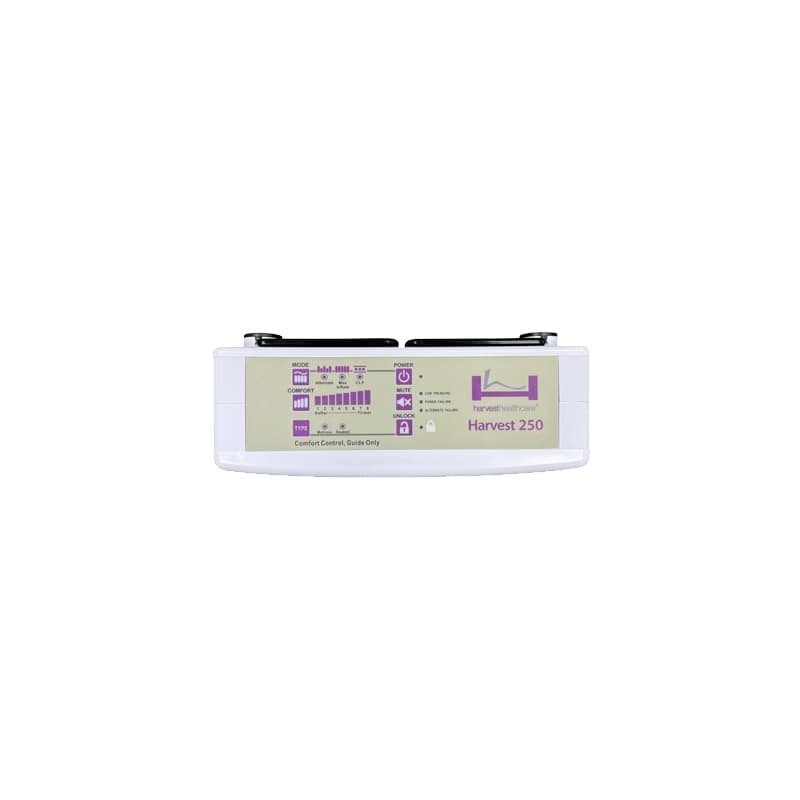


The Harvest 250 is a digital mid-range pressure pump providing four selectable therapy modes - alternating, CLP, max inflate, and seated - for active mattress systems in community, residential, and nursing home settings. Eight comfort settings cover residents from under 30kg to 200kg. The LED display and lockout function support safe, consistent operation; audible and visual alarms cover low pressure, cycle fault, and power failure. Compatible with all Harvest active overlays and standard replacement mattresses. EN60601-1 and EN60601-1-2 certified. SWL up to 200kg on compatible mattresses.
| Specification | Detail |
|---|---|
| Control Type | Digital with LED display |
| Therapy Modes | Alternating; CLP; Max Inflate; Seated Mode |
| Comfort Settings | 1-8 (under 30kg to 200kg) |
| Mattress Pressure Range | 18-55 mmHg |
| Seated Pressure Range | 40-75 mmHg |
| Cycle Time | 10 minutes |
| Safety Features | Lockout; audible and visual alarms (low pressure, cycle fault, power failure) |
| Weight | 1.7kg |
| Dimensions | 275 x 175 x 116.5mm |
| Voltage | 230v / 50Hz; Fuse T 1AL 250V |
| Safety Standards | EN 60601-1; EN 60601-1-2 |
| Compatible Mattresses | All Harvest active overlays and standard replacement mattresses |
| Reference | NCL-HPU250 |
The Harvest 250 meets EN 60601-1 and EN 60601-1-2 medical electrical equipment safety and electromagnetic compatibility standards. As the powered component of a Class IIa active medical device system under MDR 2017/745, the pump and connected mattress must be documented together in the equipment register with SWL verified against the resident's weight before deployment per MHOR 1992. Comfort setting must be documented at calibration alongside the resident's weight at the time. The lockout function must be engaged after calibration to protect the therapy setting. Power failure and low-pressure alarm functionality must be tested at deployment and the test result recorded for CQC Regulation 12 readiness.
What is constant low-pressure mode and when is it clinically selected over alternating therapy?
Constant low-pressure mode maintains all air cells in the mattress at a consistent, simultaneously inflated low pressure rather than alternating between inflated and deflated states. The clinical effect is a uniformly soft, conforming surface that reduces interface pressure across the whole body contact area to the lowest level that maintains the resident above the mattress base. CLP is selected when the resident cannot tolerate the movement associated with the alternating cycle, which may be caused by severe pain from complex wounds, fractures, post-surgical conditions, or spinal instability where cell movement during the cycle causes distress or is clinically contraindicated. It may also be selected for short periods during medical procedures or examinations that require the resident to remain still. Alternating therapy remains the primary mode for pressure injury prevention and treatment per NICE CG179 because the dynamic offloading of each body zone in sequence provides greater tissue reperfusion than a static low-pressure surface; CLP is a supplementary mode for specific clinical indications rather than a routine alternative to alternating therapy.
How is the comfort setting calibrated for a specific resident, and can it be changed once set?
The comfort setting is selected by the prescribing clinician or therapist based on the resident's weight, with setting 1 appropriate for residents under 30kg and setting 8 for residents up to 200kg. The relationship between comfort setting and cell inflation pressure is designed so that the cells fully inflate under the resident's weight at the correct therapeutic pressure without bottoming out or over-inflating. After initial calibration, the carer should observe the mattress during use: cells that are visually flat under the resident after the inflation phase indicate under-inflation (setting too low); a surface that feels very firm with minimal conformation indicates over-inflation (setting too high). The lockout function should be engaged after calibration to protect the setting from inadvertent change. If the resident's weight changes significantly - weight loss exceeding 5kg or weight gain - the setting should be recalibrated and the updated setting and weight documented in the equipment register. The lockout must be disengaged by the authorised carer for recalibration and re-engaged immediately after.