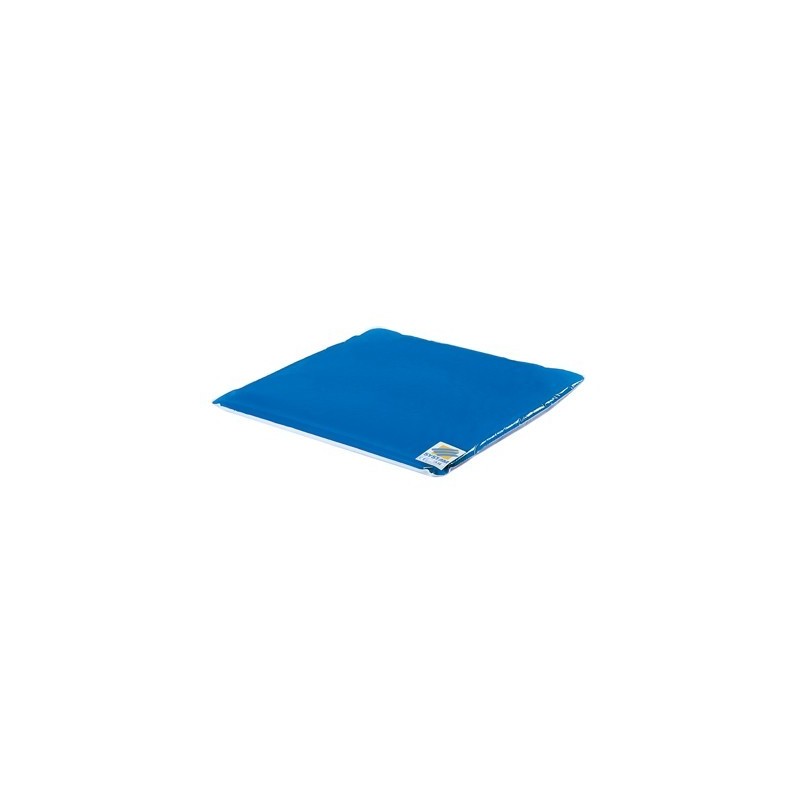


The Gel Cushion is constructed from pure high-resilience impermeable viscoelastic polyurethane gel at 25mm depth, providing a second-skin conforming effect that moulds to the sacral and posterior thigh contours for pressure redistribution. The gel provides a mild cooling effect and maintains posture without compression set. Note: not recommended for hard surfaces - requires a compliant base beneath. Two sizes: NCL-P311C40401HF (400x400x25mm, 120kg SWL) and NCL-P311C45431HF (430x450x25mm, 140kg SWL). Low-medium risk per NICE CG179. MDR 2017/745 Class I.
| Specification | Detail |
|---|---|
| NCL-P311C40401HF | 400 x 400 x 25mm - SWL 120kg (18 stone) |
| NCL-P311C45431HF | 430 x 450 x 25mm - SWL 140kg (22 stone) |
| Material | High-resilience impermeable viscoelastic polyurethane gel (no foam) |
| Cover | 4-way stretch welded water-resistant |
| Base Surface Requirement | Compliant or upholstered - not for hard surfaces |
| Paired Mattress | Community (NCL-HSMCOM) |
| Clinical Risk Level | Low-medium risk per NICE CG179 |
| Regulatory Status | MDR 2017/745 Class I medical device |
The Gel Cushion is a Class I medical device under MDR 2017/745. Clinical selection requires assessment per NICE CG179 confirming low-to-medium risk. The base surface requirement must be assessed and documented before deployment; use on hard surfaces is not appropriate and compromises the clinical function of the product. SWL must be verified per MHOR 1992. Equipment register records and MDR conformity documentation must be maintained for CQC Regulation 12 compliance.
How does a pure gel cushion provide pressure redistribution differently from a foam or gel-foam cushion?
Pure gel pressure redistribution relies on the fluid-like flow properties of viscoelastic gel under load, rather than on foam compression and spring-back. When the resident sits on the gel cushion, the gel beneath the bony prominences - primarily the ischial tuberosities - is compressed and displaced laterally, flowing outward to the less-loaded zones of the gel beneath the surrounding soft tissue. This lateral flow increases the gel depth beneath the surrounding area, raising it into contact with the soft tissue alongside the bony prominences, and reducing the gel depth under the bony prominence itself; the net effect is a redistribution of the seated load from the high-pressure bony zones toward the lower-pressure surrounding zones. This mechanism is similar to how a static gel pad functions in a clinical wound dressing or a gel heel protector, and it operates independently of any foam compressive spring-back. Foam cushions, by contrast, redistribute pressure through compression and spring-back of the foam structure, which is a different mechanical mechanism. Gel-foam hybrid cushions combine both mechanisms by using the gel's fluid redistribution at the top contact surface and the foam's structural support at the base.
What surface does the gel cushion require beneath it, and does it need to be fixed to the chair?
The gel cushion requires a compliant, yielding surface beneath it - specifically an upholstered seat, a foam seat pad, or another cushioned surface - because the gel redistributes pressure by flowing laterally; on a hard flat surface, the gel has no compliant material beneath it to allow the lateral flow mechanism to operate, and the gel simply acts as a thin layer between the resident and the hard surface without meaningful pressure redistribution. The welded cover provides the outer containment for the gel; no specific fixings are needed to secure the cushion to the chair, but the position of the cushion on the chair seat must be confirmed before the resident sits down, as a gel cushion without a non-slip base (some variants) may shift more easily than a foam cushion. The prescribing occupational therapist should confirm the intended chair has an appropriate compliant seat surface and advise care staff on how to position and check the cushion correctly before each use.