
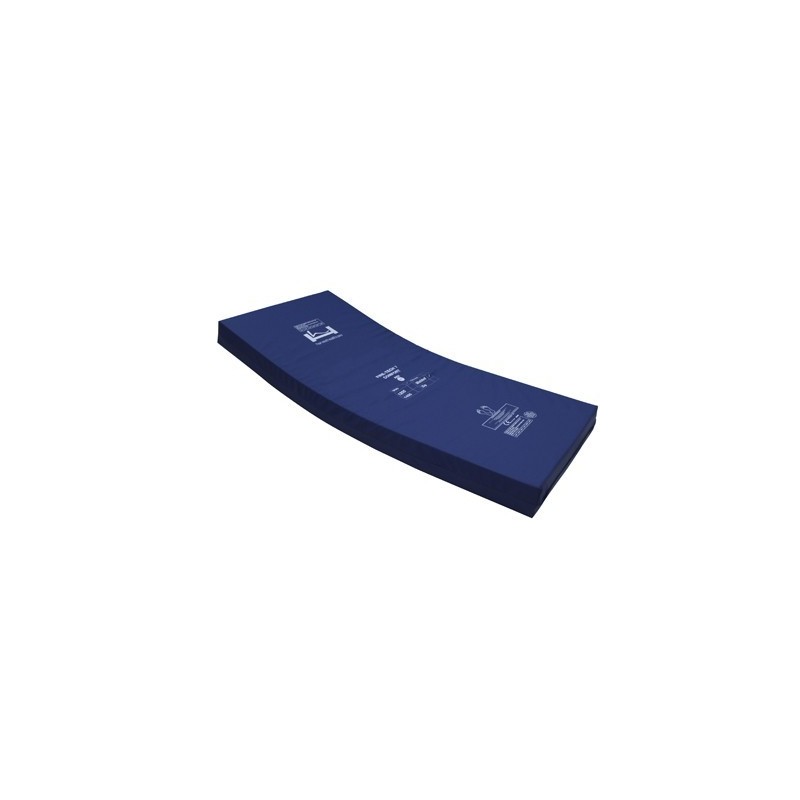

The Fire-Tech 7 Comfort Static Mattress provides high-risk pressure care in secure, psychiatric, and high-fire-risk environments with a Crib 7 fire rating and a zipped four-way stretch PU-coated cover. The zipped cover allows easier removal for deep cleaning or replacement compared to the fully welded cover of the standard Fire-Tech 7; a welded seam option is available on request for settings requiring the anti-ligature specification. Antibacterial, water resistant, and fully washable. HR foam core. SWL 190kg. 2000 x 900 x 150mm; 8.5kg.
| Specification | Detail |
|---|---|
| Fire Standard | Crib 7 (highest UK fire resistance certification) |
| Cover Type | Zipped 4-way stretch VP PU - antibacterial, water resistant, fully washable |
| Welded Seam Option | Available on request (anti-ligature specification) |
| Foam Core | High-resilience foam |
| Dimensions | 2000 x 900 x 150mm |
| Safe Working Load | 190kg (30 stone) |
| Mattress Weight | 8.5kg |
| Indicated Settings | Secure units, psychiatric inpatient, high-dependency environments |
| Clinical Risk Level | High risk per NICE CG179 |
The Fire-Tech 7 Comfort is a Class I passive medical device under Medical Devices Regulation 2017/745. The Crib 7 fire certification meets the fire safety requirement for secure and psychiatric settings under the Regulatory Reform (Fire Safety) Order 2005. Whether the zipped cover or the welded seam option is appropriate must be determined by the setting's ligature risk assessment; the local clinical and estates lead must confirm that a zip fastening is acceptable under their ligature risk framework before the standard zipped cover is deployed. SWL must be verified per MHOR 1992. Equipment register records, fire safety compliance documentation, and MDR conformity records must be maintained for CQC Regulation 12 compliance.
When should the Fire-Tech 7 Comfort with zipped cover be selected over the standard Fire-Tech 7 with welded anti-ligature cover?
The choice between the zipped Comfort and the welded standard Fire-Tech 7 is driven by the specific ligature risk assessment for the individual resident and the care environment rather than by clinical pressure care criteria, which are equivalent between the two versions. The welded anti-ligature cover of the standard Fire-Tech 7 is required when the resident's individual ligature risk assessment and the environmental safety protocol for the unit mandate the elimination of all accessible fastening points, which includes zip pull tabs. The zipped Comfort cover is appropriate when the ligature risk assessment for the resident or the unit does not require zero zip access, or where the operational benefit of zip-accessible cover removal for deep cleaning or replacement is a priority. The welded seam option available on the Comfort provides a middle path for settings that require anti-ligature specification but need the cover to be replaceable rather than permanently bonded. The decision must be documented in the resident's risk assessment and the setting's environmental safety policy.
Can the Fire-Tech 7 Comfort be used in a general care home that does not have a Crib 7 requirement?
Yes, a Crib 7 mattress can be deployed in any setting regardless of whether Crib 7 is mandated by that setting's fire safety specification. Crib 7 exceeds the Crib 5 standard required for general care homes, so using a Crib 7 mattress in a Crib 5 environment provides fire safety performance above the minimum requirement. The clinical pressure care performance and infection control properties are equivalent to other high-risk static mattresses in the range. The practical consideration is cost: Crib 7 construction uses more fire-resistant materials and processes than Crib 5, making it more expensive; for general care home use where only Crib 5 is required, the Prime Comfort or Community Plus static mattresses provide equivalent pressure care at lower procurement cost. The Fire-Tech 7 Comfort is most appropriately prescribed when the care setting's fire safety specification explicitly requires Crib 7 or where the individual risk assessment identifies a specific elevated fire risk requiring the higher standard.
